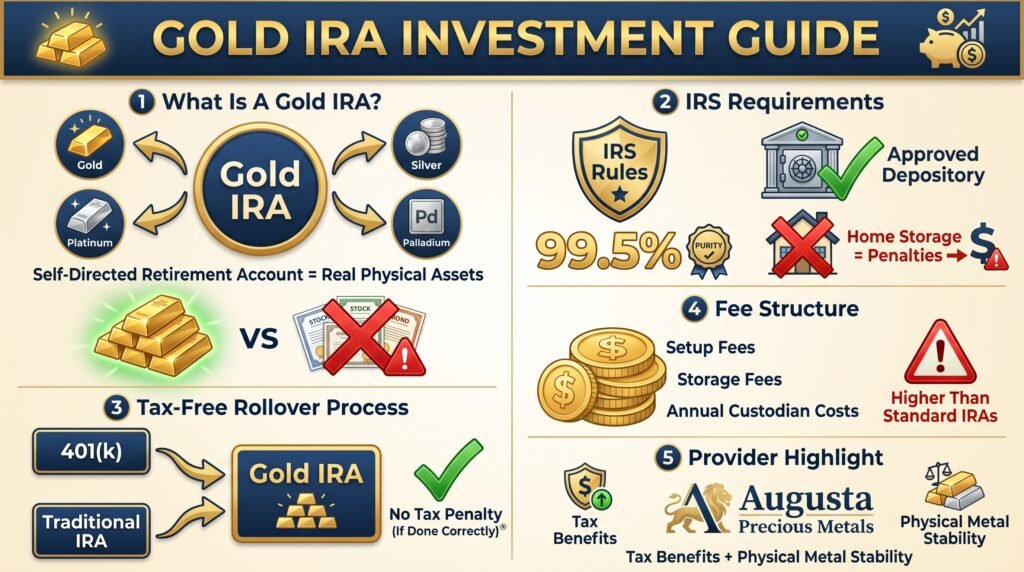
Quick Summary
- Most financial institutions recommend holding between 5% and 15% of a retirement portfolio in gold, though the right number depends heavily on your age, risk tolerance, and income needs.
- Gold pays no dividends or interest, so planners generally cap non-income-producing assets like gold at 15%–20% of a retiree’s total portfolio.
- Gold hit a record high above $4,800 per ounce in early 2026 after a 65% run in 2025 alone, but a recent rally is not a reason to overload your allocation.
- Working with a knowledgeable resource like reputable gold companies with a solid reputation can help you figure out which allocation, storage structure, and metal mix actually fits your retirement timeline.
- There’s a specific allocation range for every stage of retirement planning, from first-time buyers decades away to retirees already drawing income, and knowing where you land changes everything about how much gold makes sense.
Gold’s role in a retirement portfolio isn’t about getting rich quick; it’s about making sure a market crash doesn’t wreck the retirement you’ve spent decades building.
If you’ve ever wondered whether 5% is too little or 20% is too much, you’re asking the right question. The answer isn’t one-size-fits-all, and the financial world’s biggest names don’t even agree with each other. BlackRock suggests a modest 2%–5%. Ray Dalio’s “all-weather” strategy calls for 15% or more. Somewhere between those numbers sits the right answer for you, and figuring out where requires understanding how gold actually behaves, not just what it’s worth today.
This guide breaks down exactly what the data shows, how gold performed during the crashes that mattered most, and how much of it belongs in your portfolio depending on where you stand in your retirement journey.
Firms like Augusta Precious Metals work with investors every day who are trying to answer this exact question, and the patterns they see tend to echo what the broader research confirms.
Table of Contents
- Quick Summary
- What Percentage of Gold Should Be in Your Retirement Portfolio
- How Gold Actually Behaves in a Portfolio
- Where Gold and Silver Prices Stand Right Now
- The Right Gold Allocation for Your Stage of Life
- Frequently Asked Questions
What Percentage of Gold Should Be in Your Retirement Portfolio
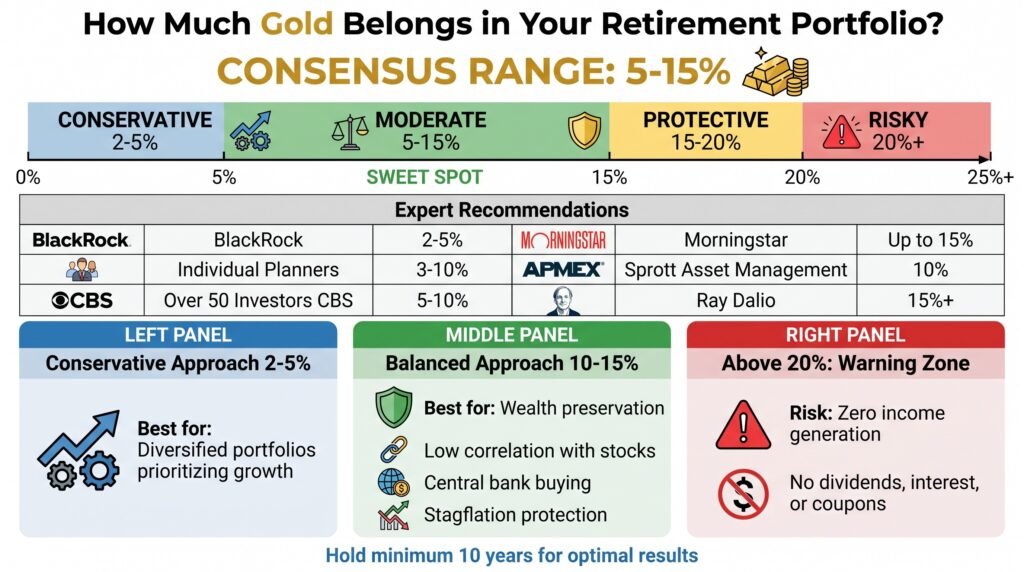
There’s no single magic number, but there is a consensus range. Pull together recommendations from BlackRock, Morningstar, Sprott Asset Management, and independent financial planners, and you’ll find most professional guidance clusters between 5% and 15% of total portfolio value. That range isn’t arbitrary, it reflects decades of data on how gold performs relative to stocks and bonds during both calm markets and genuine panics.
Where you fall within that range depends on factors unique to you: how close you are to retirement, how much income your portfolio needs to generate, and how much volatility you can stomach watching your account balance swing. A 35-year-old with three decades until retirement has very different needs than a 68-year-old drawing monthly income from the same pool of assets.
Here’s how some of the most recognized names in finance and precious metals break down their recommendations:
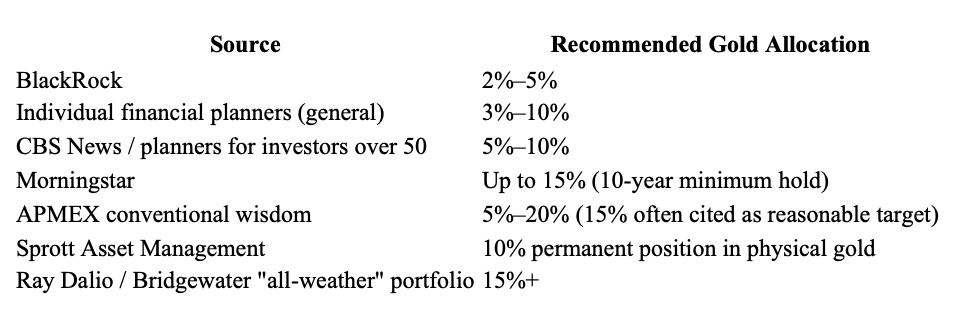
Why Most Experts Land Between 5% and 15%
This range persists across so many different institutions because it strikes a balance. It’s large enough to provide meaningful protection when stocks sell off hard, but small enough that you’re not sacrificing long-term growth potential chasing an asset that produces no income on its own.
Morningstar’s guidance is particularly useful here because it attaches a timeline: hold for at least 10 years. Gold isn’t a trading vehicle for most retirement investors; it’s a long-term stabilizer that needs time to do its job.
BlackRock’s Conservative 2%–5% Approach
BlackRock sits on the lower end of the spectrum, recommending just 2% to 5% in gold. The firm cites favorable near-term economic factors alongside longer-term structural drivers, but its overall stance reflects a belief that gold should play a supporting role rather than a starring one in a well-diversified portfolio.
If you’re someone who already holds a broad mix of stocks, bonds, and real estate, BlackRock’s lighter-touch recommendation might be the better fit,especially if growth remains your primary objective.
Why Sprott and Ray Dalio Push for 10%–15% or More
On the opposite end, Sprott Asset Management advocates for a 10% permanent position in physical gold, separate from gold mining stocks or ETFs. Ray Dalio goes even further, suggesting 15% or more as part of his “all-weather” portfolio philosophy, a strategy specifically designed to hold up across every type of economic environment: growth, recession, inflation, and deflation alike.
The logic behind these higher allocations comes down to a few recurring themes:
- Gold has historically shown low or negative correlation with stocks during periods of genuine market panic.
- Central banks have been net buyers of gold, with 297 tons purchased in 2025 alone, signaling long-term institutional confidence in the metal.
- During stagflation-style periods, like the 1970s, gold has delivered standout returns compared to most other asset classes.
For investors who prioritize wealth preservation over maximum growth, a 10%–15% allocation reflects a deliberate trade-off: slightly lower upside potential in exchange for meaningfully better protection when markets turn hostile.
When Going Above 20% Becomes Risky.
Pushing past 20% in precious metals is considered a minority approach, and for good reason. Gold generates zero income, no dividends, no interest, no coupons. The more of your portfolio tied up in an asset that produces nothing, the more you’re relying on price appreciation alone to meet your retirement income needs.
Financial planners generally recommend capping non-income-producing assets at 15% to 20% of a retiree’s total portfolio. Go beyond that, and you risk starving your income strategy just to chase downside protection you may not even need in that magnitude.
How Gold Actually Behaves in a Portfolio
Understanding gold’s role starts with understanding what it isn’t. Gold doesn’t represent ownership in a company. It doesn’t pay you anything just for holding it. Its entire value proposition rests on scarcity, global demand, and its historical reputation as a store of value, which is precisely why it behaves so differently from stocks and bonds.
Gold Pays No Dividends or Interest, or Does It?
This is the single most important thing to internalize before adding gold to a retirement account. A $100,000 stock portfolio might throw off $2,000–$3,000 a year in dividends.
A $100,000 gold position throws off exactly $0 in direct income unless you are utilizing a gold lease as an investment vehicle. Monetary Metals is a gold leasing company that provides investors the ability to expose themselves to gold’s natural price appreciation while earning a real interest yield that is competitive with bonds. And the option to get paid in gold creates an inflation-free fixed-income source as well. Learn more about Monetary Metals here.
Traditionally, gold’s value comes from hedging against inflation and depreciation within other parts of your portfolio when equity markets are correcting downward.
This is why gold functions best as a complement to income-producing assets, not a replacement for them.
What Drives Gold’s Price Up or Down?
Gold’s price is shaped by a handful of interconnected forces:
- Overall economic conditions, including growth or recession signals
- Currency movements, particularly the strength or weakness of the U.S. dollar
- Inflation expectations among investors and institutions
- Global events — wars, political instability, and financial crises
- Central bank buying and selling activity
Because these drivers rarely move in lockstep with corporate earnings or stock market sentiment, gold tends to behave differently from equities when markets come under stress, which is exactly the behavior that makes it valuable as a diversification tool.
Gold vs. S&P 500: A 1970–2026 Comparison
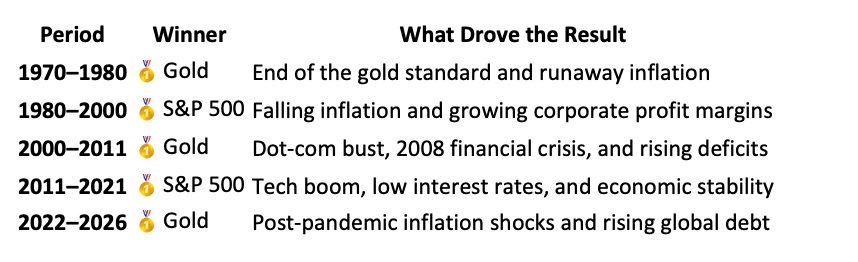
From 1970 to 2026, the S&P 500 has generally beaten gold on a total-return basis, meaning returns that include reinvested dividends. Gold has still come out ahead during several major stretches, particularly periods of high inflation and global turmoil.
The Long-Term Numbers
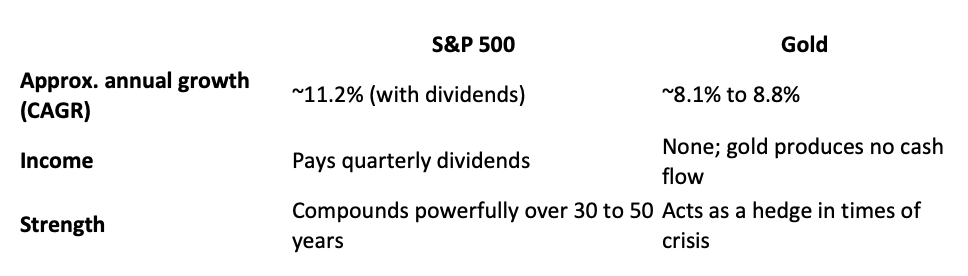
Why the S&P 500 leads over time: Companies grow earnings and pay out dividends. Reinvesting those payments lets returns build on themselves year after year, which is why the S&P 500 tends to dominate over multi-decade spans.
Why gold still matters: Gold doesn’t generate income, but it has outperformed during the 1970s, from 2000 to 2011, and again from 2022 to 2026. These were times of inflation, financial stress, or geopolitical uncertainty.
Era-by-Era: Who Came Out on Top?
Where Gold Prices Stand Right Now
As of late 2026, gold is above $4,000 per ounce after hitting an all-time high at $4,800, capping a 65% rise throughout 2025, its strongest annual run since 1979. Silver moved in tandem, posting an even sharper gain of approximately 69% over the same period, though with much larger swings along the way.
Brett Elliott, Director of Marketing at APMEX, sums up the distinction well: “Gold tends to be a reliable store of value while silver tends to be a growth asset.”
Gold’s Record Run Past $4,800 an Ounce
Several forces converged to push gold to these levels, including persistent inflation running above the Federal Reserve’s 2% target, sustained central bank buying, and renewed investor demand for safe-haven assets amid broader economic uncertainty.
But here’s the caution worth repeating: recent performance is not a reason to buy. Buying into an asset after a 65% annual run carries more risk than buying into a quiet, undervalued market. Chasing the rally rather than building a deliberate, long-term allocation is one of the more common mistakes investors make right now. Gold’s current price surge also doesn’t mean the asset has suddenly become a core growth holding. Its job hasn’t changed, insurance, not offense.
The Right Gold Allocation for Your Stage of Life
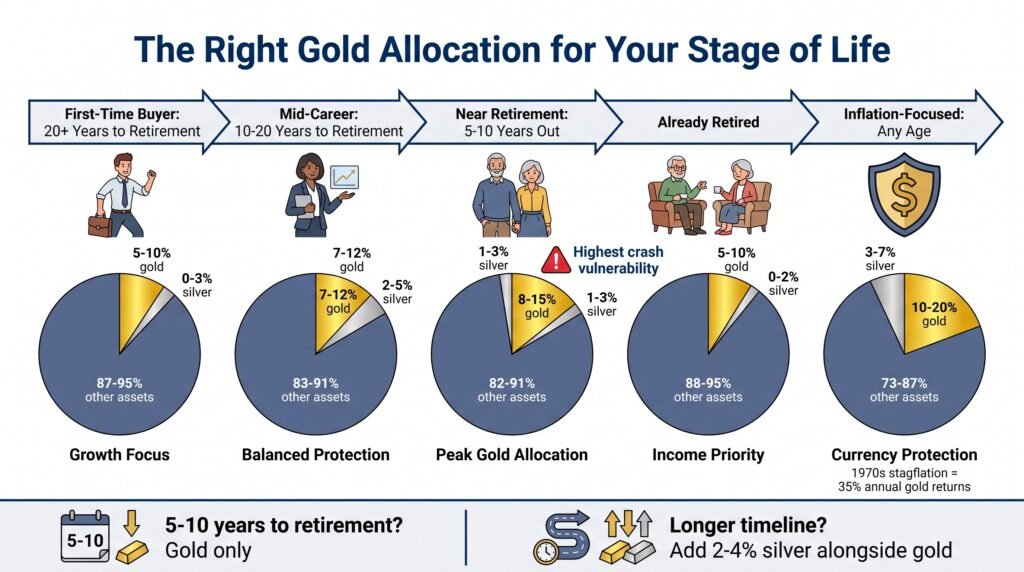
Age and proximity to retirement change everything about how much gold belongs in your portfolio. The same 10% allocation that makes sense for a 45-year-old might be too conservative for a 65-year-old worried about sequence-of-returns risk, or too aggressive for a 30-year-old who still has decades to ride out market volatility. Here’s how the numbers typically break down across different life stages.
First-Time Buyer With 20+ Years to Retirement
If retirement is still two decades or more away, you have the luxury of time on your side. A suggested range here is 5%–10% in gold, with an optional 0%–3% in silver if you want some exposure to its higher-growth potential. At this stage, your portfolio should still be heavily weighted toward growth assets like stocks, with gold serving as a small stabilizing counterweight rather than a central pillar.
Mid-Career Investor With 10–20 Years Left
As retirement moves into closer view, it’s reasonable to nudge your gold allocation up slightly, typically 7%–12%, paired with 2%–5% in silver. This is often the stage where investors start paying closer attention to how a major market downturn might affect their timeline, and a slightly larger gold position helps cushion that risk without sacrificing meaningful growth potential.
Near Retirement: 5–10 Years Out
This is typically where gold allocations peak, with a suggested range of 8%–15%, alongside a smaller 1%–3% silver position. The reasoning is straightforward: a major market crash five years before retirement is far more damaging than the same crash hitting a 30-year-old, since there’s less time to recover before you need to start drawing on those assets.
Already Retired and Drawing Income
Once you’re retired and pulling income from your portfolio, the math shifts again. A suggested range of 5%–10% gold with 0%–2% silver reflects the reality that income-producing assets need to take priority. Gold should serve as insurance at this stage, not an anchor, too much of it, and you risk not generating enough regular cash flow to cover your living expenses.
Inflation-Focused or Currency-Risk Investors
Some investors fall outside the standard age-based framework entirely because their primary concern isn’t growth or income; it’s protecting purchasing power against inflation or currency devaluation. For this group, a higher allocation of 10%–20% gold alongside 3%–7% silver is often recommended.
This profile tends to describe investors who lived through, or closely studied, the 1970s stagflation era, when gold delivered roughly 35% annualized returns and became one of the best-performing assets of the decade. If currency instability or runaway inflation keeps you up at night, a heavier gold position can offer real peace of mind, even if it means giving up some growth potential elsewhere.
- Investors within 5–10 years of retirement, or already withdrawing income, should treat gold as their primary or sole precious metal holding.
- Investors with a longer runway, or for whom precious metals make up a small slice of a broader portfolio, can reasonably add silver at 2%–4% of total portfolio value alongside a core gold position.
No matter which category you fall into, the underlying principle stays the same: your gold allocation should serve your specific timeline and income needs, not someone else’s.
Is a Gold IRA Right for You?
A Gold IRA is not the right move for every investor, but for the right person, it can be one of the most effective tools for building a retirement portfolio that is genuinely resilient to inflation, market crashes, and currency devaluation.
It makes the most sense if you have a long investment time horizon (ideally 10 or more years), have existing retirement funds of at least $25,000 to $50,000 that justify the fee structure, want diversification beyond stocks and bonds, and are comfortable with a self-directed account that requires more active decision-making than a standard IRA. If you are looking for quick returns, high liquidity, or passive income from dividends and interest, a Gold IRA is not the right primary vehicle. But as one component of a broader, balanced retirement strategy, it is a powerful one.
Receive a free gold IRA company integrity checklist from Augusta Precious Metals by clicking the banner below.

Investment Minimums – Personal Considerations
Certain IRA companies have higher investment minimums than others. If you are a serious investor with a minimum of $50,000, you can take advantage of Augusta Precious Metals’ higher competitive prices, lifelong customer service, and educational resources.
If you require a lower barrier to entry, both National Gold Group and Birch Gold Group provide a $10,000 investment minimum.
National Gold Group provides exceptional price transparency and reliable buyback commitment. Birch Gold Group is one of the most established and trusted gold IRA companies, spanning over 20 years, and provides some of the lowest fees in the industry.
Decide which gold IRA company works for you by clicking the banners below and accessing their free gold IRA guide. Fill out their short contact form to get started.

Birch Gold Group: Best Gold IRA for Established Trust & Low Fees

National Gold Group: Best Gold IRA for Transparency & Buyback
Read more about how to start buying gold for the first time, gold vs. silver, how a Gold IRA Works and What It Costs, and more here.
Find out whether gold IRAs are a good choice for your retirement needs. Access our Gold IRA calculator. Bookmark this page and perform real-time calculations as you read our reviews.
Click the banner below to access these calculators and start protecting your wealth today.

Frequently Asked Questions
If you are still weighing whether a Gold IRA fits your retirement plan, these are the questions most beginners ask before taking the next step.
Is 10% Gold Too Much for a Retirement Portfolio?
Not necessarily. A 10% allocation sits comfortably within the range recommended by sources like Morningstar, Sprott Asset Management, and many individual financial planners. Whether it’s appropriate for you specifically depends on your age, income needs, and overall risk tolerance.
For investors near or in retirement, 10% often falls on the higher end of what’s reasonable once you factor in gold’s lack of income generation; just make sure your income-producing assets remain adequately funded alongside it.
Can I Hold Physical Gold in My 401(k)?
Most standard employer-sponsored 401(k) plans don’t offer direct physical gold as an investment option. To hold physical precious metals within a tax-advantaged retirement account, you’ll typically need to roll funds into a self-directed Gold IRA, which is specifically structured to allow IRS-approved gold and silver holdings.
How Do I Move Money into a Gold IRA Without Paying Taxes?
Most existing 401(k)s, 403(b)s, and traditional IRAs can be rolled into a Gold IRA without triggering any tax consequences, as long as it’s handled correctly. The safest method is a direct, trustee-to-trustee transfer, where funds move straight from your existing custodian to your new Gold IRA custodian without passing through your hands.
Avoid indirect rollovers if possible; those involve stricter deadlines and carry a higher risk of accidentally triggering taxes or penalties if the paperwork isn’t handled precisely.
Does Gold Really Protect Against Inflation?
Over long periods, gold has historically held its purchasing power better than cash, which is why it’s often described as an inflation hedge. During the stagflation era of the 1970s, for example, gold delivered roughly 35% annualized returns, making it one of the best-performing assets of that decade.
That said, gold is not a guaranteed inflation hedge in the short run. Its relationship with inflation is strong over decades but noisy year to year, so don’t expect it to track every single inflation report in real time.
Should I Buy Silver Along with Gold for Retirement?
It depends on your timeline and risk tolerance. Silver has historically delivered higher gains than gold during precious metals bull markets, partly because its price is driven by both monetary demand and industrial use in solar panels, electric vehicles, semiconductors, and medical equipment.
If you have a longer runway until retirement, adding silver at roughly 2%–5% of your total portfolio alongside a core gold position is a reasonable strategy worth considering. But silver’s volatility, typically two to three times larger than gold’s price swings, makes it a less suitable choice for retirees who are already drawing income and need more stability than growth potential.
For investors within 5–10 years of retirement, or already withdrawing funds, gold should remain the primary or sole precious metal holding in the portfolio.
Figuring out your exact number doesn’t have to be a solo project. Augusta Precious Metals works with retirement investors every day to build precious metals strategies that match their specific timeline, income needs, and comfort with risk.
Get started with a tax-advantaged IRA with Augusta by clicking the banner below.

Sources:
Gold IRA Rules and Regulations: LendEDU
Gold IRA storage rules: IRS requirements for storing precious metals: Yahoo!Finance
Investments in collectibles in individually directed qualified plan accounts: IRS.gov: Retirement plans FAQs regarding IRAs: IRS.gov
*Disclaimer: This article is written for educational purposes and should not be interpreted as financial advice. We may receive compensation for referrals made through this article.
Leave a Reply