Quick Summary
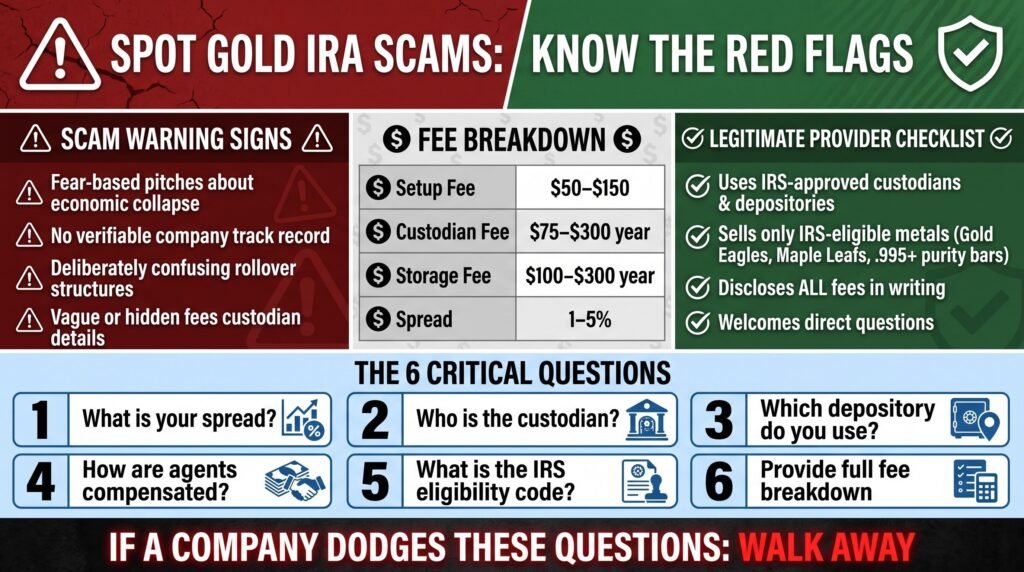
Gold IRA scams follow a predictable playbook: fear-based pitches about economic collapse, companies with no verifiable track record, deliberately confusing rollover structures, and vague or hidden fees/custodian details.
Legitimate providers use IRS-approved custodians and depositories, only sell IRS-eligible metals (e.g., Gold Eagles, Maple Leafs, .995+ bars), disclose all fees in writing (typically $50–150 setup, $75–300/year custodian, $100–300/year storage, 1–5% spread), and welcome direct questions. If a company dodges the six key questions- spread, custodian, depository, agent compensation, IRS eligibility code, and full fee breakdown- walk away.
Table of Contents
- Quick Summary
- Fear-Based Claims About Economic Collapse
- No Verifiable Business History or Independent Reviews
- Complex Structures You Cannot Clearly Explain to Someone Else
- No Written Fee Disclosures or Refusal to Identify Custodians and Storage
- How Legitimate Gold IRA Investing Actually Works
- A Dealer That Checks Out Will Welcome Your Questions, Not Dodge Them
- Frequently Asked Questions
1. Fear-Based Claims About Economic Collapse
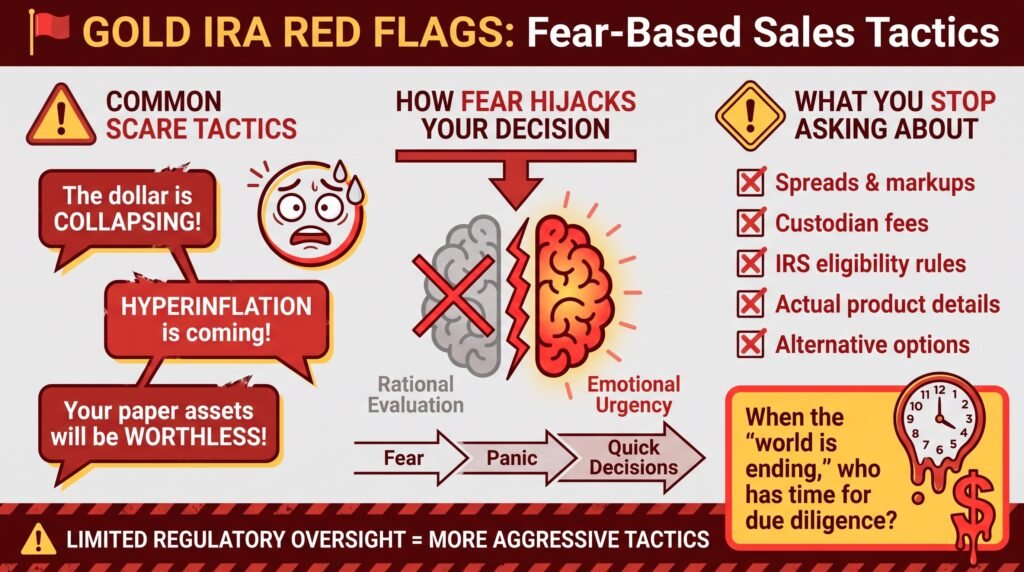
“The dollar is collapsing.” “Hyperinflation is coming.” “Your paper assets will be worthless.” These statements are engineered to create emotional urgency, and they are among the most commonly used sales tactics in the gold IRA industry. Fear sells. And in an industry with limited regulatory oversight, there is very little stopping a motivated sales agent from turning market anxiety into a closing tool.
How Doomsday Marketing Clouds Financial Judgment
When a sales pitch leads with catastrophic economic predictions, it is designed to make any rational evaluation of the actual product feel secondary. If the world is ending financially, who has time to ask about spreads, custodian fees, or IRS eligibility rules? That is exactly the point. Fear-based framing shifts your attention from due diligence to self-preservation, and in that emotional state, very expensive decisions get made very quickly.
2. No Verifiable Business History or Independent Reviews
A gold IRA company that cannot be independently verified is a company you should not trust with your retirement savings. Every legitimate precious metals dealer operating in the United States should have a traceable business history, verifiable physical address, named leadership, and a meaningful record of customer reviews on third-party platforms, not just testimonials hand-picked for their own website.
The absence of this information is not a minor inconvenience. It is a structural red flag. New companies with no track record, companies operating under recently changed names, and dealers who cannot provide references or verifiable credentials represent serious risk. In an industry where transactions regularly involve six-figure retirement rollovers, anonymity is never acceptable.
How to Vet a Gold IRA Company Before Handing Over Any Money
Before engaging with any gold IRA provider, run through this verification checklist systematically. Do not skip steps because a sales agent sounds confident or a website looks professional; visual polish is inexpensive and tells you nothing about trustworthiness.
- Search the company name on the Better Business Bureau website and review both their rating and the full complaint history
- Check the Business Consumer Alliance for precious metals dealer ratings and documented disputes
- Search the CFTC and SEC enforcement databases for any regulatory actions against the company or its principals
- Look up the company on Trustpilot and Google Reviews, read negative reviews specifically to identify patterns
- Confirm the physical business address using Google Maps Street View and cross-reference it with state business registration records
- Ask directly for the name of the IRS-approved custodian they work with and verify that custodian independently
- Request references from existing clients and actually follow up on them
A company with nothing to hide will support every single step of this process. Resistance to any part of it, particularly around custodian identity or fee documentation, should stop the conversation entirely until full transparency is provided in writing
3. Complex Structures You Cannot Clearly Explain to Someone Else
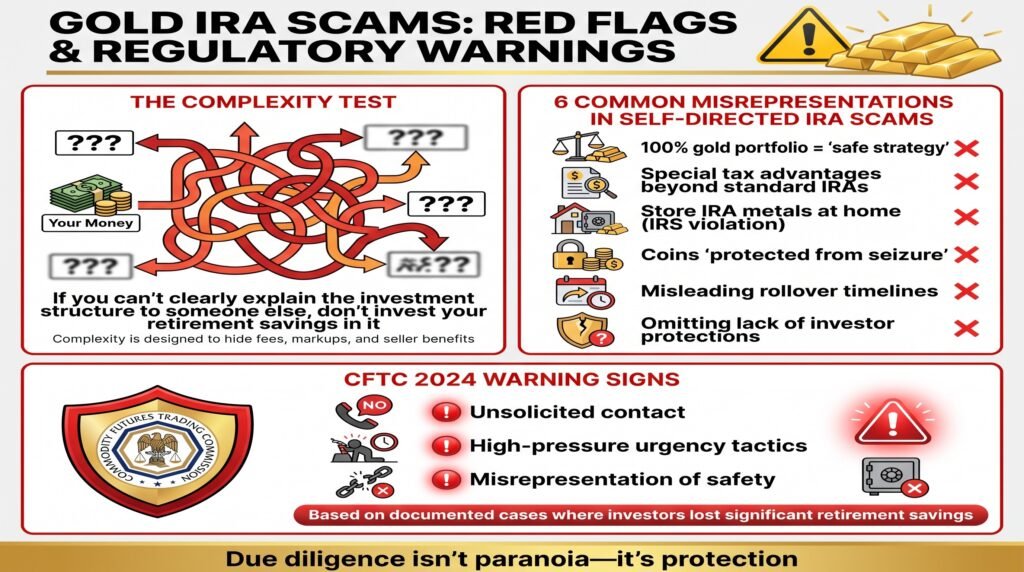
There is a reliable rule in financial decision-making: if you cannot explain an investment structure clearly to someone else, you do not understand it well enough to put your retirement savings into it. Gold IRA transactions that involve multiple layers of companies, vague rollover processes, or custodian arrangements that are difficult to trace are not sophisticated; they are designed to obscure what is actually happening to your money.
Complexity in financial products is frequently a feature, not a bug, for bad actors. The harder a structure is to follow, the easier it is to hide fees, inflate markups, misrepresent IRS rules, and move money through arrangements that benefit the seller far more than the buyer. If a gold IRA company’s process feels confusing after a full explanation, ask them to simplify it. If they cannot, or will not, that is your answer.
Self-Directed IRA Rollover Scams Regulators Have Specifically Warned About
Self-directed IRAs give investors the ability to hold alternative assets, including physical gold and silver, inside a tax-advantaged retirement account. That flexibility is legitimate and potentially valuable. But it also creates an environment where bad actors can operate with fewer guardrails than exist in traditional brokerage accounts.
Regulators have documented a consistent pattern in gold IRA fraud cases involving self-directed IRAs: investors are encouraged to roll over large portions — or in extreme cases, the entirety — of their existing retirement accounts into precious metals without being given a clear picture of the costs, tax implications, or structural risks involved. The rollover process itself is presented as simple and routine when it is anything but.
The most common misrepresentations made during self-directed IRA rollovers include:
- Claims that moving 100% of a retirement portfolio into gold is a standard and safe strategy
- Statements that gold IRAs carry special tax advantages beyond those of other retirement accounts
- Suggestions that IRA-owned metals can be stored at home — a clear IRS rule violation
- Assurances that certain coins are protected from government seizure
- Misrepresentation of the rollover timeline and its tax consequences if mishandled
- Failure to disclose that self-directed IRA transactions may not carry the same investor protections as securities
The CFTC Warnings Investors Need to Know
The Commodity Futures Trading Commission has formally warned investors about gold IRA schemes in which retirement savers were encouraged to move large sums, including full retirement account balances, into precious metals accounts through high-pressure sales tactics. Their 2024 advisory specifically identified patterns of unsolicited contact, urgency-based selling, and misrepresentation of investment safety as hallmarks of fraudulent precious metals operations.
The CFTC’s warnings are not theoretical. They reflect documented cases where real retirement investors lost significant portions of their savings to schemes that looked, on the surface, like legitimate gold IRA investments. Taking these warnings seriously and applying the red flags they describe to any gold IRA pitch you encounter is not paranoia. It is due diligence.
Augusta Precious Metals is one example of an established precious metals provider that helps investors navigate the Gold IRA process.
Receive a free gold IRA company checklist by clicking the banner below. Fill out their short form to get started.
4. No Written Fee Disclosures or Refusal to Identify Custodians and Storage
A reputable gold IRA provider will furnish written documentation that clearly identifies every cost associated with opening, maintaining, and eventually liquidating your account. This includes the one-time account setup fee (typically $50 to $150), annual IRA custodian fees (commonly $75 to $300 per year), storage fees charged by the approved depository (generally $100 to $300 annually, sometimes calculated as a percentage of holdings), transaction fees on purchases and sales, and any wire transfer or shipping costs associated with physical metal movement.
If any of these line items are missing, ask for them specifically, and get the answers in writing before proceeding. To avoid potential pitfalls, be sure to familiarize yourself with gold and silver investing scams that could impact your investment.
Custodian and Storage Requirements the IRS Actually Mandates
Under IRS rules, physical gold held inside an IRA must be stored with an IRS-approved custodian, not at your home, not in a personal safe, and not with the dealer who sold it to you. The custodian must be a bank, federally insured credit union, savings and loan association, or another entity specifically approved by the IRS under Internal Revenue Code Section 408(a). Any company suggesting otherwise is either misinformed or deliberately misleading you about tax compliance requirements.
Approved storage facilities for IRA-held gold include well-established depositories such as the Delaware Depository, Brinks Global Services, and the International Depository Services Group. Your gold IRA company should be able to name its storage partner immediately and provide documentation confirming the arrangement. If the storage location is vague, unnamed, or described as a proprietary facility you cannot independently verify, treat that as a serious compliance and security concern.
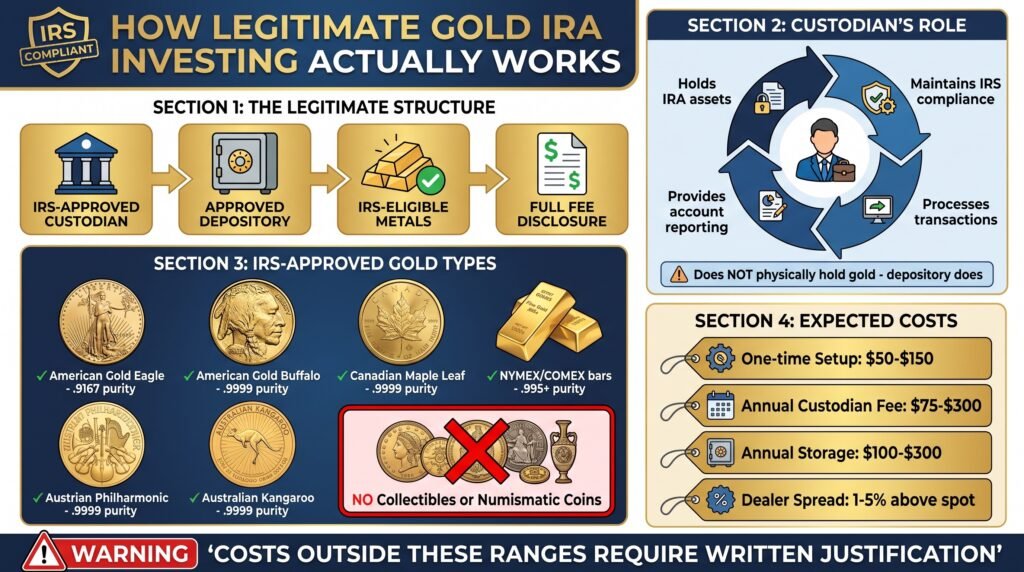
How Legitimate Gold IRA Investing Actually Works
Understanding what a legitimate gold IRA looks like makes it significantly easier to identify when something is off. A properly structured gold IRA follows a clear, documented process, one that involves an IRS-approved custodian, an approved depository, IRS-eligible metal products, and full written disclosure of every fee before any transaction is completed. The entire structure is designed to keep your retirement savings protected under the same tax-advantaged framework as a traditional IRA.
The Role of an IRS-Approved Custodian
The custodian is the financial institution responsible for holding your IRA assets, maintaining IRS compliance, processing transactions on your behalf, and providing required account reporting. In a gold IRA, the custodian does not physically hold your gold; that function belongs to the approved depository. But the custodian oversees the entire structure and carries fiduciary responsibility for the account’s regulatory compliance. You should be able to contact your custodian independently and receive direct answers about your account at any time.
Approved Gold Types for IRA Accounts
The IRS is specific about which gold products qualify for inclusion in a self-directed IRA. Meeting these standards is non-negotiable for tax compliance. Approved products include:
- American Gold Eagle coins (the only gold coin allowed at slightly below .999 purity — at .9167 fine gold, due to a specific IRS exception)
- American Gold Buffalo coins (.9999 fine gold)
- Canadian Gold Maple Leaf coins (.9999 fine gold)
- Austrian Gold Philharmonic coins (.9999 fine gold)
- Australian Gold Kangaroo/Nugget coins (.9999 fine gold)
- Gold bars and rounds produced by NYMEX- or COMEX-approved refiners meeting .995 minimum fineness
Any gold product that does not meet these specific purity standards, or that falls into the collectible or numismatic category, is not IRA-eligible. This is not a gray area. The IRS code is unambiguous, and any dealer suggesting otherwise is wrong or deliberately misleading you.
It is worth noting that even American Gold Eagle coins, which carry a face value and government backing, are valued for IRA purposes based on their gold content, not their numismatic or collector value. The distinction matters because it reinforces why chasing “rare” coins inside a retirement account structure is both financially counterproductive and potentially non-compliant.
If you are ever uncertain whether a specific product qualifies, the IRS Publication 590-A covers IRA contribution and asset rules in detail, and an independent tax professional can confirm eligibility before any purchase is made. Do not rely solely on the dealer’s word on this question.
Realistic Costs You Should Expect from a Reputable Provider
A well-structured gold IRA will involve real costs, and a trustworthy company will present them clearly upfront. Expect a one-time setup fee in the range of $50 to $150, annual custodian fees between $75 and $300, annual storage fees from $100 to $300 (or a percentage of assets under custody), and a dealer spread on purchases typically between 1% and 5% above spot price for standard bullion.
Any cost structure that deviates dramatically from these ranges, particularly on the spread, warrants direct questioning and written justification before you proceed.
If you want a full gold IRA integrity checklist from one of the most reputable companies within this space, access their checklist by clicking the banner below and fill out their short contact form to get started.
A Dealer That Checks Out Will Welcome Your Questions, Not Dodge Them
The Six Questions Every Gold IRA Investor Should Ask Before Committing:
1. What is your exact spread above spot price on this product, and will you put that in writing?
2. Which IRS-approved custodian will hold my account, and how do I contact them directly?
3. Which approved depository will store my metals, and what are the storage fees?
4. Is my sales agent paid on commission, and if so, on which products?
5. Can you provide the specific IRS code that confirms this product is IRA-eligible?
6. What are every fee, including liquidation costs, associated with this account from open to close?
These questions are not aggressive or unusual. They are the baseline of informed financial decision-making. A company that responds to any of them with defensiveness, vague language, or redirected sales talk has just told you everything you need to know about how they operate. To understand more about the potential pitfalls, you might want to explore gold and silver investing scams that some investors have faced.
The right gold IRA company will answer all six questions directly, provide written documentation for each answer, and give you time to review everything with an independent financial advisor before making any commitment. That standard is not exceptionally high; it is simply the minimum that your retirement savings deserve.
Gold can be a legitimate component of a diversified retirement strategy. The metal itself is not the problem. The problem is an industry where bad actors have learned that fear, urgency, and complexity are effective tools for separating retirement investors from their savings. Every red flag covered in this guide exists because someone used it successfully on an investor who did not see it coming. Now you do.
If you want a complete gold IRA company integrity checklist, receive Augusta Precious Metals detailed guide by clicking the banner below to get started.

Frequently Asked Questions
The questions below address the most common points of confusion among investors researching gold IRAs, including several areas where deliberate misinformation is most frequently encountered.
Each answer reflects current IRS rules and regulatory guidance. Where rules may have changed, or personal circumstances affect the answer, consultation with an independent tax or financial professional is always the recommended next step before taking action.
Can I roll over my existing 401(k) or IRA into a Gold IRA?
Yes, rolling over an existing 401(k) or traditional IRA into a gold IRA is a legitimate transaction under IRS rules when executed correctly. A direct rollover, where funds move directly from your existing custodian to the new gold IRA custodian without passing through your hands, is the cleanest method and avoids triggering any immediate tax liability or early withdrawal penalties.
An indirect rollover, where you receive the funds personally and then deposit them into the new account, must be completed within 60 days to avoid the distribution being treated as taxable income and potentially subject to early withdrawal penalties if you are under 59½.
What matters most in evaluating a rollover offer is not whether it is technically possible but whether the company presenting it is giving you a complete and accurate picture of the costs, timeline, tax implications, and the specific products your rollover funds will purchase.
What fees should I expect from a reputable Gold IRA company?
A reputable gold IRA will involve several distinct fee categories that a legitimate provider will disclose fully in writing before any transaction. Account setup fees typically run between $50 and $150 as a one-time charge. Annual IRA custodian fees generally range from $75 to $300 per year, depending on the custodian and account size. Storage fees charged by the approved depository commonly fall between $100 and $300 annually, though some depositories charge a percentage of assets under storage instead of a flat fee.
Transaction fees apply when buying or selling metals inside the account. Wire transfer fees and shipping or insurance costs may apply when metals are moved. And the dealer spread, the markup above spot price on each purchase, should always be disclosed as a specific percentage before any purchase is confirmed. Any fee structure that cannot be fully documented in writing before you commit funds is a red flag requiring immediate clarification.
Has the CFTC issued warnings about Gold IRA scams?
Yes. The Commodity Futures Trading Commission has formally issued warnings about fraudulent and deceptive practices in the precious metals and gold IRA space.
Their advisories have specifically identified patterns of investor harm involving self-directed IRA rollovers, pressure-based sales tactics, and misleading representations about the safety and structure of gold IRA investments.
-Investors being encouraged to roll over entire retirement account balances into precious metals
-High-pressure sales tactics creating artificial urgency around rollover decisions
-Misrepresentation of gold IRAs as uniquely safe, protected, or government-backed investments
-Unsolicited outreach through phone calls, email, and online communities targeting retirement-age investors
-False claims about IRS rules, including suggestions that home storage of IRA-owned metals is permitted
-Promotion of numismatic or rare coins as superior IRA investments without disclosing markup structures
The CFTC’s 2024 advisory specifically flagged the pattern of investors being encouraged to complete rollovers quickly without fully understanding the costs or structural implications involved. These warnings reflect documented cases, not theoretical risks, where retirement investors experienced significant financial harm through schemes that presented themselves as legitimate gold IRA services.
The CFTC operates the SmartCheck tool at SmartCheck.gov, which allows investors to verify whether a company or individual is registered with the CFTC and to check for any regulatory actions or fraud alerts associated with them.
Using this resource before engaging with any gold IRA company is a straightforward step that costs nothing and could save your retirement savings.-
Can I store Gold IRA metals at home?
No. This is one of the most frequently misrepresented rules in the gold IRA space, and the answer from the IRS is unambiguous. Physical metals held inside an IRA must be stored with an IRS-approved custodian arrangement, specifically, at an approved third-party depository.
Storing IRA-owned gold at home, in a personal safe, in a bank safe deposit box in your own name, or anywhere outside of an IRS-approved depository constitutes a distribution of the asset from the IRA. That distribution triggers immediate income tax on the full value of the metals plus a 10% early withdrawal penalty if you are under age 59½.
Any company or promoter suggesting that a home storage gold IRA is a legal IRS-approved structure is either wrong or deliberately misleading you — and following that advice can result in a significant and irreversible tax liability.
What should written fee disclosures from a Gold IRA company include?
A complete written fee disclosure from a reputable gold IRA company should itemize every cost associated with opening, maintaining, transacting within, and eventually closing or liquidating your account.
This means the one-time account setup fee, the annual custodian fee, the annual storage fee (specified as either a flat rate or percentage of assets), transaction fees for purchases and sales, wire transfer fees, shipping and insurance costs for metal movement, and the dealer’s spread above spot price on each product type available for purchase. Nothing should be described in vague terms like “competitive pricing” or “industry-standard fees” without specific numbers attached.
Liquidation costs are particularly important to request in writing upfront, because many investors focus on purchase fees and do not consider what it will cost to sell their gold when the time comes.
A company that is transparent about liquidation pricing, including whether they offer buyback programs and at what price relative to spot, is demonstrating a level of honesty about the full transaction cycle that commission-driven operations typically avoid. If any fee category is missing from the written disclosure you receive, request it specifically and do not proceed until it is documented in writing.
How do I report a suspected Gold IRA scam?
If you believe you have encountered or been victimized by a fraudulent gold IRA operation, report it to multiple regulatory bodies simultaneously. File a complaint with the Commodity Futures Trading Commission through their online portal at cftc.gov/complaint. Report to the Federal Trade Commission at ReportFraud.ftc.gov.
File a complaint with your state’s attorney general’s office, which often has a dedicated consumer protection or securities fraud division. If the scheme involved securities or investment advice, report it to the SEC at sec.gov/tcr. Contact the Internet
Crime Complaint Center (IC3) at ic3.gov if the fraud involved online communications. Document everything, save all emails, record call details, and retain all written materials and contracts before filing reports, as this documentation will support any investigation that follows.
Sources:
Augusta Precious Metals – 5 Questions to Ask Before Choosing a Gold IRA Company
USA Today: Gold and silver investing scams: Red flags and how to protect yourself
https://www.usatoday.com/story/money/investing/gold-and-silver-investing-scams/88744022007/
*Disclaimer: This article is written for educational purposes and should not be interpreted as financial advice. We may receive compensation for referrals made through this article.
Leave a Reply