Quick Summary
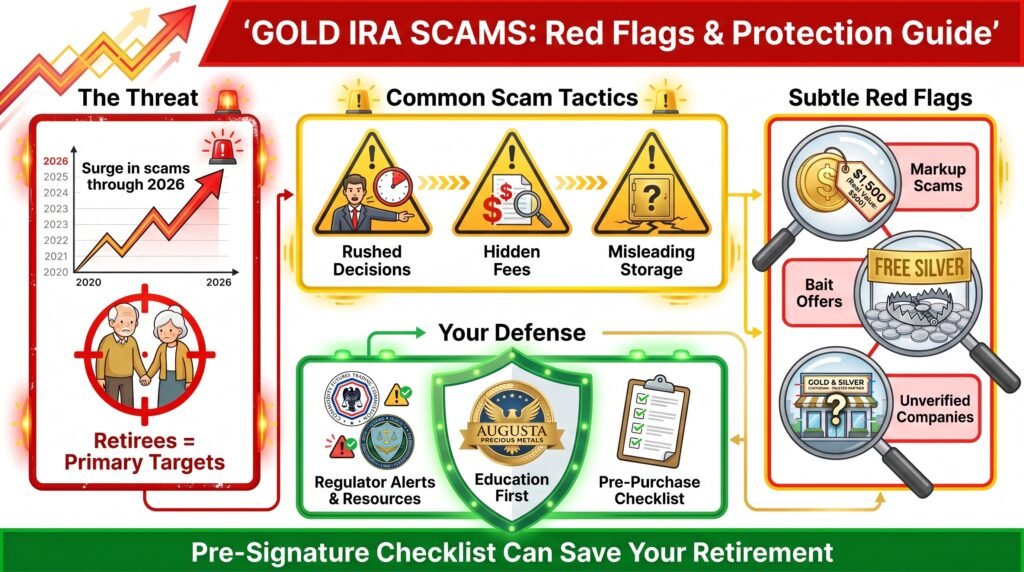
- Gold IRA scams are surging in 2026, with retirees being the primary targets of high-pressure tactics, hidden fees, and misleading storage arrangements.
- The most dangerous scams are subtle: inflated coin markups, fake “free silver” deals, and unverified custodians that look completely legitimate on the surface.
- Augusta Precious Metals is one of the few gold IRA companies that actively educates investors on how to identify and avoid fraud before they commit a single dollar.
- The CFTC and FTC have both issued warnings about precious metals fraud; knowing what regulators say can be your first line of defense.
- There is a specific checklist you can use before signing anything that could save your retirement from a scam, covered in detail below.
Table of Contents
- Quick Summary
- Gold IRA Scams Are Draining Retirements Right Now
- What Is a Gold IRA Scam?
- The Most Common Gold IRA Scams and Red Flags in 2026
- Verify a Gold IRA Company Is Legitimate Through Consumer Advocate Sites
- How to Protect Your Retirement from Gold IRA Fraud
- A Scam-Free Gold IRA Is Possible: Here Is How to Get Started
- Frequently Asked Questions
Gold IRA Scams Are Draining Retirements Right Now
The surge in gold’s popularity as a retirement hedge has made the gold IRA space one of the most targeted sectors for financial fraud in 2025 and 2026.
As more Americans look to protect their savings from inflation and market volatility, bad actors have flooded the space with deceptive companies, misleading claims, and outright theft disguised as investment advice. The appeal of gold is real, but so is the danger of choosing the wrong company to help you get there.
If you are researching gold IRAs, Augusta Precious Metals has put together a free scam protection resource here that breaks down exactly what to watch for; it is one of the most thorough investor education tools available in the industry right now.
Why Retirees Are the #1 Target
Retirees represent the most targeted demographic in gold IRA fraud for one straightforward reason: they have accumulated savings. A person approaching or in retirement often has significant assets in a 401(k) or traditional IRA that can be rolled over, and scammers know exactly how to exploit that transition period. The rollover process involves multiple steps, unfamiliar terminology, and new service providers, which creates the perfect window for manipulation.
Beyond the money, many retirees are less familiar with how precious metals pricing works. Scammers take advantage of this by presenting inflated markups as “standard industry pricing” or steering investors toward obscure collectible coins with enormous dealer margins. The emotional weight of retirement security also makes people more susceptible; fear of economic collapse and inflation anxiety are powerful psychological levers that dishonest dealers pull constantly.
What the CFTC and FTC Say About Precious Metals Fraud in 2024–2026
The Commodity Futures Trading Commission (CFTC) has explicitly warned consumers about precious metals fraud, specifically calling out schemes where dealers charge excessive markups, misrepresent storage arrangements, or claim gold is being held on behalf of investors when it is not. The CFTC notes that in many cases, the metals are never actually purchased; investors pay for gold that simply does not exist.
The Federal Trade Commission (FTC) has similarly flagged high-pressure precious metals sales as a recurring category of consumer complaints. Both agencies emphasize that legitimate dealers will never rush you into a decision, hide their fee structures, or discourage you from seeking independent advice. If any of those behaviors appear during your research process, treat them as serious warning signs, not minor inconveniences.
What Is a Gold IRA Scam?
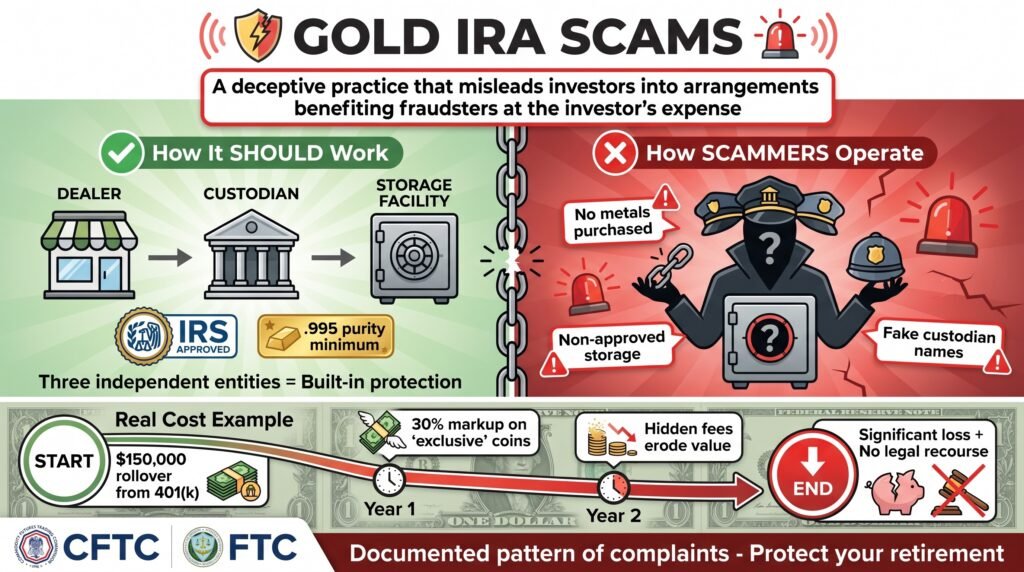
A gold IRA scam is any deceptive practice by a dealer, custodian, or promoter that misleads an investor into a gold IRA arrangement that benefits the fraudster at the investor’s expense. To any beginning gold investor, this can be a challenge to identify.
How Legitimate Gold IRAs Work
A legitimate gold IRA is an IRS-recognized self-directed individual retirement account that holds physical precious metals instead of, or alongside, traditional paper assets. To be IRS-compliant, the gold must meet a minimum purity standard of .995 fineness for bars and .9999 fineness for most coins.
The metals must be stored in an IRS-approved depository, not at home or in a personal safe. A qualified custodian, not the dealer, is legally responsible for managing the account. The process typically involves three separate entities: a dealer, a custodian, and a storage facility.
Where Scammers Hijack the Process
The multi-step nature of a gold IRA is exactly where fraud enters. Dishonest companies blur the lines between these roles, sometimes acting as dealer, custodian, and storage provider simultaneously, which removes the checks and balances that protect investors.
Others use legitimate-sounding custodian names without formal agreements, or direct your metals to non-approved storage facilities while collecting ongoing storage fees. Some never purchase the metals at all.
The Hidden Cost of Getting It Wrong
Real-world example: An investor rolls over $150,000 from a 401(k) into a gold IRA. The dealer charges a 30% markup on “exclusive” coins instead of standard bullion, adds undisclosed annual fees, and stores the metals in a non-IRS-approved facility.
Within two years, the effective value of the account, accounting for inflated purchase prices and fee erosion, is worth significantly less than a comparable investment in standard gold bullion through a transparent dealer. The investor has no easy legal recourse because they signed an agreement they did not fully understand.
This scenario is not hypothetical. It reflects the pattern of complaints documented by the CFTC, FTC, and consumer advocacy organizations. The damage is financial, but also emotional; many victims are people who were simply trying to secure their retirement and trusted the wrong company.
The Most Common Gold IRA Scams and Red Flags in 2026
These are not edge cases. Each of the following scam types has been documented in regulatory complaints and consumer reports, and several are actively in use right now.
1. Unrealistic Return Promises
No one can guarantee gold will increase in value. Full stop. Any dealer that promises specific returns, guarantees price appreciation, or presents gold as a “risk-free” investment is either uninformed or deliberately misleading you. Gold’s value fluctuates with global markets, and while it has historically served as an inflation hedge over long periods, it is not a guaranteed growth vehicle. The moment a sales rep promises you a specific return percentage, end the conversation.
2. “Free Silver” Promotions With Hidden Strings
This is one of the most widely used bait-and-switch tactics in the gold IRA industry. A company offers “free” silver coins as a bonus when you open an account, but the cost of that silver is quietly built into inflated markups on your gold purchase. You are not receiving anything free. You are paying an above-market price for gold to subsidize the “gift.” In some cases, the spread between what you pay and the actual spot price of gold is large enough to immediately put your account at a significant loss.
Always ask for the total cost breakdown, including the spot price of gold, the dealer markup, and any applicable fees, before accepting any promotional offer. A trustworthy company will give you this information without hesitation. For more tips on avoiding scams, visit this guide on gold IRA scams.
3. Obscure Coin Pushing Instead of Standard Bullion
Some dealers aggressively promote “numismatic” or “semi-numismatic” coins, collectible coins whose value is tied to rarity and condition rather than metal content alone.
These are sold with dramatically higher markups than standard IRS-approved bullion like the American Gold Eagle or Canadian Gold Maple Leaf. Dealers profit enormously from this, while investors end up with coins that are harder to liquidate, harder to price, and often do not qualify for IRA inclusion under IRS rules.
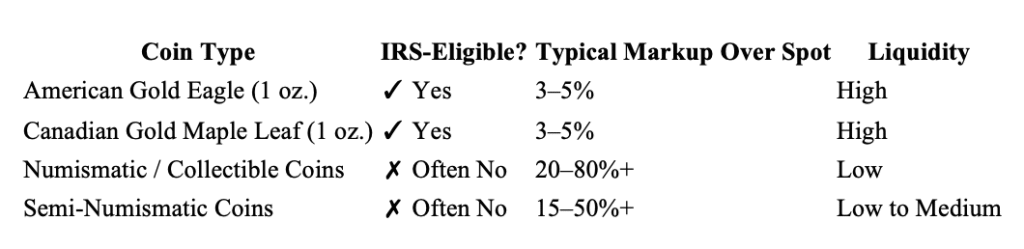
If a dealer pushes you toward coins you have never heard of while downplaying standard bullion options, that is a serious red flag. Stick with IRS-approved products and ask for the exact purity and eligibility confirmation in writing.
4. Misleading Storage Arrangements
IRS rules require that gold held in an IRA be stored in an approved depository, not at home, not in a bank safe deposit box, and not in any facility the dealer controls. Some dealers either misrepresent where metals are stored, charge fees for storage in facilities that are not IRS-compliant, or worse, collect storage fees while the metals are commingled or unaccounted for.
There have been documented cases where investors discovered their metals were never segregated from other investors’ holdings, making recovery in the event of company insolvency extremely complicated.
5. High-Pressure Sales Tactics
Legitimate gold IRA companies do not need to rush you. If a sales representative tells you that a price is “only good for today,” warns you that economic collapse is imminent unless you act immediately, or calls you repeatedly after an initial inquiry, you are being manipulated, not advised.
High-pressure tactics are specifically designed to prevent you from doing independent research, consulting a financial advisor, or simply taking the time to think clearly. That urgency is manufactured, and it should immediately disqualify the company from your consideration.
Augusta Precious Metals is an established precious metals provider that helps investors navigate the Gold IRA process, offering IRS-approved coins and bars, along with educational resources for beginners just getting started with precious metals retirement planning.
Click the banner below to visit Augusta’s official site and receive a free gold IRA company integrity checklist. Fill out their short form to get started.
Verify a Gold IRA Company Is Legitimate Through Consumer Advocate Sites
Verification is not complicated, but it does require taking a few deliberate steps that most investors skip because a sales pitch made them feel comfortable. Comfort is not the same as safety. Here is how to confirm a company is actually legitimate before you hand over a single dollar.
Check BBB, Trustpilot, and Google Reviews
Start with the Better Business Bureau (BBB). Look not just at the rating but at the nature of the complaints: fee disputes, failure to deliver metals, and poor communication are recurring themes in complaints against fraudulent dealers. A company with an A+ BBB rating and hundreds of verified customer reviews is meaningfully different from one with a high rating but only a handful of reviews that all appeared within a short time window.
Trustpilot and Google Reviews provide additional layers of independent feedback. Look for patterns rather than individual opinions. Consistent mentions of transparent pricing, no-pressure sales, and reliable delivery are good indicators. Consistent complaints about unexpected fees, pushy representatives, or difficulty liquidating metals are serious red flags, regardless of how polished the company’s website looks.
How to Protect Your Retirement from Gold IRA Fraud
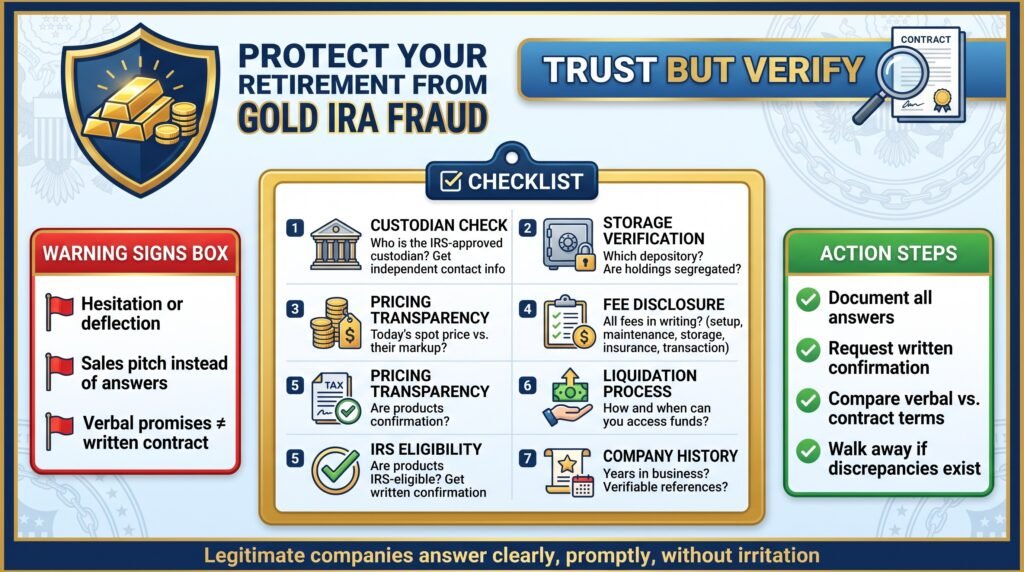
Protection starts with preparation. The investors who get scammed are not naïve; they are simply investors who trusted without verifying. Building a simple, repeatable verification process into your research eliminates the vast majority of fraud risk before it can affect you.
Questions to Ask Any Gold IRA Company Before Investing
Before committing to any gold IRA provider, run through the following questions directly with their representative. Their answers, and their willingness to answer, will tell you more than any marketing material ever could.
Gold IRA Company Vetting Questions:
What is the full name of the IRS-approved custodian managing my account, and how can I contact them independently?
Which IRS-approved depository will my metals be stored in, and will my holdings be segregated from other investors’ metals?
What is the exact spot price of gold today, and what is your markup above that price for the products you are recommending?
Are all fees- setup, annual maintenance, storage, insurance, and transaction- disclosed in writing before I sign anything?
Are the specific coins or bars you are recommending IRS-eligible for a self-directed IRA? Can you provide that confirmation in writing?
What is the process and timeline for liquidating my metals if I need to access funds?
How long has your company been operating, and can you provide verifiable references or independent reviews?
A legitimate company will answer every one of these questions clearly, promptly, and without irritation. Any hesitation, deflection, or attempt to redirect you to a sales pitch instead of a direct answer is a warning sign you should not ignore.
Document the answers you receive. Write them down during the call or ask for written confirmation via email. If a company’s verbal answers do not match what appears in their contract, walk away immediately; discrepancies between what a representative says and what appears in writing are one of the most reliable indicators of a fraudulent operation.
A Scam-Free Gold IRA Is Possible: Here Is How to Get Started
A gold IRA is a legitimate, IRS-recognized retirement tool that can genuinely serve as a hedge against inflation and market volatility; the key is choosing the right partner to help you set it up.
Start by downloading a free scam protection checklist, verify every company you consider against the criteria outlined in this article, and never allow urgency or pressure to replace deliberate, informed decision-making. Your retirement deserves the same due diligence you would apply to any major financial decision, and with the right process, a secure gold IRA is absolutely achievable.
See Augusta Precious Metals’ full gold IRA company integrity checklist by clicking the banner below. Fill out their short contact form to get started.

Investment Minimums – Personal Considerations
Certain IRA companies have higher investment minimums than others. If you are a serious investor with a minimum of $50,000, you can take advantage of Augusta Precious Metals’ higher competitive prices, lifelong customer service, and educational resources.
If you require a lower barrier to entry, both National Gold Group and Birch Gold Group are trustworthy companies that provide a $10,000 investment minimum.
National Gold Group provides exceptional price transparency and reliable buyback commitment. Birch Gold Group is one of the most established and trusted gold IRA companies, spanning over 20 years, and provides some of the lowest fees in the industry.
Decide which gold IRA company works for you by clicking the banners below and accessing their free gold IRA guide. Fill out their short contact form to get started.
Birch Gold Group: Best Gold IRA for Established Trust & Low Fees

National Gold Group: Best Gold IRA for Transparency & Buyback
Frequently Asked Questions
I couldn’t open that page because the site blocks automated access, so I couldn’t check the FAQ against the article’s own wording. I wrote these from the article’s title and topic, using widely reported guidance on gold IRA scams. Before publishing, compare them against your article so the answers match what it says, especially any figures.
The questions use natural search phrasing, and each answer is under about 60 words so it suits a rich result.
Gold IRA Scams: Frequently Asked Questions
What are the biggest red flags of a gold IRA scam?
Watch for high-pressure sales tactics, guaranteed returns, and pushy claims that you must act immediately. Other warning signs include unsolicited calls, vague or hidden fees, and refusal to put fees in writing. Legitimate companies focus on education and give you time to decide
Is it legal to store gold from an IRA at home?
No, not in the way scammers describe it. The IRS requires precious metals held in an IRA to be kept by an approved custodian in an approved depository. “Home storage” or “checkbook IRA” pitches can lead to taxes and penalties, so treat them as a serious warning sign.
How much markup is too much on gold IRA purchases?
Some markup over the spot price is normal, but excessive markups are a red flag. Regulators such as the CFTC have cited typical bullion premiums in the range of 5–10%. Ask for a written price breakdown, and be wary of collectible or “rare” coins sold at inflated prices.
How can I verify a gold IRA company is legitimate?
Check the company’s record with the Better Business Bureau, the CFPB complaint database, and your state securities regulator or attorney general. Confirm that the custodian and depository are IRS-approved and get all fees in writing before you sign anything.
What should I do if I think I’ve been scammed?
Stop sending money and gather your paperwork, including contracts, statements, and call records. Report the company to the FTC, the CFTC, the SEC, and your state attorney general. Contact your IRA custodian as well, and consider speaking with a licensed financial or legal professional.
What is a gold IRA scam and how does it work?
A gold IRA scam is any deceptive practice by a dealer, promoter, or custodian that misleads an investor into a gold IRA arrangement designed to benefit the fraudster rather than the investor. Common mechanisms include inflated markups on non-standard coins, fabricated custodian relationships, misleading storage claims, hidden fee structures, and high-pressure sales tactics that prevent informed decision-making.
The scam typically begins with aggressive outreach, a phone call, online ad, or mailer targeting retirees with messaging about economic instability and the safety of gold.
Once contact is made, a high-pressure sales process begins that emphasizes urgency, fear, and trust-building rather than transparent information.
The investor is steered toward overpriced products, often numismatic or semi-numismatic coins with markups of 20–80% above spot price, under the guise of “exclusive” or “collector-grade” investments. The investor may not discover the true cost until years later, when attempting to liquidate and finding the market value of their holdings is a fraction of what they paid.
In the most severe cases, the metals are never purchased at all.
The investor pays storage fees, maintenance fees, and annual custodial fees for years, for gold that does not exist. These cases have been prosecuted under federal fraud statutes, but recovery is often partial at best and requires protracted legal action.
What does the CFTC warn about gold IRA investing?
What does the CFTC warn about gold IRA investing?
The Commodity Futures Trading Commission has issued specific consumer alerts about precious metals fraud, warning investors about dealers who charge excessive markups, misrepresent the storage and ownership of metals, or outright fail to purchase the metals investors have paid for.
The CFTC notes that some fraudulent dealers use elaborate documentation, including fake storage receipts and account statements, to create the illusion that metals are being held on the investor’s behalf when they are not.
The CFTC also warns against dealers who use retirement account rollovers as an entry point for fraud, specifically targeting investors in the transition between employer-sponsored plans and self-directed IRAs. Their guidance consistently emphasizes the same protective steps: verify the custodian independently, confirm storage arrangements through a third party, and never allow a dealer to control both the sale and the custody of your metals. Their full consumer advisory is publicly available at cftc.gov and is worth reading before you begin any gold IRA research.
Sources:
Gold IRA Rules and Regulations: LendEDU
Gold IRA storage rules: IRS requirements for storing precious metals: Yahoo!Finance
Investments in collectibles in individually directed qualified plan accounts: IRS.gov: Retirement plans FAQs regarding IRAs: IRS.gov
*Disclaimer: This article is written for educational purposes and should not be interpreted as financial advice. We may receive compensation for referrals made through this article.
Leave a Reply