Quick Summary
- Most financial experts recommend keeping silver to just 5%-10% of your total retirement portfolio, not a core holding but a diversification tool.
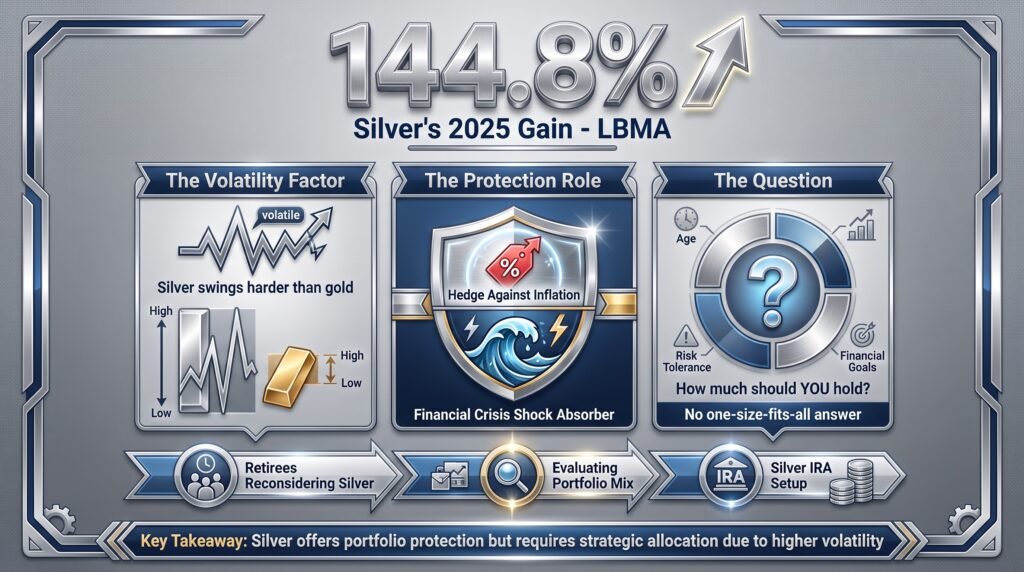
- Silver’s price surged 144.8% in 2025 alone, proving its volatility can work in your favor during the right market conditions.
- The gold-to-silver ratio gives you a built-in signal for when silver is cheap relative to gold, helping you time purchases smarter.
- Working with an established partner like Augusta Precious Metals can help you navigate IRA rules and avoid costly mistakes when adding physical silver to retirement accounts.
- Silver behaves differently than gold because industrial demand from solar panels and electric vehicles plays a massive role in its price swings, something we’ll break down later in this guide.
Silver just posted a 144.8% gain in 2025, according to the LBMA, and that kind of performance has retirees asking one question: how much of this stuff should actually sit in my portfolio?
The answer isn’t as simple as picking a random percentage and calling it a day. Silver swings harder than gold, yet it’s also proven itself as a hedge against inflation and a shock absorber during financial crises, which is exactly why so many retirees are taking a second look at it.
If you’re exploring how precious metals fit into your retirement strategy, Augusta Precious Metals has spent over a decade helping people navigate exactly these kinds of decisions, particularly when it comes to setting up silver IRAs the right way.
This guide covers the percentages experts recommend, the tools you can use to time your purchases, and the real costs and risks that don’t always make it into the sales pitch.
Table of Contents
- Quick Summary
- How Much Silver Should You Actually Own?
- Physical Silver Coins and Bars
- Paper Silver Investments
- Setting Up a Silver IRA the Right Way
- The Real Risks of Holding Silver
- Your Silver Allocation Decision Starts Now
- Frequently Asked Questions
How Much Silver Should You Actually Own?
Here’s where the rubber meets the road. Knowing silver’s history and having a timing tool is great, but none of it matters if you don’t know how much to actually allocate.
Financial advisors generally land on a few different frameworks for this, and none of them suggest going overboard.
The 5%-10% Rule for Portfolio Diversification
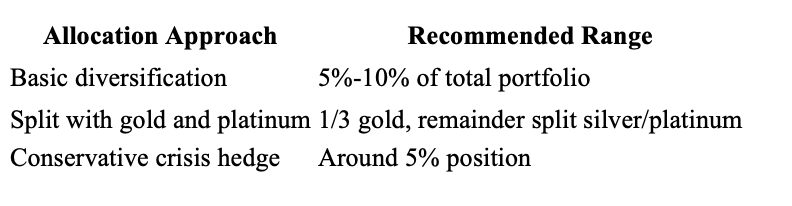
The most commonly recommended approach is keeping 5% to 10% of your total portfolio in precious metals for basic diversification. This isn’t meant to be your growth engine. It’s meant to be ballast, something that zigs when your stocks and bonds zag.
The 1/3 Rule: Splitting Between Gold, Silver, and Platinum
Another framework some investors use splits precious metals holdings into thirds: one-third in gold, with the remaining amount divided between silver and platinum. This approach spreads your precious metals exposure across multiple metals rather than concentrating entirely in one.
Why a 5% Position Might Be Your Sweet Spot
For retirees specifically, a 5% position in silver may be enough to deliver impressive returns during a financial meltdown without crushing your overall portfolio if the price moves against you. That’s the balance you’re after: meaningful upside potential during a crisis, limited downside during normal market conditions.
The consistent theme across every framework is restraint. No credible financial advisor is suggesting retirees put a large chunk of their nest egg into silver, and for good reason, which we’ll get into later in this guide.
1. Physical Silver Coins and Bars
When most people picture investing in silver, they picture the physical stuff: coins and bars you can actually hold. This remains the most straightforward way to own silver, though it comes with its own set of considerations.
Physical silver splits into two main categories, and understanding the difference helps you decide which fits your goals better.
American Silver Eagles and Canadian Maple Leafs
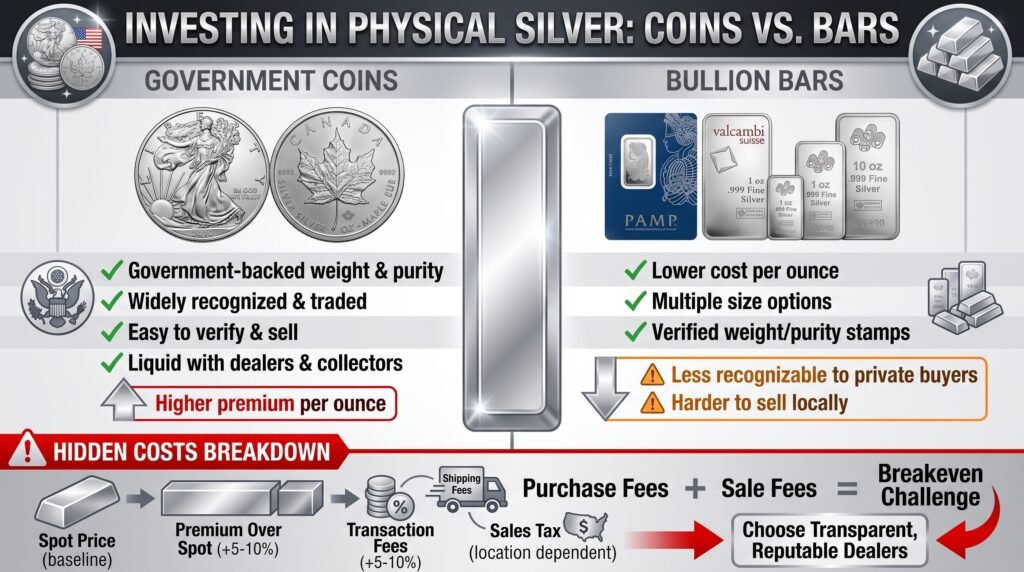
Government-minted coins represent the gold standard, so to speak, of physical silver ownership. American Silver Eagles, produced by the U.S. Mint, and Canadian Silver Maple Leafs are two of the most widely recognized and traded options. These coins carry government backing for their weight and purity, making them easy to buy, sell, and verify.
Trusted Bar Producers Like PAMP Suisse and Valcambi
Silver bullion bars come in several different sizes and typically cost less per ounce than coins, since they require less manufacturing detail. Reputable refiners stamp their bars with verified weight and purity markings, which matters enormously when it comes time to sell. The tradeoff is that bars aren’t traded as easily with private parties or local coin shops compared to coins, since they lack the instant recognizability of a government-minted coin.
The Hidden Cost of Premiums and Transaction Fees
Here’s something that catches a lot of first-time silver buyers off guard: you’ll pay a premium over the spot price for any physical silver you buy, covering manufacturing costs and dealer margins. On top of that, transaction fees for silver bullion coins or bars can run anywhere from 5% to 10%, and that’s not unusual.
If you’re paying those fees on both the purchase and the eventual sale, the price needs to climb substantially just to get you back to breakeven. Factor in shipping fees and sales tax depending on where you live, and the all-in cost of physical silver adds up fast. This is exactly why working with a reputable dealer who’s transparent about pricing matters so much.
2. Paper Silver Investments
Not everyone wants to deal with physical storage, insurance, and the hassle of verifying authenticity. That’s where paper silver investments come in, offering exposure to silver’s price movements without ever touching an actual coin or bar.
Silver ETFs Like iShares Silver Trust (SLV)
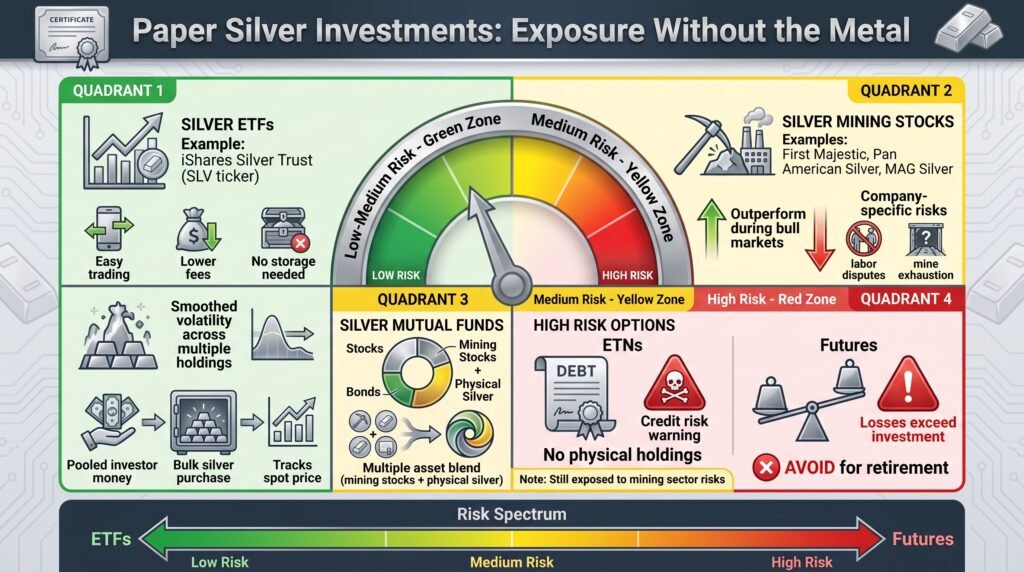
Silver exchange-traded funds pool investor money to buy silver at scale, with share prices designed to track the metal’s spot price. The iShares Silver Trust, trading under the ticker SLV, is one of the most recognized examples. ETFs let you buy and sell your silver exposure as easily as trading a stock, with lower fees than dealing in physical metal and none of the storage headaches.
Silver Mining Stocks vs. Silver Mutual Funds
Silver mining stocks represent shares in companies that actually dig silver out of the ground, names like First Majestic Silver Corp, Pan American Silver Corp, and MAG Silver Corp. These stocks can outperform silver itself during bull markets, since a rising silver price often boosts mining company profits disproportionately. But they also carry company-specific risks that have nothing to do with silver prices, like labor disputes or mine exhaustion.
Silver mutual funds, on the other hand, pool investor money across several silver-related assets, often blending mining stocks with physical silver holdings. This diversified approach can smooth out some of the volatility you’d get from betting on a single mining company, though it still carries exposure to the broader risks facing the mining sector.
ETNs and Futures Contracts: Higher Risk Options
Exchange-traded notes, or ETNs, track an underlying silver index but don’t actually hold physical silver or stock in mining companies. Instead, they’re unsecured debt securities issued by a financial institution, which means you’re taking on credit risk tied to the issuer alongside silver’s price risk. That’s an extra layer of complexity most retirees don’t need.
Silver futures take things even further into speculative territory, letting you bet on future silver prices using leverage. The potential for losses with futures can exceed your initial investment, which makes this option far too risky for most retirement portfolios. If you’re building a nest egg you plan to rely on, futures contracts belong on the “avoid” list rather than the “consider” list.
Setting Up a Silver IRA the Right Way
If you’re serious about adding silver to your retirement portfolio in a tax-advantaged way, a silver IRA is the vehicle built specifically for that purpose. But the IRS has strict rules about what qualifies, and getting this wrong can trigger unexpected taxes and penalties.
A silver IRA works similarly to a traditional retirement account, except instead of holding stocks and bonds, it holds physical silver that meets specific IRS purity requirements. Setting one up correctly requires working with the right custodian and understanding exactly what silver products qualify.
This is an area where having an experienced partner matters enormously. Augusta Precious Metals and Birch Gold Group have built relationships with mints around the world specifically to help customers purchase IRA-eligible gold and silver coins directly from their producers, which helps ensure authenticity and compliance with IRS rules from day one.
2026 Contribution Limits You Need to Know
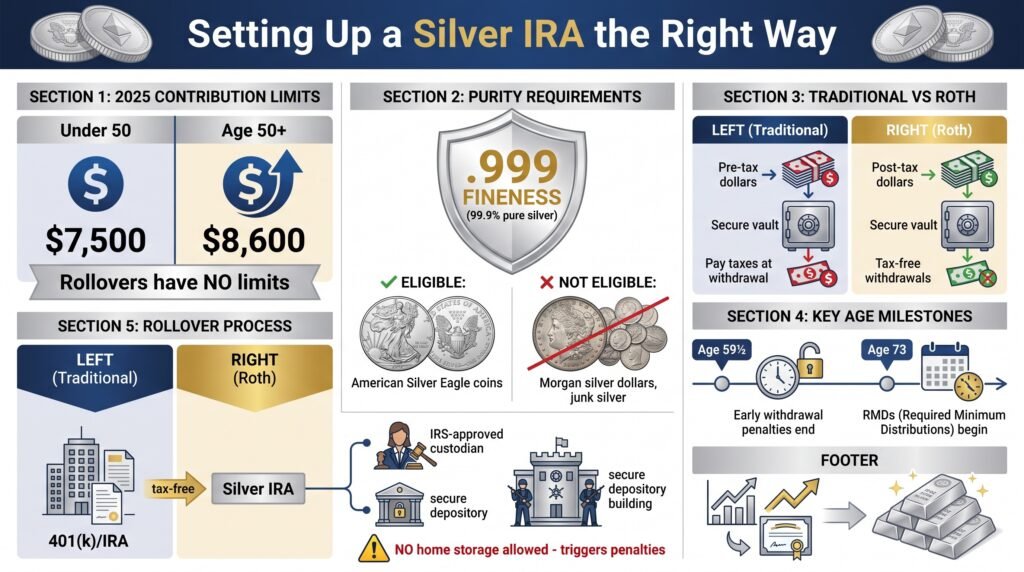
For 2026, the IRA contribution limit sits at $7,500 if you’re under age 50, and $8,600 if you’re 50 or older. These limits apply to new contributions into your account each year.
Here’s the good news if you’re rolling over an existing retirement account: contribution limits don’t apply to rollovers and transfers, which can be any sum. This means you can move funds from an existing 401(k) or traditional IRA into a silver IRA without worrying about hitting an annual cap.
Fineness Requirements for IRA-Eligible Silver
Not every silver coin or bar qualifies for an IRA. The tax code specifically forbids collectibles from being held in an IRA, and IRA-eligible silver coins must meet a minimum fineness requirement of .999, meaning 99.9% pure silver. American Silver Eagle coins produced by the U.S. Mint meet this standard and are among the most commonly held IRA-eligible silver products.
This requirement rules out a lot of silver that investors already own. Older Morgan silver dollars and US junk silver, for example, don’t meet the fineness requirement and aren’t eligible for purchase through a silver IRA. It’s also worth noting you can’t purchase coins you already personally own using silver IRA funds, since that would violate IRS rules against self-dealing.
Traditional vs. Roth Silver IRAs
Most silver IRAs are structured as Traditional IRAs, meaning you fund them with pre-tax dollars and only pay taxes once you take distributions in retirement. This setup works well if you expect to be in a lower tax bracket once you retire.
You can also open a Roth silver IRA instead, funding it with post-tax dollars. The advantage here is that qualified distributions in retirement come out completely tax-free, gains included. If you expect your tax bracket to be similar or higher in retirement, a Roth structure might serve you better long-term.
Required Minimum Distributions After Age 73
If your silver IRA is structured as a Traditional IRA, you’ll be required to take required minimum distributions, known as RMDs, once you reach age 73. This is a standard IRS rule across all traditional retirement accounts, not something unique to silver, but it’s worth planning around since you’ll need enough liquidity to satisfy these distributions.
Taking money out before age 59½ triggers potential taxes and penalties, so timing matters just as much on the front end as it does once RMDs kick in.
Rolling Over Your 401(k) or IRA Tax-Free
If you already have retirement savings sitting in a 401(k) from a previous employer, or in an existing traditional IRA, you can roll those funds into a silver IRA without triggering taxes or penalties, as long as the rollover follows IRS guidelines. This is often the most practical entry point for retirees who want silver exposure without pulling new money out of pocket.
Your silver IRA assets will need to be managed by an IRS-approved custodian, and the physical silver itself gets stored at a precious metals depository rather than in your home. Attempting to store IRA silver yourself, even in a home safe, could subject you to significant taxes and penalties, so this isn’t a step worth cutting corners on.
Augusta Precious Metals is best for high-income earners, best pricing, & lifetime customer support. Birch Gold Group is known for low investment minimums, low fees, and established trust.
Receive a free gold information kit by filling out their short contact form when you click one or both of the banners below.

The Real Risks of Holding Silver
Silver isn’t a set-it-and-forget-it investment, and pretending otherwise does retirees a disservice. The same volatility that can produce impressive gains can just as easily produce painful losses, and understanding these risks upfront helps you size your position appropriately.
- Price volatility driven by shifting industrial demand
- No income or yield generated while you hold it
- Mining stock risks tied to company-specific issues
- Long stretches of flat, directionless price action
- Difficulty timing entry and exit points
The major risk with silver investing is simply price instability. Unlike bonds that pay predictable interest, silver’s value depends entirely on what someone else is willing to pay for it at any given moment. When the broader economy is performing well, silver and other precious metals generally become less attractive, since investors shift toward assets offering higher yields elsewhere. That’s an important dynamic to keep in mind: silver often does best precisely when everything else is struggling.
Price Volatility and Industrial Demand Swings
Because industrial demand makes up such a large portion of silver’s overall demand, a decrease in that industrial activity can drop the market price fairly quickly. This differs meaningfully from gold, whose price is far less tied to industrial consumption.
This means silver’s price performance may actually be poor during exactly the kind of financial instability that would otherwise make precious metals attractive, if that same instability also suppresses industrial activity and manufacturing output.
Why Silver Produces No Yield…Or Does It.
- No dividends paid out, unlike dividend-paying stocks
- No interest earned, unlike bonds or savings accounts
- Returns come exclusively from price appreciation
This is a critical distinction for retirees to understand before allocating retirement savings toward silver. A bond or dividend stock generates cash flow you can actually live on in retirement, while silver sits there, potentially gaining value, but never paying you anything along the way unless you invest in a silver lease.
Contrary to merely holding the physical metal itself, participating in a silver lease actually puts the silver into productive use within industry and provides a real interest yield competitive with bonds. Monetary Metals provides silver as well as gold leases that average 3-4%+ during the term of the lease. Learn more here.
Mining Stock Risks Beyond Price Movement
Silver mining stocks are probably the most speculative way to participate in the silver market, and they carry risks that have nothing to do with silver’s price. International disturbances, environmental catastrophes, foreign government regulation or nationalization, labor unrest, and currency fluctuations can all tank a mining stock even while silver prices hold steady or rise. More and more people today seem to be getting nervous about the future of the economy and their financial security, which is why some are considering options like a Silver IRA as a hedge against these risks.
On top of these external risks, mining companies face risks specific to the business itself: high capital costs, the risk of mine exhaustion, oversupply of the metal, and the genuine possibility of investing heavily to develop a mine that ultimately produces minimal or no silver.
Your Silver Allocation Decision Starts Now
Silver isn’t a complicated asset once you strip away the hype. It’s a volatile, non-yielding metal with real industrial utility and a documented history of holding up during financial crises. Used correctly, in that 5% to 10% range most advisors recommend, it can serve as genuine diversification against the risks concentrated stock and bond portfolios carry.
The retirees who get the most out of silver treat it as a deliberate, limited allocation rather than a speculative bet on quick riches. Whether that means opening a silver IRA, buying physical coins through a trusted dealer, or gaining exposure through an ETF, the principles stay the same: understand the costs, respect the volatility, and size your position so a downturn in silver prices never threatens your broader retirement security.
Birch Gold Group: Best Gold IRA for Established Trust & Low Fees
Augusta Precious Metals: Best Gold IRA for Prices & Customer Support
Read more about how gold belongs in your portfolio for proper diversification, inflation hedging, and more here.
Find out whether gold IRAs are a good choice for your retirement needs. Access our Silver IRA calculator by clicking the banner below.

Frequently Asked Questions
Silver raises plenty of practical questions once you start considering it for your retirement portfolio. Here are the answers to the ones retirees ask most often.
These questions cover everything from allocation percentages to tax treatment, giving you a quick reference as you finalize your own silver strategy.
What percentage of my retirement portfolio should be silver?
Most financial advisors recommend keeping silver between 5% and 10% of your total portfolio, with some suggesting a conservative 5% position specifically for crisis protection without overexposing your retirement savings to silver’s volatility.
Can I hold silver in my IRA at home?
No. Attempting to store silver IRA assets at home could subject you to significant taxes and penalties. Your silver IRA coins and bars must be stored at an approved precious metals depository, managed by an IRS-approved custodian.
How do I start a silver IRA rollover?
You can roll over funds from an existing 401(k) or traditional IRA into a silver IRA without triggering taxes or penalties, as long as you follow IRS rollover guidelines and work with an approved custodian. Contribution limits don’t apply to rollovers, so you can transfer any sum from an eligible existing account.
Working with an experienced partner throughout this process helps ensure your silver purchases meet IRS fineness requirements and that your rollover gets handled correctly from start to finish.
What’s the difference between silver coins and silver bars for investing?
Silver coins, like American Silver Eagles, typically cost more per ounce but trade more easily with private parties and coin shops due to their instant recognizability. Silver bars cost less per ounce but aren’t traded as easily outside formal dealer networks.
Both qualify for IRA purposes as long as they meet the required .999 fineness standard, though coins tend to offer more liquidity for retirees who might need to sell quickly.
Should I choose a Traditional or Roth silver IRA?
A Traditional silver IRA uses pre-tax dollars and taxes your gains only when you take distributions, which works well if you expect a lower tax bracket in retirement. A Roth silver IRA uses post-tax dollars, but qualified distributions come out completely tax-free, which can benefit those expecting a similar or higher tax bracket down the road.
Figuring out your exact number doesn’t have to be a solo project. Augusta Precious Metals works with retirement investors every day to build precious metals strategies that match their specific timeline, income needs, and comfort with risk.
Get started with a tax-advantaged IRA with Augusta by clicking the banner below.

Sources:
How To Invest In Silver: 2026 Guide – Swiss America
*Disclaimer: This article is written for educational purposes and should not be interpreted as financial advice. We may receive compensation for referrals made through this article.
Leave a Reply