Quick Summary
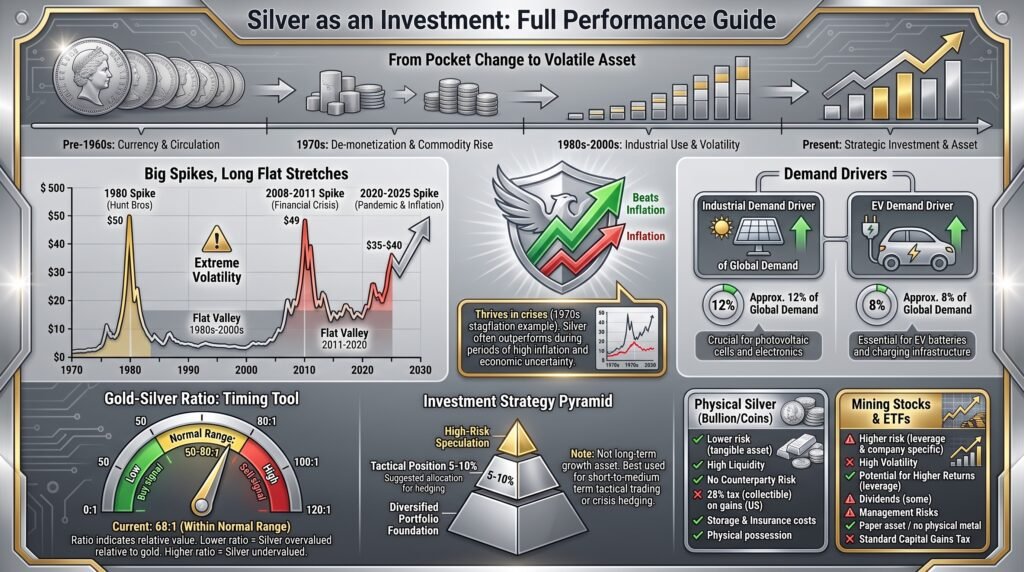
Silver has gone from pocket change to a volatile investment, with big spikes (1980, 2008-2011, 2020-2025) and long flat stretches. It has often beaten inflation and done well in crises like 1970s stagflation, and demand is now driven heavily by industrial uses like solar panels and EVs.
The gold-to-silver ratio (normally 50-80:1, currently about 68:1) can help with timing. Silver is closer to speculation than a long-term growth asset, so it works best as a small, tactical position for diversification. Mining stocks are riskier than physical silver, and physical silver is taxed as a collectible (up to 28%).
If you’re exploring how precious metals fit into your retirement strategy, Augusta Precious Metals has spent over a decade helping people navigate exactly these kinds of decisions, particularly when it comes to setting up silver IRAs the right way.
Visit Augusta’s official site and fill out their short contact form by clicking the button below.
Table of Contents
- Quick Summary
- Silver’s Wild Price History Tells a Story
- Does Silver Actually Protect You From Inflation?
- The Gold-to-Silver Ratio: Your Timing Tool
- Why Industrial Demand Is Reshaping Silver’s Future
- Is Silver a Long-Term Investment or Speculation?
- How Silver Performed During Past Financial Crises
- Silver’s Journey From Pocket Change to Portfolio Asset
- Gold vs. Silver: Picking Your Precious Metal Mix
- Frequently Asked Questions
Silver’s Wild Price History Tells a Story
Silver hasn’t always been the volatile investment vehicle it is today. For most of American history, it was quite literally pocket change, used in everyday transactions while gold sat in vaults reserved for the wealthy.
That changed dramatically once silver was demonetized, and its price history since then reads like a rollercoaster.
Understanding this history matters because it tells you what to expect. Silver doesn’t move in gentle, predictable waves. It spikes, crashes, and sometimes just sits there doing nothing for a decade at a time.
From Under $1 to $61.60: Silver’s Price Journey
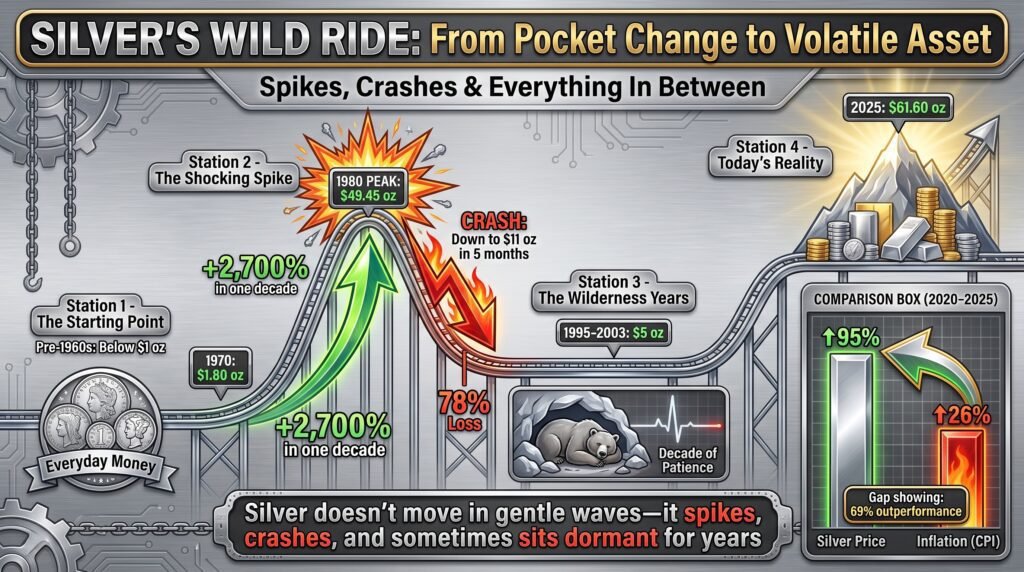
Until the 1960s, silver stayed below $1 per ounce. By the start of 1970, it had climbed to $1.80. Fast forward to today, and silver trades at $61.60 per ounce, a staggering climb that took decades of fits and starts to reach.
The 1/3 Rule: Splitting Between Gold, Silver, and Platinum
Another framework some investors use splits precious metals holdings into thirds: one-third in gold, with the remaining amount divided between silver and platinum. This approach spreads your precious metals exposure across multiple metals rather than concentrating entirely in one.
The 1980 Spike and Crash That Shocked Investors
Nothing illustrates silver’s volatility quite like 1980. Silver peaked at $49.45 per ounce that year, representing a 2,700% increase over the decade. Then it crashed to less than $11 within just five months.
Investors who bought at the top learned a hard lesson about chasing silver during a price spike, a mistake that still trips people up today.
From there, silver spent years in the wilderness. Prices languished around $5 per ounce from 1995 through the end of 2003, testing the patience of anyone holding the metal during that stretch.
Why 2020-2025 Became Silver’s Strongest Run
Silver’s average price rose roughly 95% from 2020 to 2025, while the Consumer Price Index climbed only about 26% during that same window. That gap matters.
It shows silver didn’t just keep pace with inflation; it significantly outran it, while inflation ate away at the dollar’s buying power at a much slower rate.
Does Silver Actually Protect You From Inflation?
This is the question every retiree wants answered before committing retirement savings to a metal that doesn’t pay interest or dividends. Silver’s track record suggests it can work as an inflation hedge, but the timing and context matter enormously.
Silver’s appeal as a hedge comes down to one simple idea: it tends to hold or increase its purchasing power when paper currency loses value.
Comparing Silver Gains to the Consumer Price Index
Between 2020 and 2025, silver’s roughly 95% price increase dwarfed the CPI’s 26% rise. For retirees worried about their savings losing value to inflation, that’s the kind of gap that gets attention. Silver didn’t just protect purchasing power during this stretch; it expanded it.
What Happened to Silver During 1970s Stagflation
The 1970s offer perhaps the clearest example of silver doing its job as an inflation hedge. During the stagflation of that decade, when inflation peaked above 13%, silver’s average annualized growth rate exceeded 30%. That’s not a coincidence.
Stagflation, which combines high inflation with stagnant economic growth, tends to be exactly the environment where precious metals shine while traditional stocks and bonds struggle.
The Gold-to-Silver Ratio: Your Timing Tool
If you’re trying to figure out whether now is a good time to buy silver, the gold-to-silver ratio gives you a concrete number to work with instead of guessing based on headlines.
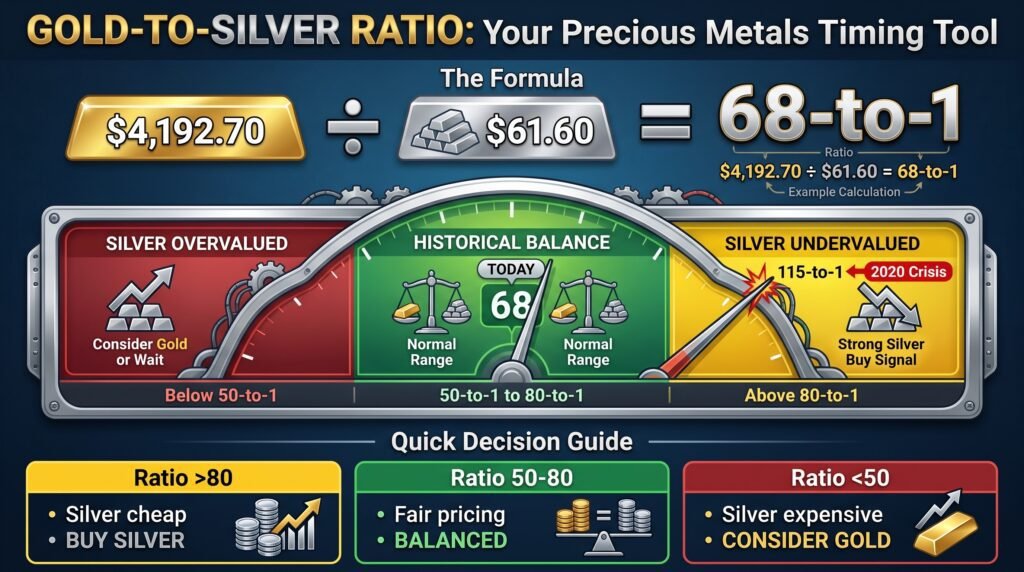
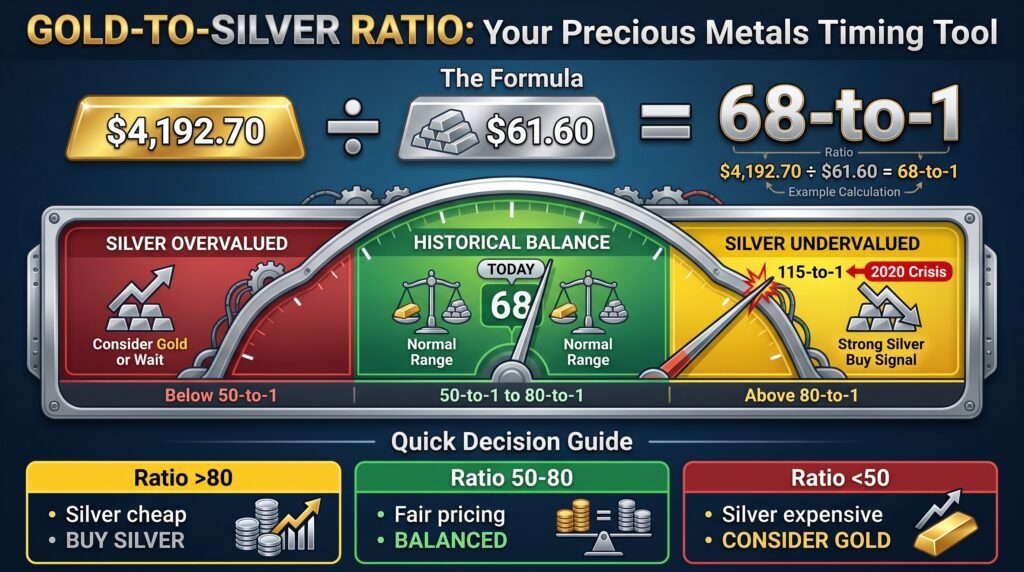
This ratio simply divides the price of gold by the price of silver, telling you how many ounces of silver it takes to buy one ounce of gold. It’s one of the oldest tools precious metals investors use to time their purchases.
What a Normal Ratio Looks Like (50-to-1 to 80-to-1)
Historically, the gold-to-silver ratio sits somewhere between 50-to-1 and 80-to-1. When the ratio falls within this range, it suggests both metals are priced roughly in line with their historical relationship to each other.
As of October 2026, with gold currently priced at $4,192.70 per ounce and silver at $61.60, the current ratio sits right around 68-to-1, comfortably within that normal historical band.
How the Ratio Hit 115-to-1 in 2020
Sometimes the ratio swings way outside its normal range, and 2020 gave us a perfect example. The gold-to-silver ratio grew to nearly 115-to-1 in early 2020, meaning silver was historically cheap compared to gold.
This kind of extreme reading tends to happen during moments of acute market stress, when investors flock to gold as the ultimate safe haven while silver, with its industrial demand component, gets temporarily left behind.
For investors watching the ratio, that 115-to-1 reading in 2020 would have signaled an unusually attractive entry point into silver relative to gold.
Using the Ratio to Decide When to Buy More Silver
The basic strategy here isn’t complicated. When the ratio runs high, above 80-to-1, it signals silver is relatively inexpensive and may be worth adding more of to your holdings.
When the ratio runs low, below 50-to-1, silver is relatively expensive, and you might lean toward gold instead or simply hold off on new silver purchases.
A ratio above 80 historically suggests silver is undervalued relative to gold. A ratio below 50 suggests silver is overvalued. Anywhere in between, the two metals are roughly in historical balance.
This isn’t a crystal ball, but it’s a far better decision-making tool than simply buying whenever silver makes headlines.
Tax-Advantaged Silver IRAs
If you’re serious about adding silver to your retirement portfolio in a tax-advantaged way, a silver IRA is the vehicle built specifically for that purpose. But the IRS has strict rules about what qualifies, and getting this wrong can trigger unexpected taxes and penalties.
A silver IRA works similarly to a traditional retirement account, except instead of holding stocks and bonds, it holds physical silver that meets specific IRS purity requirements. Setting one up correctly requires working with the right custodian and understanding exactly what silver products qualify.
This is an area where having an experienced partner matters enormously. Augusta Precious Metals and Birch Gold Group have built relationships with mints around the world specifically to help customers purchase IRA-eligible gold and silver coins directly from their producers, which helps ensure authenticity and compliance with IRS rules from day one.
Augusta Precious Metals is best for high-income earners, best pricing, & lifetime customer support. Birch Gold Group is known for low investment minimums, low fees, and established trust.
Receive a free gold information kit by filling out their short contact form when you click one or both of the banners below.

Why Industrial Demand Is Reshaping Silver’s Future
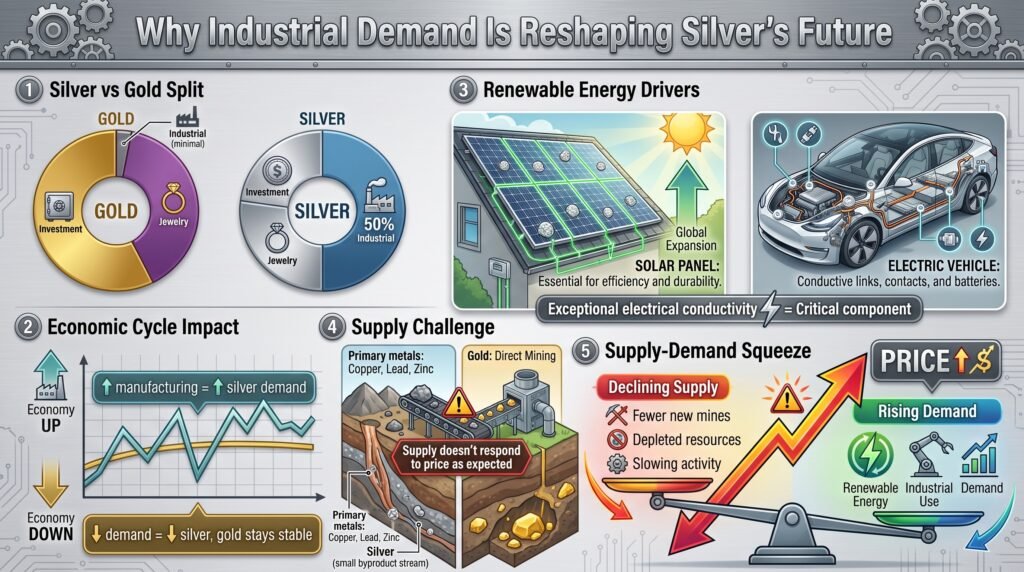
Here’s what separates silver from gold in a fundamental way: roughly half of all silver demand comes from industrial applications, not investment or jewelry. Gold sits in vaults and gets worn as jewelry. Silver gets used, consumed, and often never recovered, which creates a completely different demand dynamic.
This industrial component is exactly why silver’s price can behave unpredictably compared to gold. When the economy heats up and manufacturing increases, industrial silver demand climbs right alongside it.
When the economy slows, that same demand can dry up fast, pulling silver prices down even while gold holds steady as a safe haven.
Right now, the renewable energy movement has become one of the biggest tailwinds silver has ever seen. Solar panels and electric vehicle components both rely heavily on silver, and as the world continues shifting toward renewable energy, that demand isn’t going away anytime soon.
Solar Panels and Electric Vehicles Driving Demand
Every solar panel manufactured today contains silver, used for its exceptional electrical conductivity. As solar installations continue expanding globally, the silver required to manufacture those panels scales right alongside it.
Electric vehicles tell a similar story, with silver playing a critical role in various electrical components throughout the car.
This demand arrives at a particularly interesting moment for silver supply. Unlike gold, which gets mined specifically because it’s gold, a huge portion of silver comes as a byproduct of mining other metals like copper, lead, and zinc. That means silver supply doesn’t always respond to silver prices the way you’d expect.
Mining Supply Shortages You Should Watch
Silver demand is hitting the market at a time when silver is in genuinely short supply, largely because mining activity has slowed. Fewer new mines are coming online, and existing mines face the usual challenges of resource depletion over time.
For investors tracking silver’s long-term trajectory, this supply-demand imbalance is worth watching closely, since tightening supply combined with rising industrial demand tends to push prices upward over time.
Is Silver a Long-Term Investment or Speculation?
This question deserves an honest answer, and the honest answer is that silver sits closer to speculation than traditional long-term investment. That doesn’t mean it has no place in a retirement portfolio, but it does mean your expectations need to be calibrated correctly.
Silver shouldn’t be considered a long-term growth asset in the same way you might view a diversified stock portfolio held over several decades. It’s better understood as a tactical position, something you hold in a specific, limited amount for diversification and crisis protection rather than as your primary growth engine.
Why Silver Often Trades Flat for Years
Most of the time, and in most markets, silver trades in a very tight price range, essentially going flat for extended stretches. This happened for nearly a decade between 1995 and 2003, when prices hovered around $5 per ounce with little movement. If you buy silver expecting consistent year-over-year appreciation, that flat stretch can test your patience considerably.
Silver Mining and Streaming Companies Explained
Beyond direct mining stocks, silver streaming companies offer a different way to gain exposure. These companies provide upfront financing to mining operations, and in exchange, they’re paid back by being able to buy silver from their mining partners at well below the going market rate.
This model can provide more stable returns than direct mining stocks, since streaming companies aren’t directly exposed to the operational risks of running a mine.
That said, streaming company stocks can still underperform silver itself if their financing arrangements go sour or if the mining companies they’re connected to run into trouble.
How Silver Performed During Past Financial Crises
If there’s one argument in favor of holding a small silver position, it’s silver’s track record during genuine financial crises. While this doesn’t guarantee future performance, history offers some meaningful data points worth considering.
The 2008 Crash and Silver’s Five-Year Recovery Story
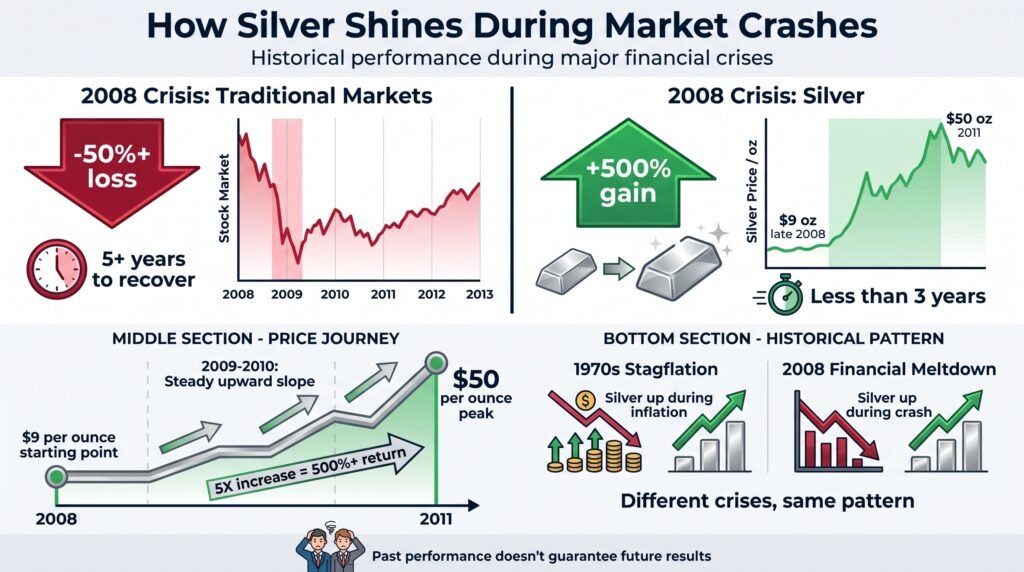
During the 2008 financial crisis, broader markets lost well over 50% of their value and took more than five years to regain their pre-crisis levels.
March – October 2008, Silver corrected downward, with markets from a peak of nearly $21 per ounce in March 2008 down to roughly $9 to $10 per ounce by October 2008—a correction of approximately 57%.
Late 2008 – 2011, in the years that followed, silver more than quintupled in price, climbing from less than $9 per ounce in late 2008 to nearly $50 per ounce by 2011.
That’s a return of 400-500% in less than three years, a performance that stands in sharp contrast to how long traditional stock portfolios needed just to recover their original value.
Why Silver Tends to Rise When Markets Struggle
Silver has built a genuine reputation for increasing in price as broader markets begin performing poorly. This pattern showed up clearly during the stagflation of the 1970s and again during the financial meltdown of 2008, two very different economic environments that nonetheless both favored silver.
Silver’s Journey From Pocket Change to Portfolio Asset
Silver’s relationship with money runs deeper than most people realize. For centuries, people used silver as actual currency in everyday transactions, while gold stayed largely in the hands of the wealthy as a store of value rather than a medium of exchange.
That dynamic shaped how silver gets treated even today, as something more accessible and more tied to practical use than gold.
That history took a sharp turn in the 1960s, and understanding what happened explains why silver behaves so differently from gold in modern markets.
How the Coinage Act of 1965 Changed Everything
Under the Coinage Act of 1965, the U.S. government withdrew silver from American coinage as the metal’s price began climbing. Up until that point, dimes, quarters, and half-dollars contained real silver content.
Once silver prices rose high enough that the metal in the coins became worth more than the coins’ face value, the government had no choice but to phase it out of everyday currency.
This single legislative decision marked silver’s transition from circulating money into something entirely different: an investment asset. After being demonetized, silver’s price rose, and it increasingly took on the characteristics of an investment rather than a currency.
Why Silver Is Called “The Poor Man’s Gold”
Silver earned the nickname “the poor man’s gold” precisely because of this historical accessibility. While gold required substantial wealth to accumulate meaningfully, silver’s lower price point made it something ordinary people could actually hold and use.
That nickname still shows up in investment circles today, reflecting silver’s lower barrier to entry compared to gold, even though silver has become far more of an industrial metal than a monetary one in recent decades.
Read more about how gold belongs in your portfolio for proper diversification, inflation hedging, and more here.
Find out whether a silver IRA is a good choice for your retirement needs. Access our Silver IRA calculator by clicking the banner below.

Gold vs. Silver: Picking Your Precious Metal Mix
Deciding between gold and silver isn’t really an either-or question for most retirees. It’s more a question of proportion, since both metals bring something different to a portfolio.
Why Central Banks Still Favor Gold
Gold has long been considered the more established investment metal, in large part because it still carries characteristics of a monetary asset. Major central banks around the world hold substantial gold reserves, a practice that reinforces gold’s reputation as the ultimate store of value during times of crisis.
Silver, by contrast, has become increasingly industrial over the past several decades. That shift means silver’s price gets influenced by factors gold rarely has to contend with, like solar panel manufacturing or electric vehicle production volumes.
How the Two Metals Move Together in Price
Generally speaking, gold and silver prices tend to rise and fall in tandem, since both respond to many of the same macroeconomic forces, including inflation expectations, currency strength, and investor demand for safe-haven assets.
That said, silver’s industrial component means it can diverge from gold’s movements at times, sometimes amplifying gold’s trend and sometimes lagging behind it. This is exactly why the gold-to-silver ratio becomes such a useful tool, since it captures those moments of divergence.
A silver and gold IRA is a tax-advantaged means of owning the physical metal without the need or liability of storing it in your own residence.
Augusta Precious Metals and Birch Gold Group have built relationships with mints around the world specifically to help customers purchase IRA-eligible gold and silver coins directly from their producers, which helps ensure authenticity and compliance with IRS rules from day one.
Receive a free gold information kit by filling out their short contact form when you click one or both of the banners below.
Birch Gold Group: Best Gold IRA for Established Trust & Low Fees
Augusta Precious Metals: Best Gold IRA for Prices & Customer Support
Frequently Asked Questions
Silver raises plenty of practical questions once you start considering it for your retirement portfolio. Here are the answers to the ones retirees ask most often.
These questions cover everything from allocation percentages to tax treatment, giving you a quick reference as you finalize your own silver strategy
Is silver a good hedge against inflation?
Silver has historically outpaced inflation during several key periods, including a roughly 95% price increase from 2020 to 2025 compared to a 26% rise in the Consumer Price Index. During the stagflation of the 1970s, silver’s average annualized growth rate exceeded 30% while inflation peaked above 13%.
That said, silver’s inflation-hedging performance isn’t guaranteed in every environment, since its industrial demand component can pull prices in a different direction than inflation alone would suggest.
What is the gold-to-silver ratio and why does it matter?
The gold-to-silver ratio measures how many ounces of silver it takes to equal the price of one ounce of gold. This ratio normally sits between 50-to-1 and 80-to-1, and readings outside that range can signal whether silver is relatively cheap or expensive compared to gold.
In early 2020, for example, the ratio climbed to nearly 115-to-1, signaling that silver was unusually inexpensive relative to gold at that moment.
Are silver mining stocks riskier than physical silver?
Yes, generally speaking. Mining stocks carry all the risks tied to silver’s price movements, plus additional company-specific risks that have nothing to do with silver itself.
Labor unrest and operational disruptions
Foreign government regulation or nationalization
Mine exhaustion or failed exploration efforts
Environmental catastrophes affecting operations
Physical silver avoids all these company-specific risks, which is why it’s generally considered the more conservative way to gain silver exposure.
How is silver taxed when I sell it?
If you sell physical silver at a gain after holding it for more than one year, you’ll owe capital gains taxes, which can run as high as 28% since silver is classified as a collectible. Silver held inside a properly structured precious metals IRA avoids this capital gains treatment, following standard IRA distribution tax rules instead.
What happens to silver prices during a recession?
Silver has a documented tendency to rise during periods of economic or financial instability, as seen during the 1970s stagflation and the 2008 financial crisis, when silver more than quintupled in price over the following years while broader markets took over five years to recover.
Figuring out your exact number doesn’t have to be a solo project. Augusta Precious Metals works with retirement investors every day to build precious metals strategies that match their specific timeline, income needs, and comfort with risk.
Get started with a tax-advantaged IRA with Augusta by clicking the banner below.

Sources:
How To Invest In Silver: 2026 Guide – Swiss America
*Disclaimer: This article is written for educational purposes and should not be interpreted as financial advice. We may receive compensation for referrals made through this article.
Leave a Reply