A follow-up to “A Historic Gold Price Revision? The Bond Market Is Sending a Message, and the US Treasury Is Listening”
Quick Summary: What Gold Price Would Back Today’s US Dollar? The 40% Rule?
The interest rate on America’s 10-year Treasury note has climbed to its highest level since 2002. Government bonds are not the most exciting topic, but that single number touches almost everything in your financial life.
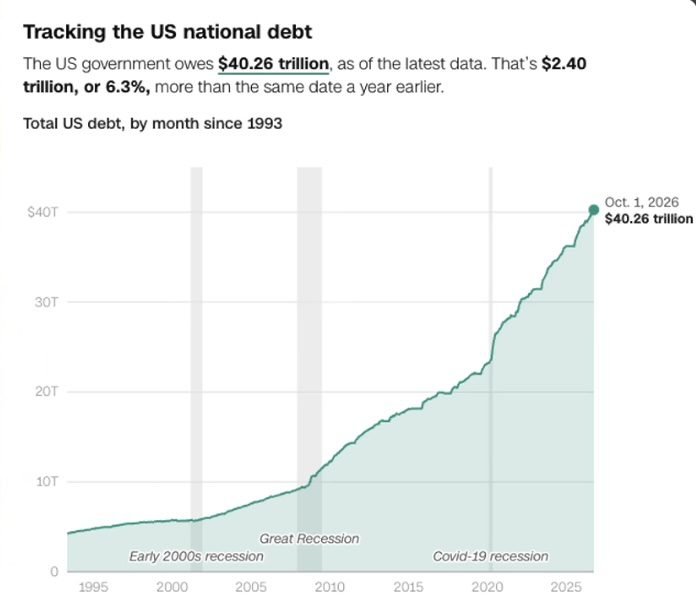
It influences mortgage rates, what businesses pay to borrow, how much Washington owes on its roughly $40 trillion of debt, and over time, what each dollar you own can buy.
The 24-year high isn’t even the strangest part. At the same moment, three other developments have emerged that are rarely discussed together:
- The President has openly said that inflation can help pay down the national debt.
- Central banks are buying gold even as bond yields rise.
- The Treasury has brought on Judy Shelton, an economist who has long argued for a bigger role for gold in the monetary system.
Taken separately, each looks like a headline. Taken together, they look more like a pattern. Let’s walk through it.
Table of Contents
- Quick Summary: What Gold Price Would Back Today’s US Dollar? The 40% Rule?
- A Quick Recap of the Original Argument
- Where the 40% Figure Comes From
- Gold Price Inputs and Results
- The Surprise: Paper Cash is Already Covered
- The Harder Tests
- What Revaluation Would and Wouldn’t Do for the Treasury
- The Trust Bond’s Gold Problem
- What to Watch
- The Bottom Line
- Frequently Asked Questions
A Quick Recap of the Original Argument
The earlier article rested on five observations. The 10-year Treasury yield has climbed to a 24-year high, which matters because the government has roughly $40 trillion in debt that must be rolled over at today’s higher rates.
Gold has held up despite rising yields, which is unusual, because higher yields normally make a non-yielding metal less attractive. Central banks appear to be the reason: they have been buying physical gold, citing geopolitical risk and government debt risk, and physical gold carries no counterparty risk.
Shelton’s best-known idea is a Treasury “trust bond,” a long-dated note, perhaps 50 years, that would let the holder choose repayment in dollars or in a fixed amount of gold.
And on the Treasury’s books, the national gold stock is still valued at the statutory $42.22 per ounce, which makes the entire hoard worth only about $11 billion.
That last point is the hinge for this article. The original noted that at market prices the same gold is worth closer to a trillion dollars, and it floated outside estimates of a revaluation price ranging from $5,000 to $100,000 per ounce.
Those figures came without a method. Here is one.
Where the 40% Figure Comes From
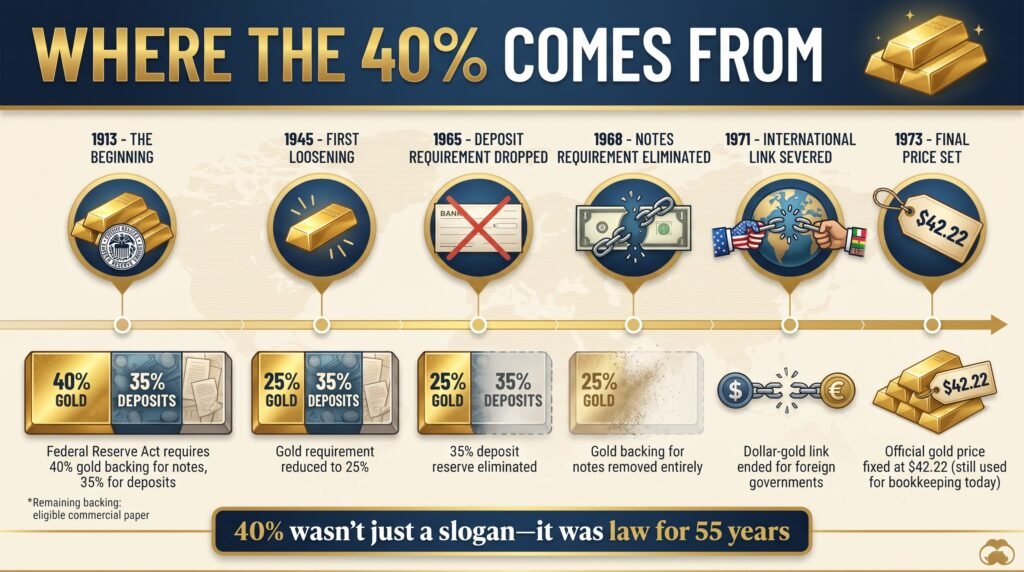
When the Federal Reserve Act passed in 1913, it required the Reserve Banks to hold gold equal to 40% of the Federal Reserve notes they issued, and a 35% reserve against deposits. The rest of the backing could be eligible commercial paper.
The ratio was loosened to 25% in 1945, the deposit requirement was dropped in 1965, and the requirement on notes was eliminated in 1968.
In 1971, the link between the dollar and gold was severed for foreign governments, and the official price was last changed in 1973, to the $42.22 we still use for bookkeeping.
So “40% gold backing” is a real piece of American monetary history, not a slogan. It is also a useful yardstick, because it lets us ask a concrete question: at what gold price would the U.S. gold stock cover 40% of the money in the system?
Gold Price Inputs and Results
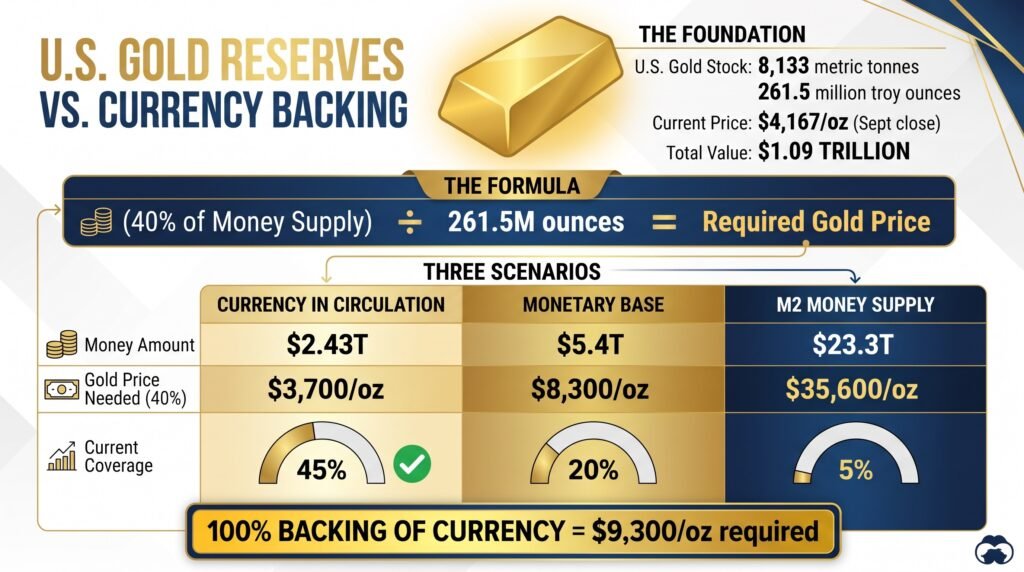
The calculation needs three things. The first is the gold stock: the U.S. holds about 8,133 metric tonnes, or roughly 261.5 million troy ounces.
The second is the price of gold. Spot gold has been trading in a band of roughly $4,100 to $4,200 an ounce in recent weeks, after closing September near $4,167. That values the stockpile at about $1.09 trillion.
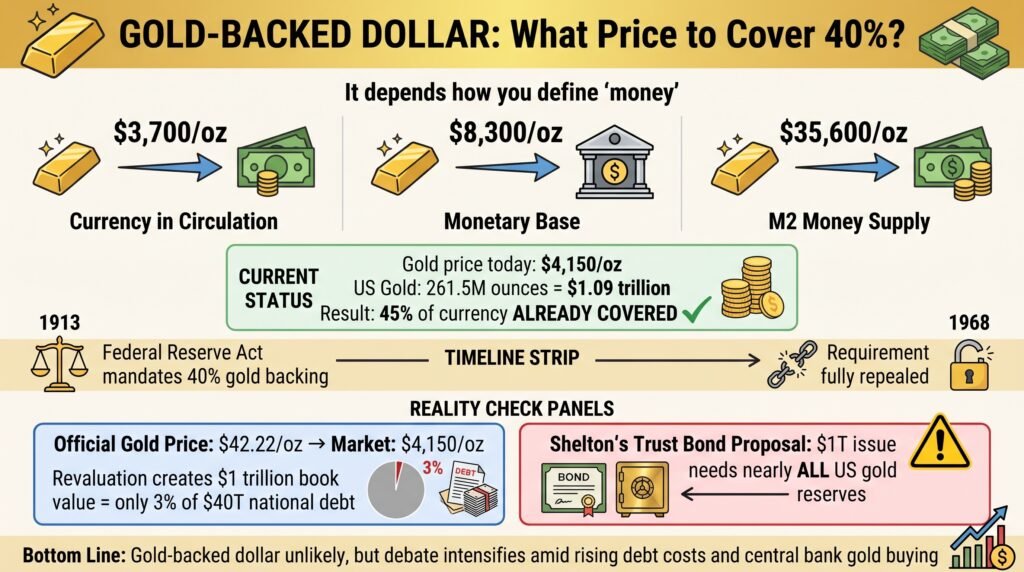
The third input is the one that does all the work: what counts as “the currency”? Three reasonable definitions, using the latest Federal Reserve data available, give very different answers:
- Currency in circulation (paper notes and coins): about $2.43 trillion.
- The monetary base (currency plus bank reserves held at the Fed): about $5.4 trillion.
- M2 (the broad money supply, including checking and savings deposits): about $23.3 trillion.
The formula is simple: required price equals 40% of the money supply, divided by 261.5 million ounces.

For comparison, backing currency in circulation 100% would take about $9,300 an ounce.
The Surprise: Paper Cash is Already Covered
The first row deserves a second look. At roughly $4,150 per ounce, the U.S. stock is already worth about 45% of the currency in circulation.
In other words, if the 1913 rule still applied to Federal Reserve notes, the country would comply today without any revaluation at all. The gold price would have to fall below about $3,700 before the 40% test failed.
That is a striking result, and it suggests something the original article hinted at but did not spell out: the 40% benchmark, applied to the thing it was originally written for, is no longer demanding.
What made the old standard binding was not the percentage but the scale of the money supply it had to cover. In 1913, notes were most of the money. Today they are a small slice of a financial system built on bank deposits, reserves, and credit.
The Harder Tests
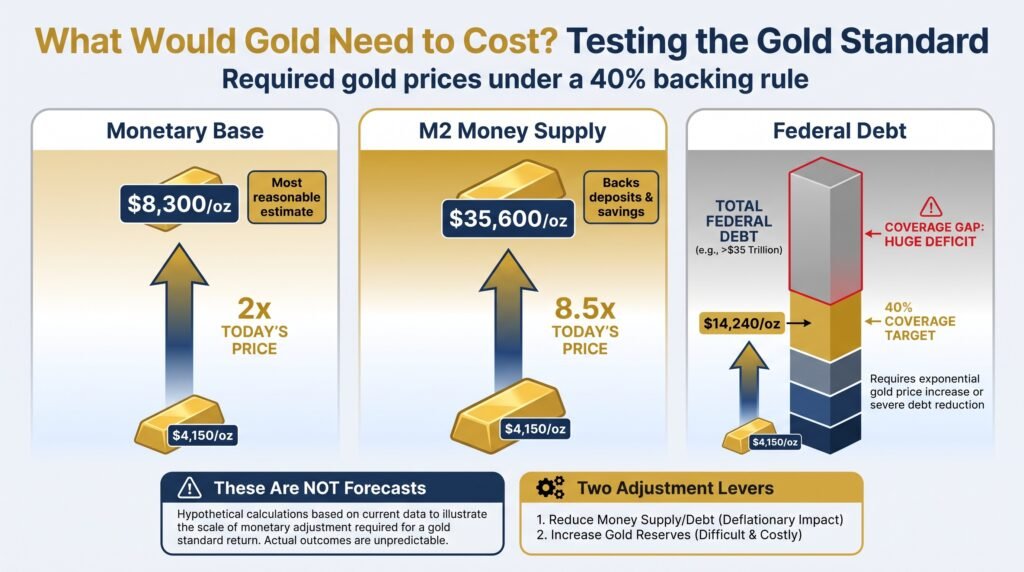
The monetary base is a fairer comparison for a modern system, because bank reserves are liabilities of the Fed just as notes are. It is also much larger than it was before 2008, when the Fed began expanding its balance sheet.
Covering 40% of it would take gold near $8,300, about double today’s price. That number falls squarely inside the $5,000-plus range of outside estimates the original article cited, and it is the figure most often implied when commentators talk about a “reasonable” revaluation.
The M2 figure, about $35,600, shows why the highest estimates, like $100,000, exist. They require the gold stock to back deposits and savings, and sometimes the nation’s debts as well.
Measured against $40 trillion of federal debt, the entire gold hoard at today’s price covers less than 3%. Even at $35,600 an ounce, it would cover only about a quarter of the debt.
Two cautions apply. First, these are accounting prices, not forecasts. Nothing in the math says gold must rise to $8,300 or $35,600; it says what a rigid 40% rule would require if the stock of gold stayed fixed.
Second, a gold standard has two adjustment levers, the price of gold and the quantity of money, and governments historically pulled whichever was less painful.
The quantity lever means contracting credit, which is why strict gold regimes have been associated with deflation and, in the 1930s, deepened downturns.
What Revaluation Would and Wouldn’t Do for the Treasury
The original article suggested that revaluing the gold at market prices could let Treasury “recognize hundreds of billions, perhaps trillions” of balance-sheet value. The mechanics deserve a clearer description.
The Treasury has historically issued gold certificates to the Federal Reserve in exchange for dollar credit, and those certificates are booked at the statutory price.
Mark them to $4,150, and the book value rises from about $11 billion to about $1.09 trillion, creating roughly $1.08 trillion of new Treasury deposit balances at the Fed.
That is meaningful, and it has precedent. In 1934, after the Gold Reserve Act raised the official price from $20.67 to $35, the Treasury booked the gain and used it to capitalize the Exchange Stabilization Fund and fund other operations.
But set it against the problem the original article described. A one-time credit of about $1.08 trillion is under 3% of a $40 trillion debt. The government’s interest costs, by recent estimates close to a trillion dollars a year, would absorb that windfall in roughly a year.
A revaluation is a bookkeeping event with real but limited fiscal value; it is not a debt solution by itself.
It also doesn’t create new gold. As the original piece put it, the U.S. didn’t acquire more gold, only the number attached to it changed.
The practical effect of a higher official price is a larger credit on paper, and, if the Fed monetizes it, more dollars in the system, which is exactly the inflationary channel that readers of the first article were told to watch.
The Trust Bond’s Gold Problem
Shelton’s trust bond is arguably more interesting than a revaluation, because it tries to use gold to lower the government’s borrowing costs rather than to fill a balance-sheet hole.
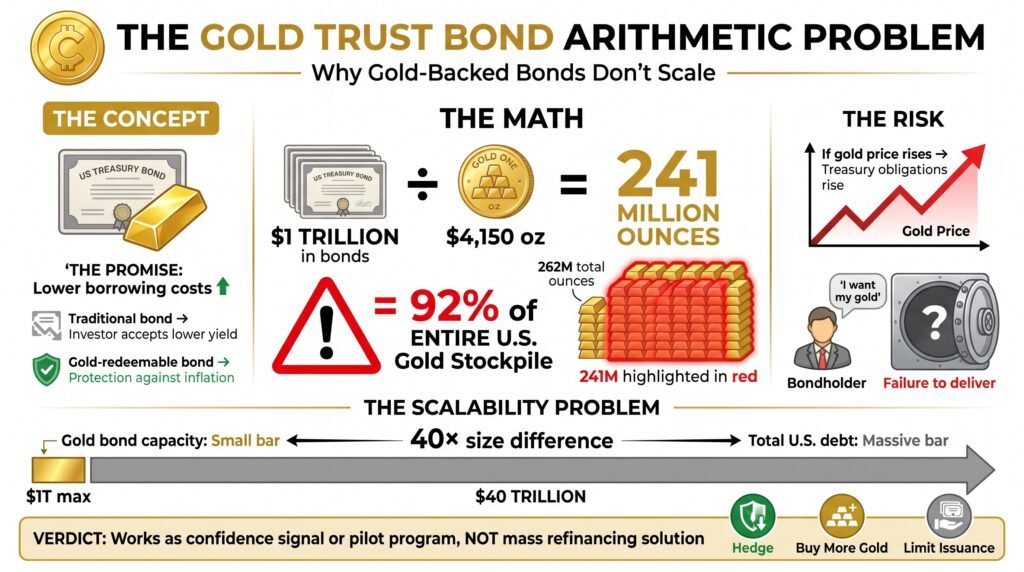
The logic: if investors can opt to be repaid in gold, they have protection against dollar erosion, so they might accept a lower yield. The Treasury effectively sells a piece of inflation insurance and gets paid for it in cheaper financing.
But the arithmetic is unforgiving. Imagine the Treasury issued $1 trillion of gold-redeemable bonds. At $4,150 an ounce, that is about 241 million ounces of gold exposure, nearly 92% of the entire federal stockpile.
If gold rose, the Treasury’s obligations would rise with it, and holders could demand gold the government may not have. Unless the Treasury hedged, bought more gold or limited issuance to a small tranche, the program would be capped at a tiny fraction of the debt.
It could be a confidence signal and a pilot, which matches the original article’s caution that nothing announced so far commits the country to such a bond. As a mass refinancing tool for $40 trillion, it may not scale.
What to Watch
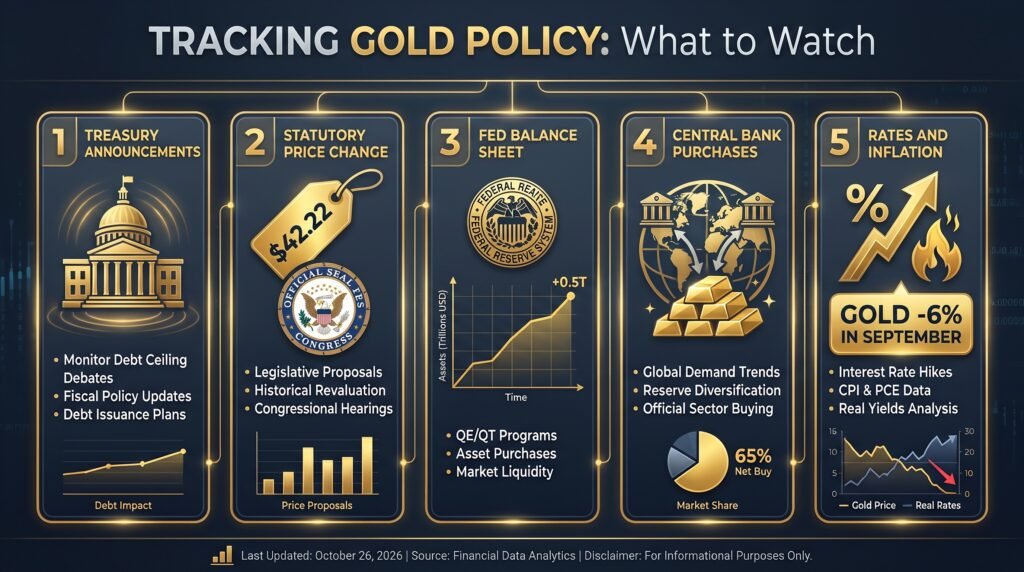
If you want to track whether any of this is turning from conversation into policy, a few markers matter more than the price of gold itself:
–Treasury announcements on gold-linked debt. A pilot trust bond, or even a formal study, would be the first concrete step beyond rhetoric.
–Any change to the $42.22 statutory price. That requires Congress, and it would be hard to do quietly.
–Fed communications on balance-sheet size. The monetary base is the number that determines how demanding any gold test would be.
–Central bank purchase data. Continued buying at the current pace supports the gold floor the first article described, whatever Washington does.
–Policy rates and inflation prints. Gold has been under pressure from rate-hike expectations, falling more than 6% in September, even as longer-term arguments for it hold.
Positioning Yourself: The Case for a Gold IRA
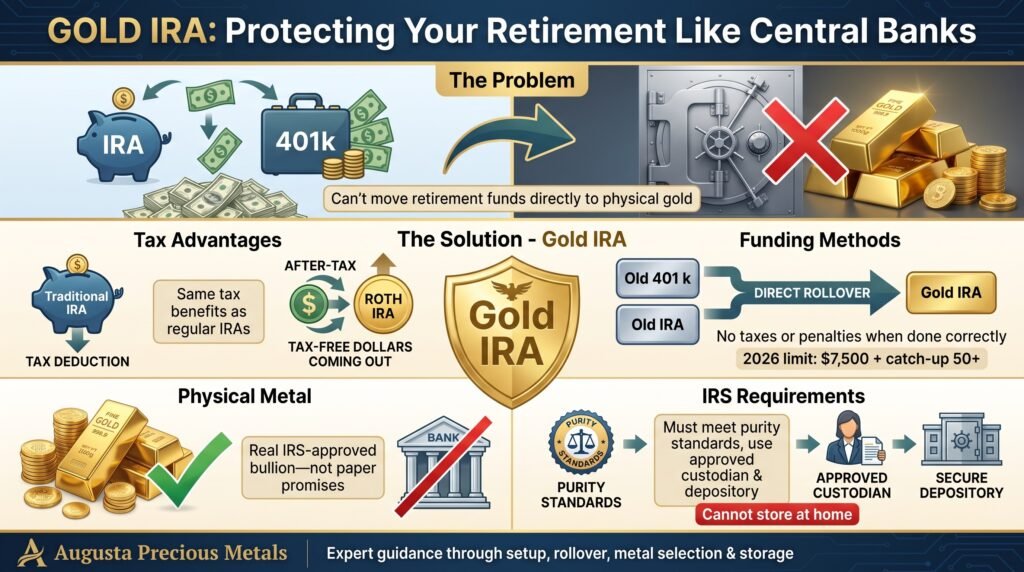
If central banks are hedging, individual savers can consider doing the same. The challenge for many people is that most of their wealth sits in retirement accounts, such as IRAs and 401(k)s, where it can’t simply be moved into a safe full of bullion. That is where a gold IRA comes in.
A gold IRA is a self-directed individual retirement account that holds physical precious metals instead of, or in addition to, traditional paper assets. It offers several features worth understanding:
Tax advantages. A gold IRA follows the same tax framework as other IRAs. In a traditional gold IRA, contributions may be tax-deductible, and growth is tax-deferred until withdrawal. In a Roth gold IRA, you contribute after-tax dollars and qualified withdrawals can be tax-free. Either way, you gain exposure to physical metal without the immediate tax hit you could face if you simply sold other investments to buy gold.
Rollovers and transfers. Many savers fund a gold IRA by rolling over or transferring funds from an existing IRA or an old 401(k), such as one from a former employer. When done correctly as a direct rollover, this generally doesn’t trigger taxes or penalties.
For direct contributions, ordinary annual IRA limits apply (for 2026, $7,500, with an additional catch-up contribution for those 50 and older).
Physical metal, outside the banking system. Unlike gold-focused funds or mining stocks, a gold IRA holds actual IRS-approved bullion and coins. There is no counterparty promising to deliver value, which is the same quality that appeals to central banks.
IRS rules to know. The metals must meet IRS purity standards, and they must be held by an approved custodian and stored in an approved depository. You can’t keep IRA metals at home. A qualified provider helps you navigate these requirements so mistakes don’t trigger penalties.

Where Augusta Precious Metals Fits
Setting up a gold IRA involves several moving parts: choosing a self-directed IRA custodian, completing the rollover paperwork, selecting eligible metals, and arranging secure storage. That is where a specialist can help.
Augusta Precious Metals is a precious metals firm that helps individuals open and fund tax-advantaged gold and silver IRAs and walks them through each of those steps.
Their approach emphasizes education, so that you understand what you’re buying, what it costs, and how it fits into your overall retirement picture before you commit. Augusta is one of the leading gold investing companies for trust, customer empowerment, and prices.

If you already hold some gold and silver and want a second opinion on whether you’re positioned properly, Augusta can review your situation.
If you hold none and your savings are concentrated in dollar-denominated assets, a conversation about a gold IRA is a reasonable first step toward building a plan that covers both the present and whatever comes after a possible reset or revaluation.
Click the banner below to receive a free gold IRA integrity checklist from their official site. Fill out their short contact form to get started.

The Bottom Line
The answer to “what would gold have to be worth?” is not one number but three. Covering 40% of paper currency takes about $3,700 an ounce, a threshold the market has already cleared.
Covering 40% of the monetary base takes about $8,300.
Covering 40% of M2 takes about $35,600, and that still wouldn’t come close to the national debt.
The $5,000 to $100,000 range cited in the original article is therefore not as arbitrary as it first appears. It spans the plausible definitions of what a gold-backed dollar would back. What it doesn’t tell us is whether Washington wants to go there.
A revaluation would deliver a one-time credit of around a trillion dollars, helpful but small against the debt. A gold-linked bond could lower financing costs but is limited by the size of the gold stock.
And a true gold standard would trade the flexibility the Treasury and the Fed currently depend on for discipline they have not shown an appetite for.
The more productive question for investors, then, isn’t whether the United States will return to gold at $8,300. It is whether the forces behind the debate- high debt, high yields, and central banks hedging against paper promises- will keep supporting gold on their own.
That is a market question, not a monetary-regime question, and it deserves a position sized to your circumstances and advice from a licensed professional rather than a headline.

Frequently Asked Questions
What gold price would be needed to back the dollar 40%?
It depends on what you count as money. Backing currency in circulation (about $2.43 trillion) takes roughly $3,700 an ounce.
The monetary base (about $5.4 trillion) takes about $8,300, and M2 (about $23.3 trillion) takes about $35,600.
Why is 40% the benchmark?
The 1913 Federal Reserve Act required the Reserve Banks to hold gold equal to 40% of the Federal Reserve notes they issued. The ratio fell to 25% in 1945, and the requirement on notes was eliminated in 1968.
How much gold does the U.S. hold?
About 8,133 metric tonnes, or roughly 261.5 million troy ounces. At around $4,150 an ounce, that is worth about $1.09 trillion.
What is the $42.22 official gold price?
It is the statutory price at which the Treasury still carries its gold on the books, last set in 1973. At that price, the whole stockpile is worth only about $11 billion, far below its market value.
Would revaluing U.S. gold pay off the national debt?
No. Marking the gold to market would create roughly $1 trillion in book value, under 3% of the $40 trillion debt. Annual interest costs could absorb that windfall in about a year.
What is Judy Shelton’s “trust bond”?
It is a proposed long-dated Treasury note, possibly 50 years, that would let the holder choose repayment in dollars or in a fixed amount of gold. Investors might accept a lower yield in exchange for that protection.
Could a gold-linked bond refinance the debt?
Probably not at scale. A $1 trillion issue at current prices would represent about 241 million ounces of gold exposure, nearly 92% of the U.S. stockpile.
Does this mean gold will reach $8,300 or $35,600?
No. These are accounting thresholds for a rigid 40% rule, not forecasts. Nothing announced so far commits the U.S. to a gold standard or a revaluation.
Click the right banner for your individual needs. Fill out their short contact form on their site to get started.
This article is for educational purposes only and is not financial advice. Calculations use approximate U.S. gold holdings of 261.5 million troy ounces and recent Federal Reserve money-supply data; figures are rounded and will change.
*Disclaimer: This article is written for educational purposes and should not be interpreted as financial advice. We may receive compensation for referrals made through this article.
Leave a Reply