Category: Uncategorized

  • TSP to Gold IRA Rollover for Federal Employees (Complete Guide)

    TSP to Gold IRA Rollover for Federal Employees (Complete Guide)

    How to Roll Your 401(k) Into Gold Without Paying Penalties

    Quick Summary

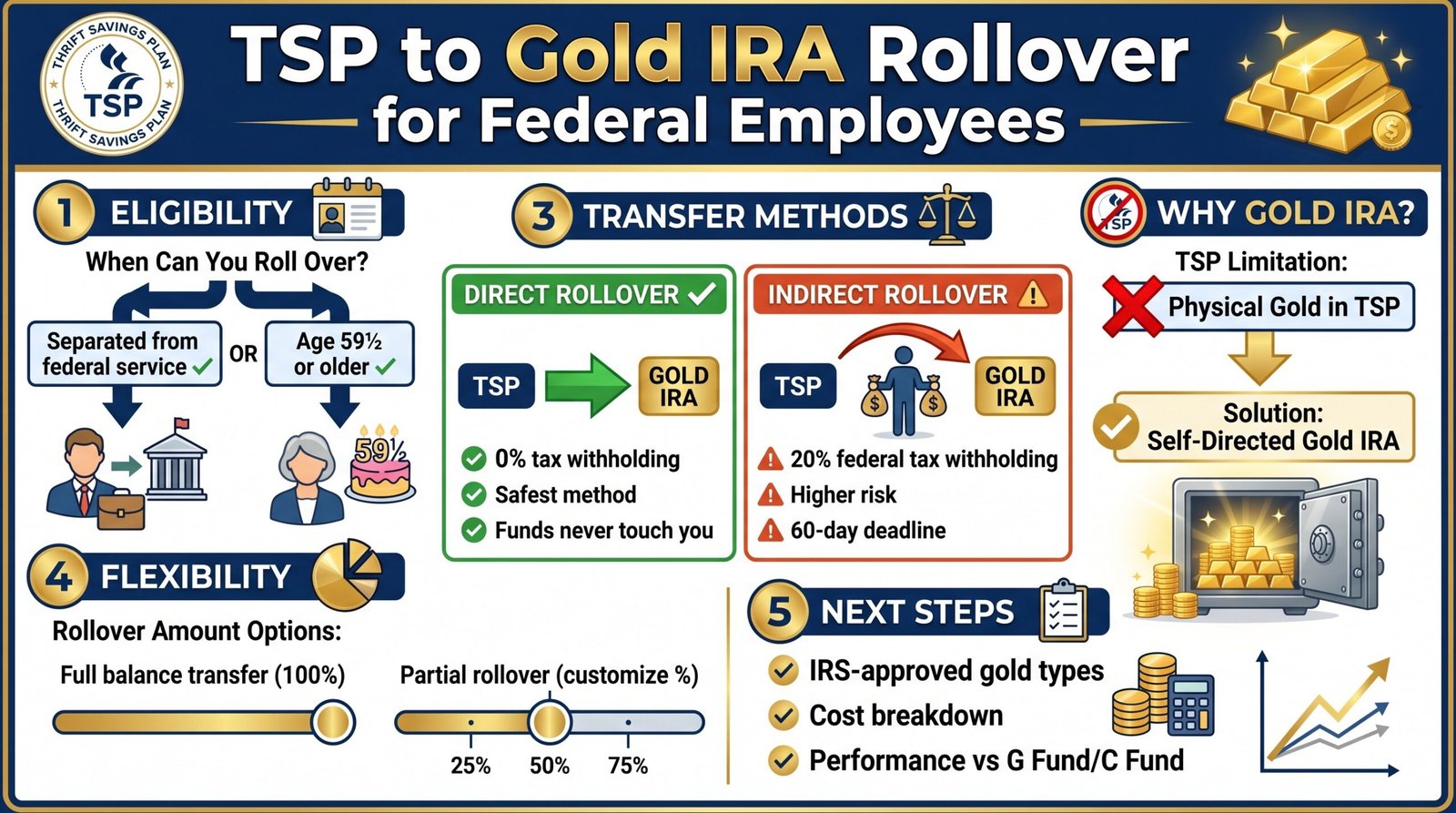
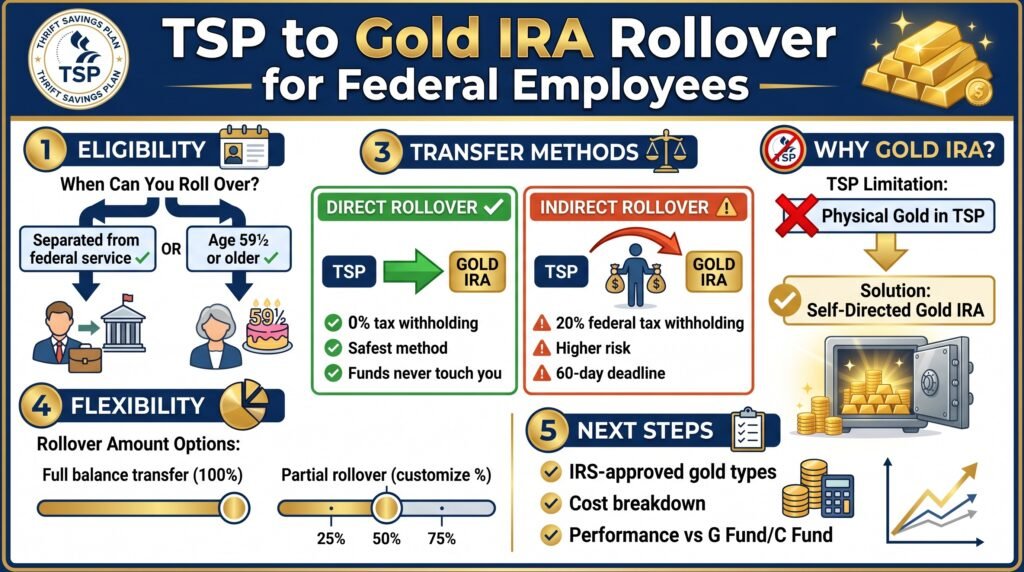
    1. Federal employees and uniformed service members can roll over TSP funds into a Gold IRA, but only after separating from service or reaching age 59½.
    2. The TSP does not allow direct investment in physical gold; a self-directed IRA is the only way to hold precious metals in a federally tax-advantaged retirement account.
    3. A direct rollover is the safest transfer method, avoiding the 20% federal tax withholding that hits indirect rollovers.
    4. You don’t have to move your entire TSP balance; partial rollovers are allowed, giving you flexibility to diversify without going all in.
    5. Keep reading to find out which IRS-approved gold coins and bars qualify, how much a Gold IRA costs, and how gold stacks up against the TSP’s G Fund and C Fund.

    Table of Contents

    1. Quick Summary
    2. Federal Employees Can Move TSP Funds to Gold: Here’s What You Need to Know First
    3. TSP Rollover vs. TSP Transfer: The Difference Matters
    4. How to Convert Your TSP to a Gold IRA in 5 Steps
    5. Costs Involved in a TSP to Gold IRA Transfer
    6. Tax Implications of Rolling Over a TSP to a Gold IRA
    7. Your TSP Retirement Savings Deserve More Than One Option
    8. Frequently Asked Questions

    Federal Employees Can Move TSP Funds to

    Your TSP has been quietly growing for years, but it only offers a handful of fund options, none of which include physical gold. For federal employees looking to hedge against inflation or diversify beyond stock and bond funds, a TSP-to-Gold IRA transfer opens a door most government workers don’t even know exists.

    For people beginning their gold investment research, professional guidance is necessary to take the initial steps.

    Augusta Precious Metals specializes in helping federal employees navigate this exact process, breaking down the rules, costs, and steps involved in moving TSP funds into IRS-compliant precious metals accounts.

    Who Is Eligible to Roll Over a TSP to a Gold IRA

    Not every federal employee can initiate a TSP rollover at will. Eligibility hinges on two key conditions: you must have either separated from federal service or reached age 59½ while still employed. Once either condition is met, you’re eligible to roll over all or part of your TSP balance into a self-directed Gold IRA.

    Members of the uniformed services follow the same rules. If you’re still actively employed and under 59½, an in-service withdrawal may be limited, so timing your rollover matters.

    Why the TSP Cannot Hold Physical Gold Directly

    The Thrift Savings Plan is a government-sponsored defined contribution plan with a fixed menu of investment funds: the G, F, C, S, I, and L Funds. Physical commodities like gold bullion are simply not on that menu. Even indirect exposure through gold mining company stocks is not permitted within TSP fund structures. The TSP is built for simplicity, not alternative assets.

    What a Self-Directed Gold IRA Actually Is

    A self-directed IRA (SDIRA) is a type of individual retirement account that allows you to hold alternative assets, including physical gold, silver, platinum, and palladium, that standard IRAs won’t touch. The IRS permits this structure under specific rules, and it requires a specialized custodian who is approved to manage these asset types.

    Unlike a brokerage IRA where the custodian controls your investment options, an SDIRA puts the investment decisions in your hands, within IRS guidelines. That means you choose which IRS-approved metals to buy, and those metals are stored in an IRS-approved depository, not your home.

    • Holds physical gold, silver, platinum, and palladium
    • Requires an IRS-approved custodian to manage the account
    • Metals must be stored at an approved third-party depository
    • Follows all traditional IRA contribution and distribution rules

    TSP funds can be rolled into this structure tax-free via a direct rollover.

    TSP Rollover vs. TSP Transfer: The Difference Matters

    The terms “rollover” and “transfer” get used interchangeably, but they describe two different processes with very different tax consequences. Understanding the distinction before you move a single dollar out of your TSP can save you from an unexpected tax bill.

    Direct Rollover: The Safest Way to Move TSP Funds

    In a direct rollover, your TSP funds move directly from the TSP to your new Gold IRA custodian; you never touch the money. Because the funds go institution to institution, the IRS does not treat this as a taxable distribution. No withholding, no penalties, no 60-day clock. This is the method most Gold IRA companies will recommend, and for good reason.

    The paperwork involved is straightforward. You’ll work with your Gold IRA custodian to complete the transfer request, and the custodian coordinates with the TSP on your behalf. The entire process typically takes up to two weeks from initiation to when your Gold IRA is funded and ready for metal purchases.

    Indirect Rollover: The 60-Day Rule and Tax Risks

    An indirect rollover means the TSP sends the funds directly to you, and you then have 60 days to deposit them into your Gold IRA. The problem is that the TSP is required to withhold 20% for federal income tax the moment it cuts that check. To complete a full rollover and avoid taxes and penalties, you must deposit 100% of the original amount, including the 20% that was withheld, into your new account within 60 days. That means coming up with the withheld portion out of pocket.

    Miss the 60-day window and the entire distribution becomes taxable income for that year, plus a 10% early withdrawal penalty if you’re under age 59½. The indirect rollover route is rarely worth the risk when a direct rollover is available.
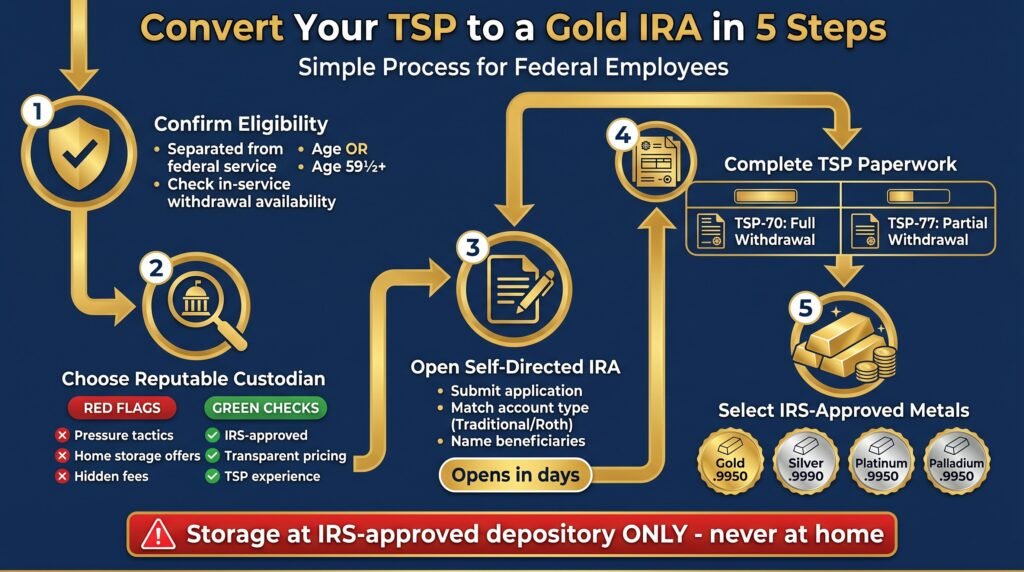
    How to Convert Your TSP to a Gold IRA in 5 Steps

    The process is more straightforward than most federal employees expect. Here’s exactly how it works from start to finish.

    1. Confirm Your Eligibility to Withdraw From the TSP

    Before anything else, verify that you meet the eligibility requirements. You must have separated from federal service or be at or above age 59½. If you’re still employed and under 59½, check whether your agency allows in-service withdrawals; these are limited and not always available.

    2. Choose a Reputable Gold IRA Custodian

    This is the most important decision in the entire process. Your Gold IRA custodian is the IRS-approved entity that will hold your account, coordinate the transfer, and facilitate metal purchases. Look for custodians with verifiable track records, transparent fee structures, and experience specifically working with federal employees on TSP rollovers.

    Be cautious of any company that pressures you to act fast, pushes numismatic or collectible coins with inflated markups, or is vague about storage arrangements and fees. Legitimate custodians never need to rush you. Avoid companies that suggest storing your Gold IRA metals at home; home storage of IRA-owned gold is not IRS-compliant and can result in full account disqualification.

    Augusta Precious Metals is a leading and established gold IRA company that helps investors navigate the Gold IRA process, providing a combination of an ethics-centered approach to empower the customer, the best prices, superb customer service, and expert educational resources.

    Click the banner below to visit Augusta’s official site and receive a free gold IRA company integrity checklist. Fill out their short form to get started.

    Free Gold IRA Guide
    Free Gold IRA Guide

    3. Open Your Self-Directed IRA Account

    Once you’ve selected a company, you’ll complete their account application to establish the self-directed IRA. This includes providing identification, selecting a traditional gold IRA structure that matches your TSP account type, and designating beneficiaries. Most custodians can get an account opened within a few business days.

    4. Complete Form TSP-70 or TSP-77 to Initiate the Rollover

    This is where the official TSP paperwork comes in. Form TSP-70 is used for a full withdrawal of your TSP balance, while Form TSP-77 covers partial withdrawals. Your Gold IRA custodian will typically help you complete these forms correctly; an error here can delay the transfer or trigger unintended tax consequences.

    5. Select and Purchase IRS-Approved Precious Metals

    With your Gold IRA funded, you can now direct your custodian to purchase IRS-approved precious metals on your behalf. You don’t physically buy the gold yourself; you instruct your custodian which metals to acquire, and they execute the purchase and arrange for storage at an approved depository. Your options go beyond just gold and include silver, platinum, and palladium, all subject to IRS purity requirements.

    • Gold bullion bars and coins meeting .9950 minimum purity
    • Silver bullion bars and coins meeting .9990 minimum purity
    • Platinum and palladium products meeting .9950 minimum purity
    • IRS-approved coins such as the American Gold Eagle and Canadian Gold Maple Leaf
    • Storage arranged at an IRS-approved depository, not at home

    You are not required to invest your entire rollover into gold. Many federal employees use this stage to build a diversified mix of metals based on their risk tolerance and retirement timeline.

    Once the metals are purchased and transferred to the depository, your Gold IRA is fully operational. From this point forward, the account functions like any other traditional IRA for tax and distribution purposes.

    Costs Involved in a TSP to Gold IRA Transfer

    A Gold IRA is not a free account to maintain. Unlike a TSP, which has some of the lowest administrative fees of any retirement plan in the country, a Gold IRA involves multiple cost layers that you need to understand before committing.

    The good news is that fee structures vary significantly between providers, and some companies offer zero-fee arrangements specifically designed for federal employees making TSP rollovers. Comparing total cost of ownership, not just the setup fee, is essential before choosing a custodian.

    Setup Fees, Annual Maintenance, and Storage Fees

    Most Gold IRA custodians charge a one-time account setup fee ranging from $50 to $150. On top of that, there’s typically an annual maintenance fee between $75 and $300 per year depending on the provider. The third cost layer, and often the largest, is the storage fee charged by the depository holding your physical metals.

    Segregated storage (where your metals are stored separately from other clients’ holdings) costs more than commingled storage, typically ranging from $100 to $150 per year or a small percentage of your account’s total value.

    Zero-Fee Gold IRA Options for Federal Employees

    Some Gold IRA companies offer fee waivers for government workers rolling over TSP funds, covering setup costs, annual maintenance, and sometimes even the first year of storage fees. These offers are worth investigating closely; read the terms to confirm what’s included and for how long, since some waivers only apply for the first year before standard fees resume.

    Learn if your TSP account qualifies for certain fee waivers. Click the banner below to visit Augusta’s official site, receive a free gold IRA company guide, and get the process started. Fill out their short form to get started.

    Free Gold IRA Kit
    Tax Implications of Rolling Over a TSP to a Gold IRA
    Tax Implications of Rolling Over a TSP to a Gold IRA

    Tax Implications of Rolling Over a TSP to a Gold IRA

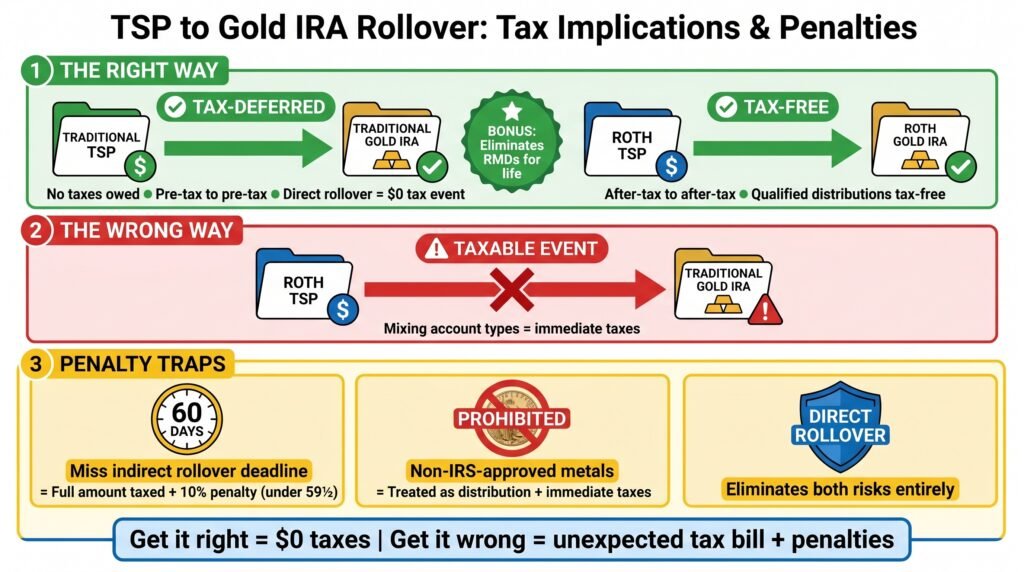
    Tax treatment during a TSP to Gold IRA transfer depends entirely on how the rollover is executed and which account types are involved. Get this part right, and the transfer is completely tax-neutral. Get it wrong, and you could face an unexpected tax bill plus penalties.

    Traditional TSP to Traditional Gold IRA: Tax-Deferred Transfer

    When you roll a traditional TSP directly into a traditional Gold IRA, the transfer is completely tax-deferred, meaning no taxes are owed at the time of the transfer.

    Both accounts operate on the same pre-tax basis: contributions went in before taxes, growth compounds tax-deferred, and distributions in retirement are taxed as ordinary income. As long as you execute a direct rollover, the IRS sees no taxable event, and your full balance moves into the Gold IRA intact.

    Roth TSP to Roth Gold IRA: What Changes

    A Roth TSP rollover to a Roth Gold IRA follows the same tax-free logic; contributions were already made with after-tax dollars, so qualified distributions in retirement remain tax-free. The key is making sure you’re rolling Roth to Roth. Mixing account types, such as rolling a Roth TSP into a traditional Gold IRA, creates a taxable event that most federal employees want to avoid entirely.

    One important detail: Roth IRAs do not have required minimum distributions (RMDs) during the account holder’s lifetime, while the Roth TSP does. Rolling a Roth TSP into a Roth Gold IRA can actually eliminate your RMD obligation on those funds, which is a meaningful long-term tax planning advantage worth discussing with a financial advisor.

    Penalties to Avoid During the Rollover Process

    The two biggest penalty traps in a TSP to Gold IRA transfer are missing the 60-day window on an indirect rollover and rolling funds into a non-qualifying account type. A failed rollover results in the full distributed amount being treated as taxable income for that year, plus a 10% early withdrawal penalty if you’re under age 59½.

    Using a direct rollover eliminates both risks. Additionally, purchasing non-IRS-approved metals inside your Gold IRA, such as collectible coins, is treated as a distribution in the year of purchase, triggering immediate taxes on the full value of those assets.

    Your TSP Retirement Savings Deserve More Than One Option

    The TSP is one of the best employer-sponsored retirement plans available, low fees, consistent fund options, and decades of reliable performance for federal employees. But having all your retirement assets in a single plan with no exposure to hard assets is a concentration risk, especially during periods of inflation, dollar weakness, or prolonged market downturns. A TSP to Gold IRA transfer isn’t about abandoning your TSP; it’s about building a more complete retirement strategy that the TSP alone was never designed to provide.

    Physical gold has preserved wealth through currency crises, recessions, and geopolitical instability for thousands of years. Adding even a measured allocation through a properly structured Gold IRA can give federal employees a layer of portfolio protection that no TSP fund- not the G Fund, not the C Fund- is built to deliver. You’ve spent a career building your retirement security. Protecting it with more than one tool is simply smart planning. Get the process started of rolling over your TSP account today.

    Click the banner below to visit Augusta’s official site and receive a free gold IRA company guide. Fill out their short form to get started.

    Frequently Asked Questions

    Below are the most common questions federal employees ask when researching a TSP to Gold IRA transfer. The answers are based on current IRS guidelines and TSP regulations.

    Can I Roll Over My TSP to a Gold IRA While Still Employed?

    Generally, no, unless you are age 59½ or older. Federal employees under 59½ who are still actively employed cannot initiate a full TSP rollover to an external IRA. Once you reach 59½, an in-service withdrawal becomes available, giving you the ability to roll over TSP funds into a Gold IRA without separating from service. If you’ve already separated from federal employment at any age, you are eligible to initiate the rollover regardless of age, though the 10% early withdrawal penalty may apply if you’re under 59½ and use an indirect rollover incorrectly.

    How Long Does a TSP to Gold IRA Transfer Take?
    The typical timeline from initiating the paperwork to having your Gold IRA fully funded is up to two weeks. The exact duration depends on how quickly your forms are processed by the TSP and how efficiently your Gold IRA custodian handles the incoming transfer.

    Delays can occur if forms are completed incorrectly or if additional verification is required by the TSP. Working with a Gold IRA company that has direct experience handling TSP transfers reduces the chance of paperwork errors that slow the process down.

    Once the metals are purchased, they are transferred directly to your designated IRS-approved depository. You will receive confirmation of both the purchase and the storage arrangement from your custodian.

    Do I Have to Roll Over My Entire TSP Balance?

    No. Partial rollovers are fully permitted. Using Form TSP-77, you can specify exactly how much of your TSP balance you want to transfer to your Gold IRA while leaving the remainder in your TSP funds. This gives federal employees the flexibility to diversify into gold without fully exiting the TSP, a strategy that makes practical sense for those who want to maintain exposure to the C Fund or other TSP options while adding a hard asset allocation.

    Is Physical Gold Stored at Home Allowed in a Gold IRA?

    No, and this is a critical point. IRS rules require that all physical metals held inside an IRA be stored at an IRS-approved depository. Taking personal possession of Gold IRA metals, including storing them at home or in a personal safe, is treated by the IRS as a distribution. That means the full value of the metals becomes taxable income in the year you take possession, plus the 10% early withdrawal penalty if you’re under 59½. Any company suggesting home storage as a valid Gold IRA strategy is either misinformed or deliberately misleading you.

    Will I Owe Taxes When I Move My TSP to a Gold IRA?

    No taxes are owed when a TSP is rolled over directly into a Gold IRA of the same account type, traditional to traditional, or Roth to Roth. A direct rollover is a trustee-to-trustee transfer where the funds never pass through your hands, so the IRS does not classify it as a taxable distribution.

    Taxes only become a factor if you choose an indirect rollover, miss the 60-day reinvestment window, roll funds into the wrong account type, or purchase non-IRS-approved assets inside your Gold IRA. All of these scenarios are avoidable with proper planning and the right custodian guiding the process.

    If you have a mix of traditional and Roth TSP funds, work with your Gold IRA provider to ensure each portion rolls into the correct corresponding account type. Mismatching account types during a rollover creates a taxable event that cannot be reversed after the fact.

    For federal employees ready to explore diversifying their retirement with physical precious metals, Augusta Precious Metals provides step-by-step guidance on TSP rollovers, custodian selection, and IRS-compliant precious metals investing tailored specifically for government workers and uniformed service members.

    Investment Minimums – Personal Considerations

    Certain IRA companies have higher investment minimums than others. If you are a serious investor with a minimum of $50,000, you can take advantage of Augusta Precious Metals’ higher competitive prices, life-long customer service, and educational resources.

    If you require a lower barrier to entry, both National Gold Group and Birch Gold Group are trustworthy companies that provide a $10,000 investment minimum.

    National Gold Group provides exceptional price transparency and reliable buyback commitment. Birch Gold Group is one of the most established and trusted gold IRA companies, spanning over 20 years, and provides some of the lowest fees in the industry.

    Decide which gold IRA company works for you by clicking the banners below and accessing their free gold IRA guide. Fill out their short contact form to get started.

    Birch Gold Group: Best Gold IRA for Established Trust & Low Fees

    National Gold Group Review

    National Gold Group: Best Gold IRA for Transparency & Buyback

    Sources:

    Gold IRA Rules and Regulations: LendEDU

    Gold IRA storage rules: IRS requirements for storing precious metals: Yahoo!Finance

    Investments in collectibles in individually directed qualified plan accounts: IRS.gov: Retirement plans FAQs regarding IRAs: IRS.gov

    Transform Your TSP into a Secure Gold Investment – FedPilot

    Gold IRA storage rules: IRS requirements for storing precious metals: Yahoo!Finance
  • Gold IRA Scams in 2026 – Red Flags + How to Protect Your Retirement

    Gold IRA Scams in 2026 – Red Flags + How to Protect Your Retirement

    How to Roll Your 401(k) Into Gold Without Paying Penalties

    Quick Summary

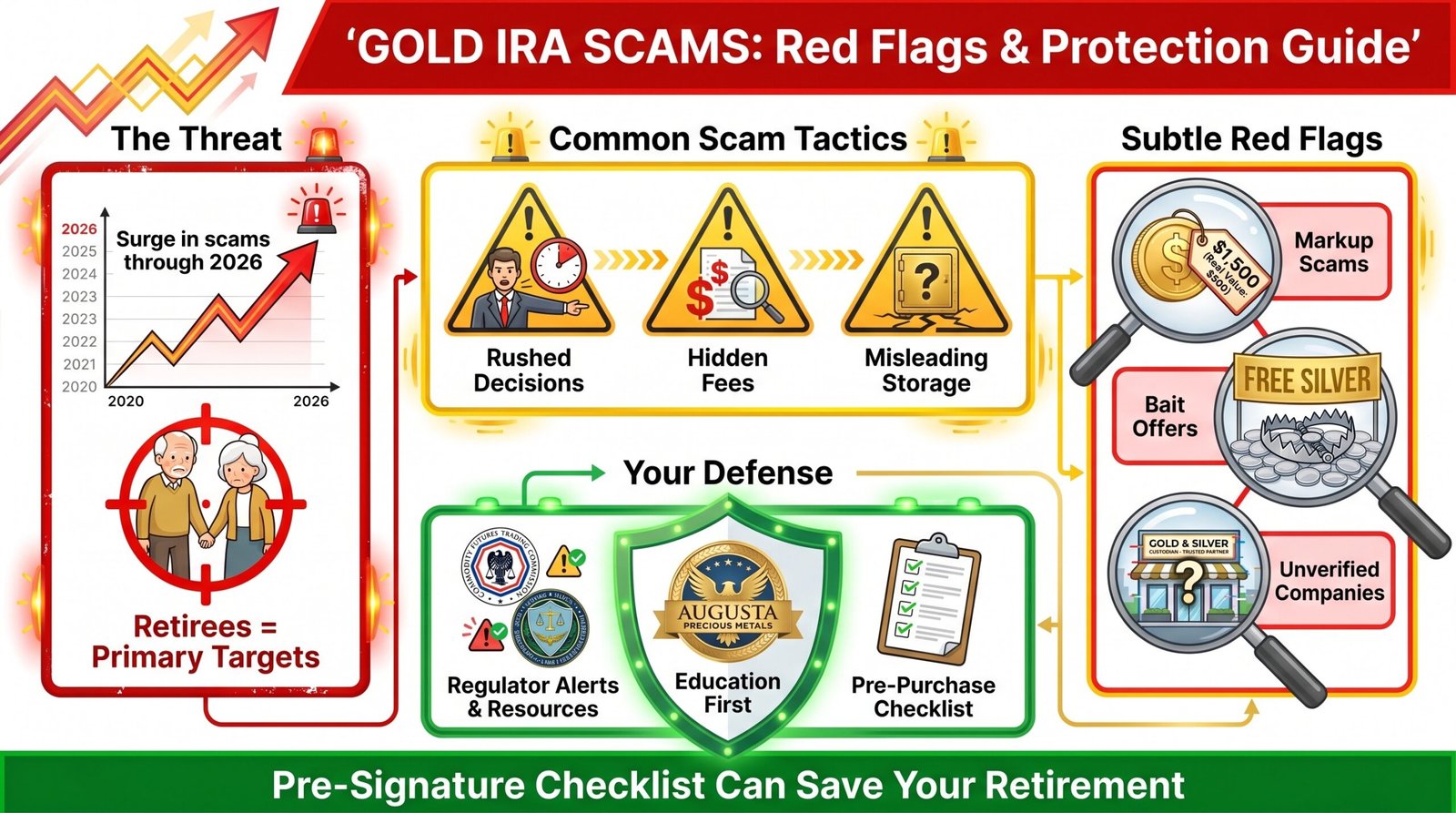
    1. Gold IRA scams are surging in 2026, with retirees being the primary targets of high-pressure tactics, hidden fees, and misleading storage arrangements.
    2. The most dangerous scams are subtle: inflated coin markups, fake “free silver” deals, and unverified custodians that look completely legitimate on the surface.
    3. Augusta Precious Metals is one of the few gold IRA companies that actively educates investors on how to identify and avoid fraud before they commit a single dollar.
    4. The CFTC and FTC have both issued warnings about precious metals fraud; knowing what regulators say can be your first line of defense.
    5. There is a specific checklist you can use before signing anything that could save your retirement from a scam, covered in detail below.

    Table of Contents

    1. Quick Summary
    2. Gold IRA Scams Are Draining Retirements Right Now
    3. What Is a Gold IRA Scam?
    4. The Most Common Gold IRA Scams and Red Flags in 2026
    5. Verify a Gold IRA Company Is Legitimate Through Consumer Advocate Sites
    6. How to Protect Your Retirement from Gold IRA Fraud
    7. A Scam-Free Gold IRA Is Possible: Here Is How to Get Started
    8. Frequently Asked Questions

    Gold IRA Scams Are Draining Retirements Right Now

    The surge in gold’s popularity as a retirement hedge has made the gold IRA space one of the most targeted sectors for financial fraud in 2025 and 2026.

    As more Americans look to protect their savings from inflation and market volatility, bad actors have flooded the space with deceptive companies, misleading claims, and outright theft disguised as investment advice. The appeal of gold is real, but so is the danger of choosing the wrong company to help you get there.

    If you are researching gold IRAs, Augusta Precious Metals has put together a free scam protection resource here that breaks down exactly what to watch for; it is one of the most thorough investor education tools available in the industry right now.

    Why Retirees Are the #1 Target

    Retirees represent the most targeted demographic in gold IRA fraud for one straightforward reason: they have accumulated savings. A person approaching or in retirement often has significant assets in a 401(k) or traditional IRA that can be rolled over, and scammers know exactly how to exploit that transition period. The rollover process involves multiple steps, unfamiliar terminology, and new service providers, which creates the perfect window for manipulation.

    Beyond the money, many retirees are less familiar with how precious metals pricing works. Scammers take advantage of this by presenting inflated markups as “standard industry pricing” or steering investors toward obscure collectible coins with enormous dealer margins. The emotional weight of retirement security also makes people more susceptible; fear of economic collapse and inflation anxiety are powerful psychological levers that dishonest dealers pull constantly.

    What the CFTC and FTC Say About Precious Metals Fraud in 2024–2026

    The Commodity Futures Trading Commission (CFTC) has explicitly warned consumers about precious metals fraud, specifically calling out schemes where dealers charge excessive markups, misrepresent storage arrangements, or claim gold is being held on behalf of investors when it is not. The CFTC notes that in many cases, the metals are never actually purchased; investors pay for gold that simply does not exist.

    The Federal Trade Commission (FTC) has similarly flagged high-pressure precious metals sales as a recurring category of consumer complaints. Both agencies emphasize that legitimate dealers will never rush you into a decision, hide their fee structures, or discourage you from seeking independent advice. If any of those behaviors appear during your research process, treat them as serious warning signs, not minor inconveniences.

    What Is a Gold IRA Scam?
    What Is a Gold IRA Scam?

    What Is a Gold IRA Scam?

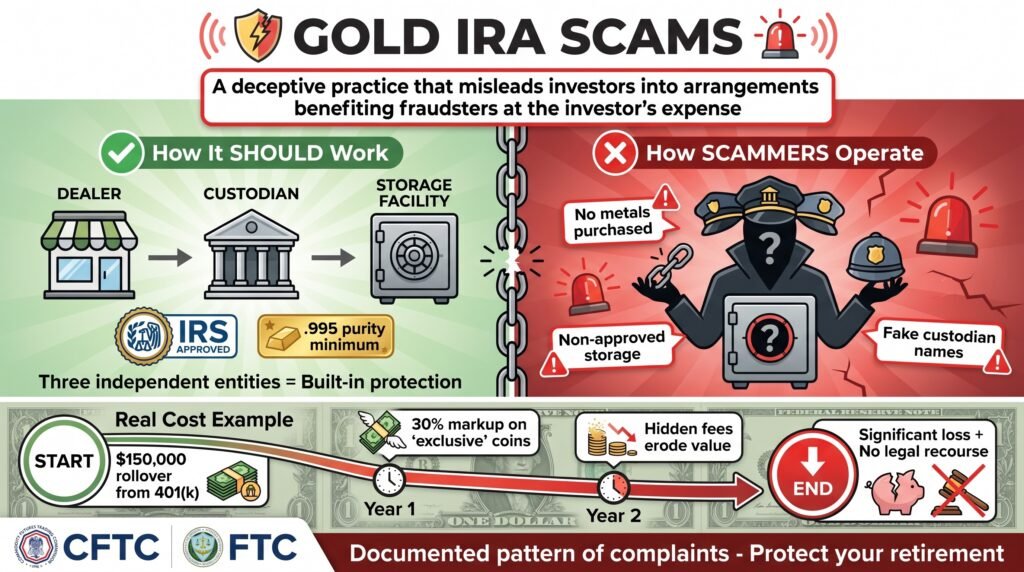
    A gold IRA scam is any deceptive practice by a dealer, custodian, or promoter that misleads an investor into a gold IRA arrangement that benefits the fraudster at the investor’s expense. To any beginning gold investor, this can be a challenge to identify.

    How Legitimate Gold IRAs Work

    A legitimate gold IRA is an IRS-recognized self-directed individual retirement account that holds physical precious metals instead of, or alongside, traditional paper assets. To be IRS-compliant, the gold must meet a minimum purity standard of .995 fineness for bars and .9999 fineness for most coins.

    The metals must be stored in an IRS-approved depository, not at home or in a personal safe. A qualified custodian, not the dealer, is legally responsible for managing the account. The process typically involves three separate entities: a dealer, a custodian, and a storage facility.

    Where Scammers Hijack the Process

    The multi-step nature of a gold IRA is exactly where fraud enters. Dishonest companies blur the lines between these roles, sometimes acting as dealer, custodian, and storage provider simultaneously, which removes the checks and balances that protect investors.

    Others use legitimate-sounding custodian names without formal agreements, or direct your metals to non-approved storage facilities while collecting ongoing storage fees. Some never purchase the metals at all.

    The Hidden Cost of Getting It Wrong

    Real-world example: An investor rolls over $150,000 from a 401(k) into a gold IRA. The dealer charges a 30% markup on “exclusive” coins instead of standard bullion, adds undisclosed annual fees, and stores the metals in a non-IRS-approved facility.

    Within two years, the effective value of the account, accounting for inflated purchase prices and fee erosion, is worth significantly less than a comparable investment in standard gold bullion through a transparent dealer. The investor has no easy legal recourse because they signed an agreement they did not fully understand.

    This scenario is not hypothetical. It reflects the pattern of complaints documented by the CFTC, FTC, and consumer advocacy organizations. The damage is financial, but also emotional; many victims are people who were simply trying to secure their retirement and trusted the wrong company.

    The Most Common Gold IRA Scams and Red Flags in 2026

    These are not edge cases. Each of the following scam types has been documented in regulatory complaints and consumer reports, and several are actively in use right now.

    1. Unrealistic Return Promises

    No one can guarantee gold will increase in value. Full stop. Any dealer that promises specific returns, guarantees price appreciation, or presents gold as a “risk-free” investment is either uninformed or deliberately misleading you. Gold’s value fluctuates with global markets, and while it has historically served as an inflation hedge over long periods, it is not a guaranteed growth vehicle. The moment a sales rep promises you a specific return percentage, end the conversation.

    2. “Free Silver” Promotions With Hidden Strings

    This is one of the most widely used bait-and-switch tactics in the gold IRA industry. A company offers “free” silver coins as a bonus when you open an account, but the cost of that silver is quietly built into inflated markups on your gold purchase. You are not receiving anything free. You are paying an above-market price for gold to subsidize the “gift.” In some cases, the spread between what you pay and the actual spot price of gold is large enough to immediately put your account at a significant loss.

    Always ask for the total cost breakdown, including the spot price of gold, the dealer markup, and any applicable fees, before accepting any promotional offer. A trustworthy company will give you this information without hesitation. For more tips on avoiding scams, visit this guide on gold IRA scams.

    3. Obscure Coin Pushing Instead of Standard Bullion

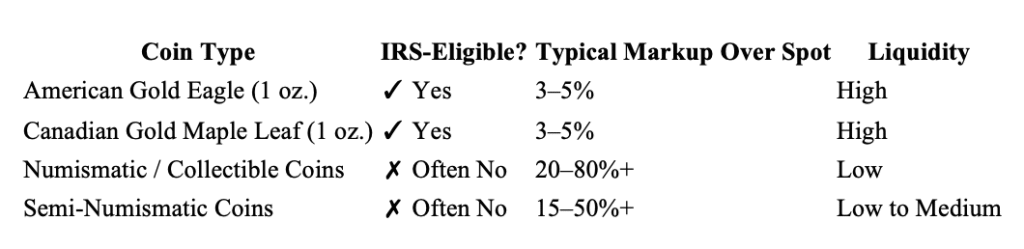
    Some dealers aggressively promote “numismatic” or “semi-numismatic” coins, collectible coins whose value is tied to rarity and condition rather than metal content alone.

    These are sold with dramatically higher markups than standard IRS-approved bullion like the American Gold Eagle or Canadian Gold Maple Leaf. Dealers profit enormously from this, while investors end up with coins that are harder to liquidate, harder to price, and often do not qualify for IRA inclusion under IRS rules.

    If a dealer pushes you toward coins you have never heard of while downplaying standard bullion options, that is a serious red flag. Stick with IRS-approved products and ask for the exact purity and eligibility confirmation in writing.

    4. Misleading Storage Arrangements

    IRS rules require that gold held in an IRA be stored in an approved depository, not at home, not in a bank safe deposit box, and not in any facility the dealer controls. Some dealers either misrepresent where metals are stored, charge fees for storage in facilities that are not IRS-compliant, or worse, collect storage fees while the metals are commingled or unaccounted for.

    There have been documented cases where investors discovered their metals were never segregated from other investors’ holdings, making recovery in the event of company insolvency extremely complicated.

    5. High-Pressure Sales Tactics

    Legitimate gold IRA companies do not need to rush you. If a sales representative tells you that a price is “only good for today,” warns you that economic collapse is imminent unless you act immediately, or calls you repeatedly after an initial inquiry, you are being manipulated, not advised.

    High-pressure tactics are specifically designed to prevent you from doing independent research, consulting a financial advisor, or simply taking the time to think clearly. That urgency is manufactured, and it should immediately disqualify the company from your consideration.

    Augusta Precious Metals is an established precious metals provider that helps investors navigate the Gold IRA process, offering IRS-approved coins and bars, along with educational resources for beginners just getting started with precious metals retirement planning.

    Click the banner below to visit Augusta’s official site and receive a free gold IRA company integrity checklist. Fill out their short form to get started.

    gold ira scam
    gold ira scam

    Verify a Gold IRA Company Is Legitimate Through Consumer Advocate Sites

    Verification is not complicated, but it does require taking a few deliberate steps that most investors skip because a sales pitch made them feel comfortable. Comfort is not the same as safety. Here is how to confirm a company is actually legitimate before you hand over a single dollar.

    Check BBB, Trustpilot, and Google Reviews

    Start with the Better Business Bureau (BBB). Look not just at the rating but at the nature of the complaints: fee disputes, failure to deliver metals, and poor communication are recurring themes in complaints against fraudulent dealers. A company with an A+ BBB rating and hundreds of verified customer reviews is meaningfully different from one with a high rating but only a handful of reviews that all appeared within a short time window.

    Trustpilot and Google Reviews provide additional layers of independent feedback. Look for patterns rather than individual opinions. Consistent mentions of transparent pricing, no-pressure sales, and reliable delivery are good indicators. Consistent complaints about unexpected fees, pushy representatives, or difficulty liquidating metals are serious red flags, regardless of how polished the company’s website looks.

    How to Protect Your Retirement From Gold IRA Fraud
    How to Protect Your Retirement From Gold IRA Fraud

    How to Protect Your Retirement from Gold IRA Fraud

    Protection starts with preparation. The investors who get scammed are not naïve; they are simply investors who trusted without verifying. Building a simple, repeatable verification process into your research eliminates the vast majority of fraud risk before it can affect you.

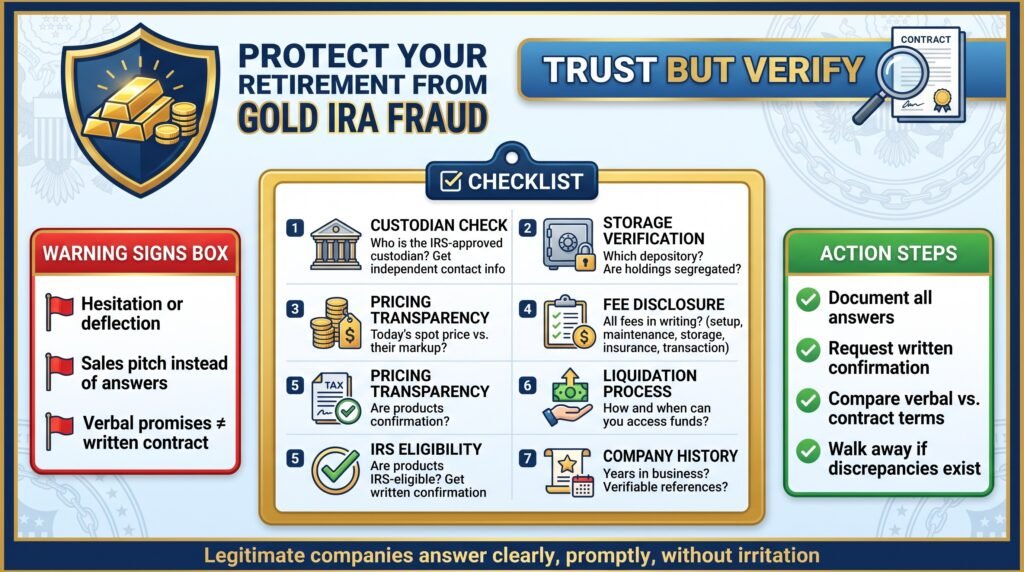
    Questions to Ask Any Gold IRA Company Before Investing

    Before committing to any gold IRA provider, run through the following questions directly with their representative. Their answers, and their willingness to answer, will tell you more than any marketing material ever could.

    Gold IRA Company Vetting Questions:

    What is the full name of the IRS-approved custodian managing my account, and how can I contact them independently?

    Which IRS-approved depository will my metals be stored in, and will my holdings be segregated from other investors’ metals?

    What is the exact spot price of gold today, and what is your markup above that price for the products you are recommending?

    Are all fees: setup, annual maintenance, storage, insurance, and transaction, disclosed in writing before I sign anything?

    Are the specific coins or bars you are recommending IRS-eligible for a self-directed IRA? Can you provide that confirmation in writing?

    What is the process and timeline for liquidating my metals if I need to access funds?

    How long has your company been operating, and can you provide verifiable references or independent reviews?

    A legitimate company will answer every one of these questions clearly, promptly, and without irritation. Any hesitation, deflection, or attempt to redirect you to a sales pitch instead of a direct answer is a warning sign you should not ignore.

    Document the answers you receive. Write them down during the call or ask for written confirmation via email. If a company’s verbal answers do not match what appears in their contract, walk away immediately; discrepancies between what a representative says and what appears in writing are one of the most reliable indicators of a fraudulent operation.

    See Augusta Precious Metal’s full gold IRA company integrity checklist by clicking the banner below. Fill out their short contact form to get started.

    A Scam-Free Gold IRA Is Possible: Here Is How to Get Started

    A gold IRA is a legitimate, IRS-recognized retirement tool that can genuinely serve as a hedge against inflation and market volatility; the key is choosing the right partner to help you set it up.

    Start by downloading a free scam protection checklist, verify every company you consider against the criteria outlined in this article, and never allow urgency or pressure to replace deliberate, informed decision-making. Your retirement deserves the same due diligence you would apply to any major financial decision, and with the right process, a secure gold IRA is absolutely achievable.

    Frequently Asked Questions

    What is a gold IRA scam and how does it work?

    A gold IRA scam is any deceptive practice by a dealer, promoter, or custodian that misleads an investor into a gold IRA arrangement designed to benefit the fraudster rather than the investor. Common mechanisms include inflated markups on non-standard coins, fabricated custodian relationships, misleading storage claims, hidden fee structures, and high-pressure sales tactics that prevent informed decision-making.

    The scam typically begins with aggressive outreach, a phone call, online ad, or mailer targeting retirees with messaging about economic instability and the safety of gold. Once contact is made, a high-pressure sales process begins that emphasizes urgency, fear, and trust-building rather than transparent information.

    The investor is steered toward overpriced products, often numismatic or semi-numismatic coins with markups of 20–80% above spot price, under the guise of “exclusive” or “collector-grade” investments. The investor may not discover the true cost until years later, when attempting to liquidate and finding the market value of their holdings is a fraction of what they paid.

    In the most severe cases, the metals are never purchased at all. The investor pays storage fees, maintenance fees, and annual custodial fees for years, for gold that does not exist. These cases have been prosecuted under federal fraud statutes, but recovery is often partial at best and requires protracted legal action.

    What does the CFTC warn about gold IRA investing?

    The Commodity Futures Trading Commission has issued specific consumer alerts about precious metals fraud, warning investors about dealers who charge excessive markups, misrepresent the storage and ownership of metals, or outright fail to purchase the metals investors have paid for. The CFTC notes that some fraudulent dealers use elaborate documentation, including fake storage receipts and account statements, to create the illusion that metals are being held on the investor’s behalf when they are not.

    The CFTC also warns against dealers who use retirement account rollovers as an entry point for fraud, specifically targeting investors in the transition between employer-sponsored plans and self-directed IRAs. Their guidance consistently emphasizes the same protective steps: verify the custodian independently, confirm storage arrangements through a third party, and never allow a dealer to control both the sale and the custody of your metals. Their full consumer advisory is publicly available at cftc.gov and is worth reading before you begin any gold IRA research.

    What should I do if I think I have been targeted by a gold IRA scam?

    If you suspect you are being targeted, even if you have not yet invested, the first step is to stop all communication with the company until you have independently verified their credentials. Do not provide personal financial information, Social Security numbers, or IRA account details to any company you have not thoroughly verified. Save all communications, emails, call recordings if permitted in your state, mailings, and any contracts you have been sent. These records are valuable if you later need to file a complaint or pursue legal action.

    If you have already transferred funds or begun a rollover, contact your original IRA custodian or 401(k) plan administrator immediately to understand what stage the transfer is at and whether it can be paused or reversed. Simultaneously, file complaints with the FTC at ReportFraud.ftc.gov, the CFTC at cftc.gov/complaint, and your state attorney general’s consumer protection division. The Internet Crime Complaint Center (IC3) at ic3.gov also accepts complaints related to online investment fraud.

    Consulting a securities attorney who specializes in investment fraud is one of the most important steps you can take, and many work on a contingency basis for verified fraud cases, meaning you may not need to pay upfront. Acting quickly matters: some legal remedies and regulatory complaint windows have time limitations, and the faster you engage the process, the better your chances of recovering assets or preventing further harm to other investors who may be targeted by the same company.

    Gold IRA Investment Guide
    Gold IRA Investment Guide

    Investment Minimums – Personal Considerations

    Certain IRA companies have higher investment minimums than others. If you are a serious investor with a minimum of $50,000, you can take advantage of Augusta Precious Metals’ higher competitive prices, life-long customer service, and educational resources.

    If you require a lower barrier to entry, both National Gold Group and Birch Gold Group are trustworthy companies that provide a $10,000 investment minimum.

    National Gold Group provides exceptional price transparency and reliable buyback commitment. Birch Gold Group is one of the most established and trusted gold IRA companies, spanning over 20 years, and provides some of the lowest fees in the industry.

    Decide which gold IRA company works for you by clicking the banners below and accessing their free gold IRA guide. Fill out their short contact form to get started.

    Birch Gold Group: Best Gold IRA for Established Trust & Low Fees

    National Gold Group Review

    National Gold Group: Best Gold IRA for Transparency & Buyback

    Sources:

    Gold IRA Rules and Regulations: LendEDU

    Gold IRA storage rules: IRS requirements for storing precious metals: Yahoo!Finance
    Investments in collectibles in individually directed qualified plan accounts: IRS.gov: Retirement plans FAQs regarding IRAs: IRS.gov

  • How to Roll Your 401(k) Into Gold Without Paying Penalties

    How to Roll Your 401(k) Into Gold Without Paying Penalties

    How to Roll Your 401(k) Into Gold Without Paying Penalties
    How to Roll Your 401(k) Into Gold Without Paying Penalties

    Quick Summary

    • Rolling your 401(k) into gold is possible without taxes or penalties, but only if you follow the IRS-approved rollover process correctly, starting with a self-directed Gold IRA.
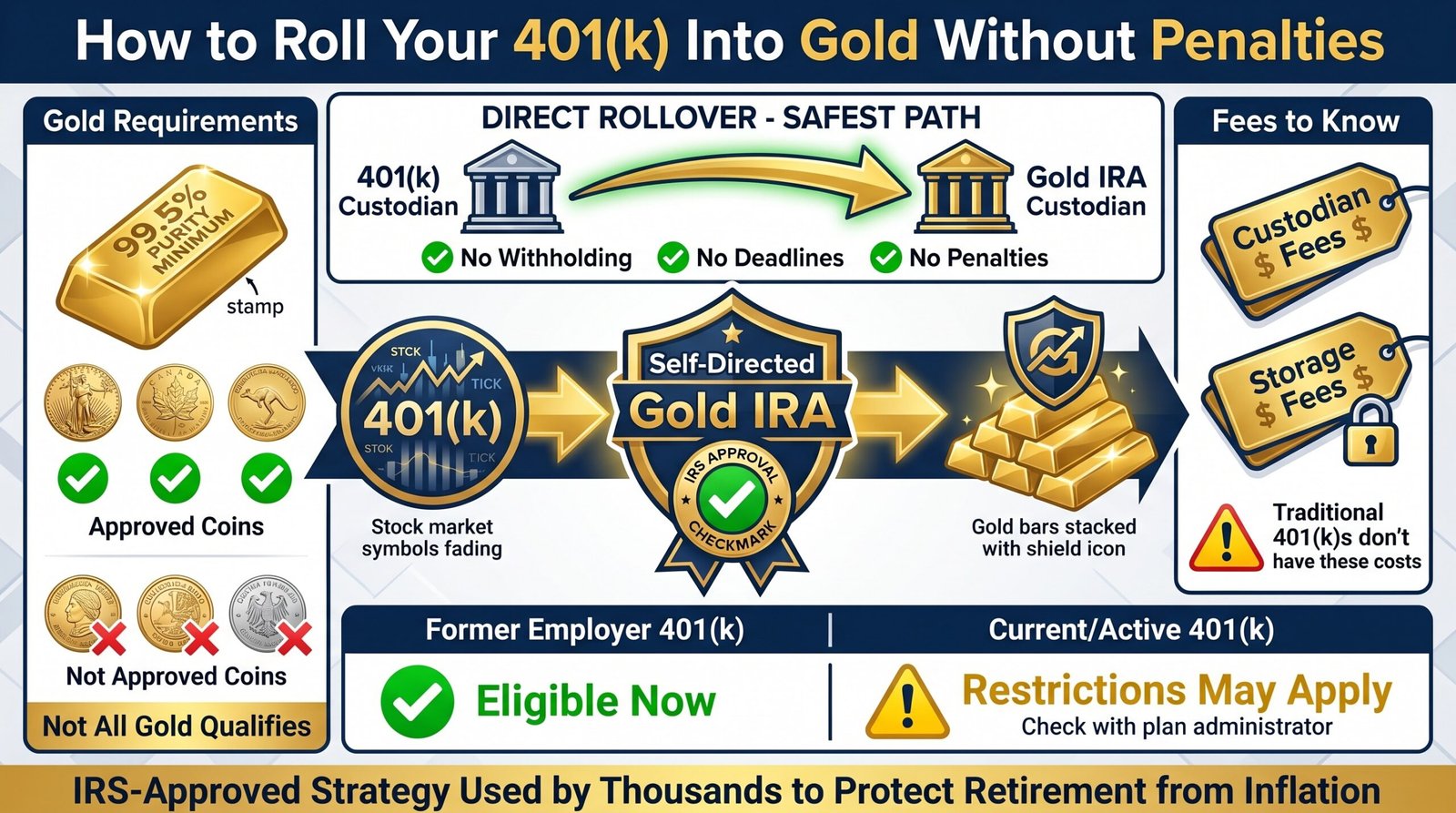
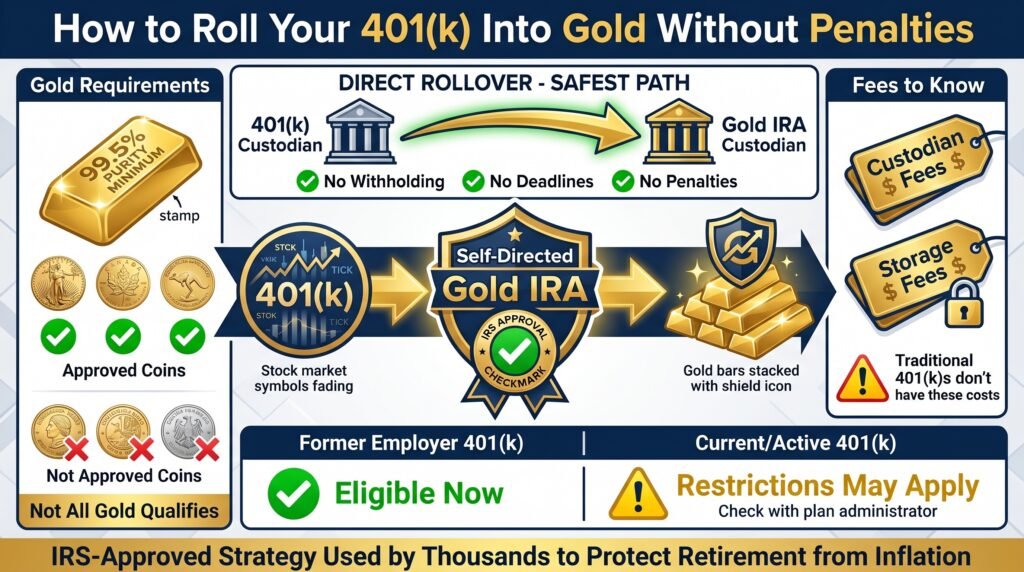
    • A direct rollover is the safest method: funds move directly from your 401(k) custodians to your Gold IRA custodian, with no withholding, no deadlines, and no risk of accidental penalties.
    • Not all gold qualifies: the IRS requires a minimum purity of 99.5% for gold bars and only approves specific coins, so knowing what you can actually hold matters before you invest.
    • There are fees involved: Gold IRAs come with custodian and storage fees that traditional 401(k) accounts do not, and understanding these upfront protects your long-term returns.
    • Keep reading to find out which type of 401(k) you have and whether you can roll it over right now, because the answer is different depending on whether your plan is active or from a previous employer.

    Your 401(k) doesn’t have to stay locked in the stock market while inflation quietly chips away at its value; rolling it into gold is a real, IRS-approved strategy that thousands of Americans use to protect their retirement.

    A gold IRA rollover from Augusta Precious Metals and similar providers has become one of the most searched retirement strategies in recent years, and for good reason. When paper assets lose value, physical gold has historically held its ground. This guide cuts through the noise and gives you exactly what you need to make the move correctly, without triggering taxes or penalties.

    Table of Contents

    1. Quick Summary
    2. What Is a Gold IRA and Why It Matters for Your Retirement?
    3. Direct Rollover vs. Indirect Rollover: Which One Should You Use
    4. How to Roll Your 401(k) Into Gold in 4 Steps
    5. Your 401(k) Can Work Harder for Your Retirement in Gold
    6. Frequently Asked Questions

    What Is a Gold IRA and Why It Matters for Your Retirement?

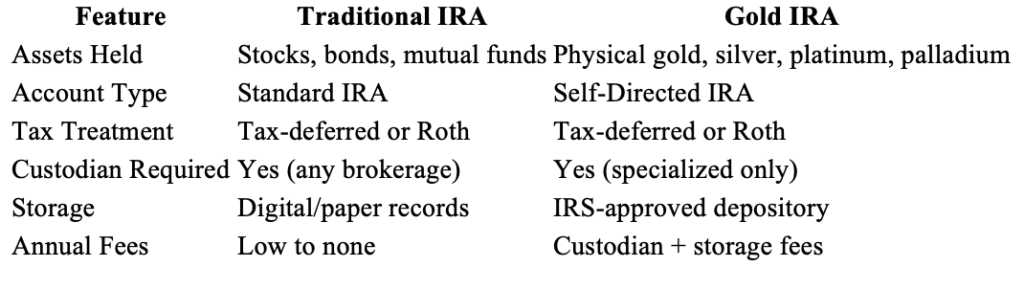
    A Gold IRA is a self-directed individual retirement account that holds physical precious metals instead of stocks, bonds, or mutual funds. It operates under the same IRS rules as a traditional IRA, meaning the same contribution limits, the same tax treatment, and the same required minimum distributions apply. The critical difference is what sits inside the account.

    How a Gold IRA Differs from a Traditional IRA

    A traditional IRA is managed by a brokerage that offers a preset menu of paper investments. A Gold IRA, on the other hand, requires a self-directed IRA custodian, a specialized financial institution approved by the IRS to hold alternative assets including physical precious metals. You do not manage the gold yourself. The custodian handles all compliance, reporting, and storage logistics on your behalf.

    This structure matters because it’s what makes a Gold IRA legally distinct from simply buying gold coins at a dealer. Inside a Gold IRA, your metals are held in a secure, IRS-approved depository, and the account retains all the tax advantages you’ve already built up in your 401(k).

    Why Gold Has Been a Reliable Store of Wealth

    Most beginning gold investors may not know that gold has functioned as a store of value for over 5,000 years. Unlike paper currency, it cannot be printed into devaluation.

    During periods of high inflation, currency crises, and stock market downturns, gold has consistently preserved purchasing power in ways that bonds and cash equivalents often cannot. That track record is exactly why it remains a core diversification tool for serious retirement planners.

    The Role of a Custodian in a Gold IRA

    Every Gold IRA must have an IRS-approved custodian. This is non-negotiable. The custodian is responsible for holding the account, executing purchases of approved metals, arranging insured storage at an approved depository, and filing the necessary IRS reports each year.

    Choosing the right custodian is one of the most important decisions in the entire rollover process. A custodian that specializes in precious metals IRAs will know exactly which gold products are IRS-compliant, which depositories meet federal standards, and how to execute a rollover from your specific 401(k) plan without triggering a taxable event.

    Not every financial institution offers self-directed IRA custody. Banks, standard brokerages, and most 401(k) plan administrators cannot serve as Gold IRA custodians. You will need to open a new account specifically designed for this purpose before initiating any transfer of funds.

    Quick Reference: Traditional IRA vs. Gold IRA

    Augusta Precious Metals is an established precious metals provider that helps investors navigate the Gold IRA process, offering IRS-approved coins and bars, along with educational resources for beginners just getting started with precious metals retirement planning.

    Click the banner below to visit Augusta’s official site and receive a free gold IRA guide. Fill out their short form to get started.

    Gold IRA Guide
    Gold IRA Guide

    Direct Rollover vs. Indirect Rollover: Which One Should You Use

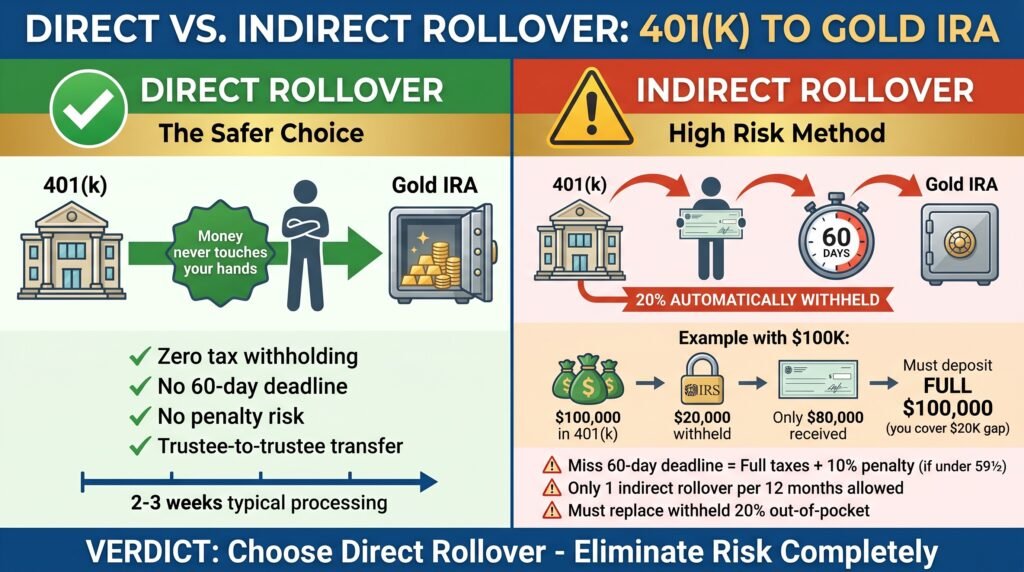
    When moving your 401(k) into a Gold IRA, you have two options: a direct rollover or an indirect rollover. They both get your money to the same destination, but the risks involved are not even close to equal.

    For most people, the answer is simple — use the direct rollover. It eliminates risk, removes the pressure of deadlines, and ensures not a single dollar is withheld for taxes during the transfer.

    How a Direct Rollover Works and Why It Is the Safer Option

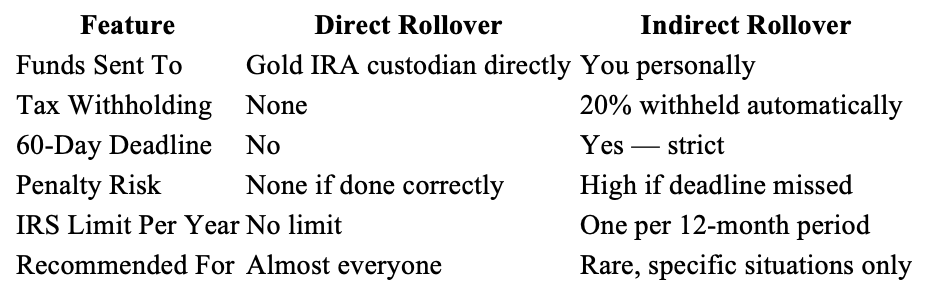
    In a direct rollover, your 401(k) plan administrator transfers your funds directly to your new Gold IRA custodian. The money never passes through your hands. There is no IRS withholding, no 60-day countdown, and no chance of accidentally triggering a taxable distribution. This is the method the IRS refers to as a trustee-to-trustee transfer, and it is the cleanest way to move retirement assets.

    The process typically involves completing paperwork with both your 401(k) plan administrator and your new Gold IRA custodian. Once both sides confirm the transfer, the funds move, sometimes within a few business days, sometimes in two to three weeks depending on your existing plan’s processing time.

    The 60-Day Rule for Indirect Rollovers and the Risks Involved

    An indirect rollover works differently. Your 401(k) plan administrator sends the funds directly to you, and you then have exactly 60 days to deposit the full amount into your new Gold IRA. Miss that deadline by even one day, and the IRS treats the entire distribution as ordinary income, taxable in full, plus a 10% early withdrawal penalty if you are under age 59½.

    How Tax Withholding Can Catch You Off Guard with an Indirect Rollover

    The Hidden Withholding Problem: When a 401(k) plan distributes funds directly to you in an indirect rollover, the IRS requires your plan administrator to withhold 20% for federal taxes automatically. That means if you have $100,000 in your 401(k), you only receive $80,000. To complete a full rollover without penalty, you must deposit the entire $100,000 into your Gold IRA within 60 days, which means you will need to pay the missing $20,000 out of pocket. You do get that 20% back as a tax refund later, but only after filing your return.

    This withholding trap catches a surprising number of people off guard. Many assume they can simply deposit the check they receive and call it complete, only to find they owe taxes on the withheld portion because they didn’t cover the shortfall in time.

    The 60-day indirect rollover also carries an additional restriction: the IRS only allows one indirect rollover per 12-month period across all your IRA accounts. Exceed that limit, and the second transfer is treated as a fully taxable distribution regardless of timing.

    Given all these risks, the indirect rollover rarely makes sense for someone moving a 401(k) into a Gold IRA. Unless you have a specific reason to take possession of the funds temporarily, the direct rollover protects you completely.

    How to Roll Your 401(k) Into Gold in 4 Steps

    The rollover process is more straightforward than most people expect. Once you understand which type of account you have and confirm your eligibility, the actual execution comes down to four clear steps. Following each one in order is what keeps the process tax-free and penalty-free from start to finish.

    1. Confirm Your 401(k) Rollover Eligibility

    Before anything else, you need to confirm that your specific 401(k) plan allows a rollover and under what conditions. For old employer plans, eligibility is almost always automatic. For active employer plans, you need to check whether your plan includes an in-service distribution provision. Call your plan administrator directly and ask two specific questions: “Does my plan allow in-service distributions?” and “What documentation is required to initiate a rollover to an outside IRA?”

    Get the answers in writing if possible. Plan administrators are required to provide you with a Summary Plan Description that outlines all rollover rules, and you are entitled to request one at any time. This step takes a day or two but prevents costly surprises later in the process.

    2. Open a Self-Directed Gold IRA With an Approved Custodian

    Your Gold IRA account must be open and ready to receive funds before you initiate the transfer from your 401(k). Choose a gold IRA company that has a clear, transparent fee structure. During the account opening process, you will complete identity verification and receive the account details your 401(k) plan administrator will need to send the funds. This step typically takes two to five business days once your application is submitted.

    Click the banner below to visit Augusta’s official site and receive a free gold IRA guide. Fill out their short form to get the process started.

    3. Initiate the Rollover and Transfer Your Funds

    Once your Gold IRA account is open, contact your 401(k) plan administrator and formally request a direct rollover. Provide them with your new Gold IRA custodian‘s account information, including the receiving institution’s name, address, account number, and any wire transfer instructions. The administrator will process the request and send the funds directly to your new custodian — no check passes through your hands, no taxes are withheld, and no deadline clock starts ticking.

    Processing times vary. Some 401(k) plans move quickly and complete the transfer in under a week. Others, particularly older plans or those with less modern infrastructure,  can take three to four weeks. Your Gold IRA custodian will notify you when the funds arrive and are ready to be invested.

    Direct Rollover vs. Indirect Rollover: At a Glance

    Direct Rollover vs. Indirect Rollover- At a Glance
    Direct Rollover vs. Indirect Rollover- At a Glance

    Once your custodian confirms the funds have arrived, you will work with them to select which IRS-approved gold products to purchase. This is where the physical asset acquisition actually happens, and it is where purity standards and product eligibility become critically important.

    Keep records of every step of this process. Retain the rollover request confirmation from your 401(k) administrators, any wire transfer receipts, and the purchase confirmations from your Gold IRA custodian. These documents are your evidence that the rollover was completed correctly if the IRS ever has questions about the transaction.

    4. Select and Purchase IRS-Approved Gold for Your IRA

    After the funds arrive in your Gold IRA, your custodian will guide you through selecting eligible gold products. This is not as open-ended as buying gold from a dealer; the IRS has a strict list of approved coins and bars that can legally be held inside a retirement account. Your custodian will only offer products that qualify, which removes most of the guesswork from this step.

    Once you select your preferred gold holdings, the custodian purchases them on your behalf and arranges for secure delivery to an IRS-approved depository. You will receive confirmation of the purchase and documentation showing the specific metals held in your account, their weight, purity, and current valuation. From that point forward, your Gold IRA is fully funded and actively holding physical precious metals on your behalf.

    If you are ready to get started with one of the most reputable gold IRA companies for lifelong customer service, prices, and education, click the banner below to visit Augusta Precious Metals’ official site. Access their free gold IRA guide by filling out their short contact form.

    There are many other IRS rules, such as withdrawals, approved depositories, and more, that are worth reviewing once your gold IRA rollover is established. See the full guide here.

    Find out whether gold IRAs are a good choice for your retirement needs. Access our Gold IRA and Inflation-Retirement Calculators.  Perform real-time calculations as you read our reviews. See the buttons below to access these calculators and start protecting your wealth today.

    GOLD IRA CALCULATOR
    GOLD IRA CALCULATOR

    Your 401(k) Can Work Harder for Your Retirement in Gold

    If your retirement savings are sitting in a standard 401(k) exposed entirely to market volatility, you already understand the risk; you have probably watched your balance drop during downturns and wondered whether there is a better way to protect what you have built. Rolling part or all of that 401(k) into a Gold IRA is not a radical move.

    It is a deliberate, IRS-compliant strategy to hold a portion of your wealth in an asset that has preserved value across centuries of economic upheaval. The process is straightforward, the protections are real, and when done correctly with a direct rollover, it costs nothing in taxes or penalties to make the move. Augusta Precious Metals’ step-by-step rollover process is one resource worth reviewing as you evaluate your options and choose a custodian that fits your retirement goals.

    Click the banner below to receive a free gold IRA company integrity checklist from Augusta Precious Metals. Fill out their short contact form to get started.

    Gold IRA Investment Guide
    Gold IRA Investment Guide

    Investment Minimums – Personal Considerations

    Certain IRA companies have higher investment minimums than others. If you are a serious investor with a minimum of $50,000, you can take advantage of Augusta Precious Metals’ higher competitive prices, life-long customer service, and educational resources.

    If you require a lower barrier to entry, both National Gold Group and Birch Gold Group provide a $10,000 investment minimum.

    National Gold Group provides exceptional price transparency and reliable buyback commitment. Birch Gold Group is one of the most established and trusted gold IRA companies, spanning over 20 years, and provides some of the lowest fees in the industry.

    Decide which gold IRA company works for you by clicking the banners below and accessing their free gold IRA guide. Fill out their short contact form to get started.

    Birch Gold Group: Best Gold IRA for Established Trust & Low Fees

    National Gold Group Review

    National Gold Group: Best Gold IRA for Transparency & Buyback

    Frequently Asked Questions

    Rolling a 401(k) into a Gold IRA raises a lot of specific questions, especially around taxes, timing, and IRS rules. Here are the most common ones answered clearly so you can move forward with confidence.

    Can I Roll My Entire 401(k) Into a Gold IRA Without Paying Taxes?

    Yes, you can roll your entire 401(k) balance into a Gold IRA without paying taxes, provided you use a direct rollover. In a direct rollover, your funds move from your 401(k) plan administrator directly to your Gold IRA custodian without ever passing through your hands. No taxes are withheld, no taxable event is triggered, and the full balance transfers intact.

    The tax treatment of the Gold IRA going forward depends on which type you open. A Traditional Gold IRA mirrors a traditional 401(k) — contributions and growth are tax-deferred, and you pay ordinary income tax when you take distributions in retirement.

    How Long Does a 401(k) to Gold IRA Rollover Take?

    The timeline from initiating a rollover to having physical gold in your account typically runs between two and six weeks. Opening your Gold IRA account takes two to five business days. The fund transfer from your 401(k) plan administrator can take anywhere from a few days to three weeks depending on your plan’s internal processing speed and whether they require paper forms or accept electronic requests. Once the funds arrive at your Gold IRA custodian, purchasing the approved gold products and arranging depository delivery usually takes an additional two to five business days. Starting the process with all your paperwork organized shortens the timeline considerably.

    What Happens if I Miss the 60-Day Deadline on an Indirect Rollover?

    Missing the 60-day deadline on an indirect rollover is a costly mistake. The IRS treats the entire amount that was not deposited into a qualifying retirement account by day 60 as a taxable distribution. You owe ordinary income tax on that amount for the year it was distributed, and if you are under age 59½, you also owe a 10% early withdrawal penalty on top of the tax bill.

    The IRS does allow for waivers in certain documented hardship situations, such as a serious illness, a natural disaster, or errors made by a financial institution, but these waivers are not automatic. You must formally request a waiver from the IRS and provide evidence of the qualifying circumstance. The safest way to avoid this scenario entirely is to use a direct rollover from the beginning, which eliminates the 60-day deadline completely.

    Can I Hold Physical Gold at Home if It Is Purchased Through My Gold IRA?

    No. Gold purchased through your Gold IRA must be stored at an IRS-approved depository, not in your home, not in a personal safe, and not in a safety deposit box that you control. The moment you take personal possession of gold that is legally owned by your IRA, the IRS considers that a distribution.

    However, once you reach retirement age and begin taking distributions from your Gold IRA, you can choose to receive your distributions in the form of physical metal rather than cash. At that point, the gold is legally distributed to you and is no longer inside the IRA structure, meaning you can store it however you choose. Taking an in-kind distribution of physical gold is a legitimate retirement income strategy and one that some investors specifically plan for from the beginning of their Gold IRA journey.

    Sources:
    Gold IRA Rules and Regulations: LendEDU

    Gold IRA storage rules: IRS requirements for storing precious metals: Yahoo!Finance
    Investments in collectibles in individually directed qualified plan accounts: IRS.gov: Retirement plans FAQs regarding IRAs: IRS.gov

  • Hello world!

    Welcome to WordPress. This is your first post. Edit or delete it, then start writing!