Quick Summary
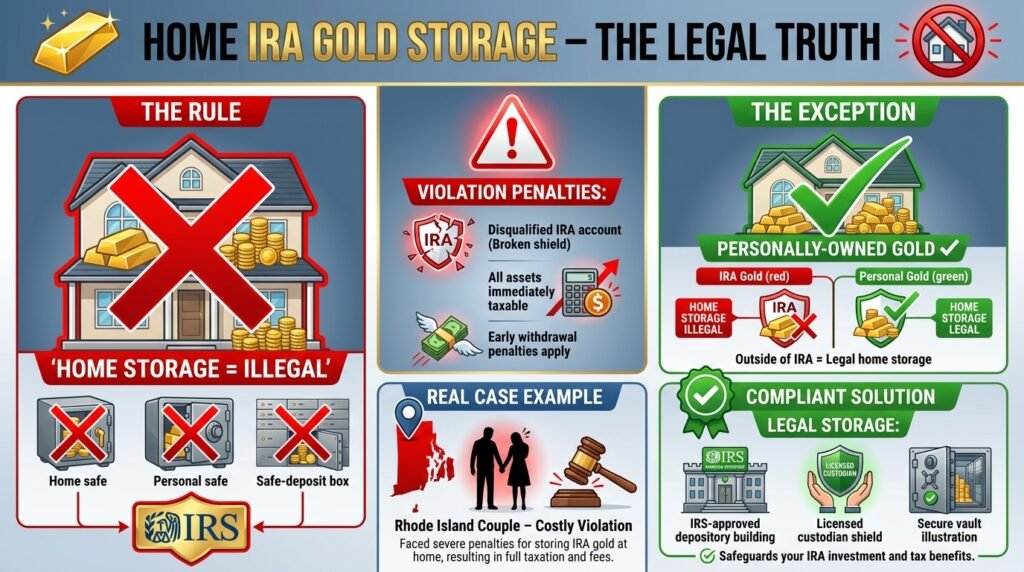
Home storage of IRA gold is illegal; the IRS strictly prohibits keeping precious metals from a self-directed IRA in your home, a personal safe, or a safe-deposit box.
Violations can trigger full IRA disqualification, meaning all assets in the account become immediately taxable plus subject to early withdrawal penalties.
Personally owned gold (outside of an IRA) can legally be stored at home; the restriction only applies to IRA-owned precious metals.
A real court case involving a Rhode Island couple illustrates just how costly ignoring these rules can be, and the outcome may surprise you.
IRS-approved depositories and licensed custodians are the only compliant way to store gold held inside a retirement account.
Table of Contents
- Quick Summary
- The IRS Says No to Home Gold IRA Storage: Here’s What That Means for You
- IRS Rules on Physical Gold IRA Storage
- The Real Legal Consequences of Storing IRA Gold at Home
- IRS-Approved Alternatives to Home Gold Storage
- How to Set Up a Compliant Gold IRA
- Home Storage Gold IRAs Are Illegal: Protect Your Retirement Now
- Frequently Asked Questions
The IRS Says No to Home Gold IRA Storage: Here’s What That Means for You
Storing your gold IRA at home seems like a smart move for control and security, until the IRS gets involved.
Gold IRAs have grown in popularity as investors look for ways to protect wealth against inflation and economic uncertainty. The appeal of holding physical gold is real. But many investors make a critical mistake: they assume that because they own the gold, they can store it wherever they want. That assumption is wrong, and it can cost you everything you’ve saved.
The IRS has very specific rules about where IRA-owned precious metals must be kept, and your home is not on the approved list. Augusta Precious Metals is a trusted authority in precious metals and regularly helps investors navigate these exact compliance challenges. Understanding the distinction between what you legally can and cannot do with IRA gold is the single most important thing you can do to protect your retirement.
IRS Rules on Physical Gold IRA Storage
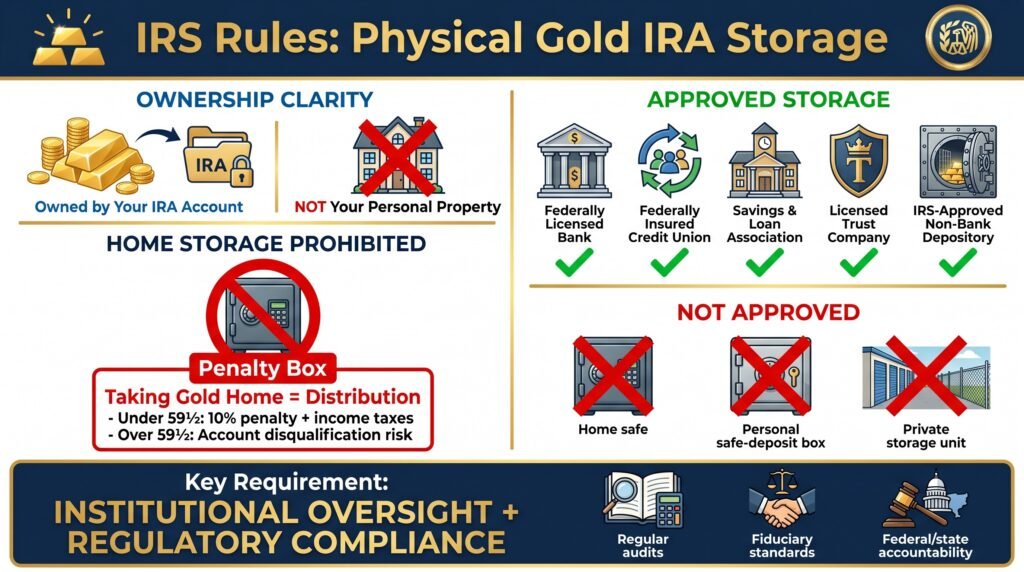
The IRS treats physical gold inside a self-directed IRA as a retirement asset, not personal property. That classification comes with strict custody and storage requirements that every gold IRA holder must follow.
Why the IRS Prohibits Home Storage of IRA Gold
The core reason home storage is prohibited comes down to the legal structure of an IRA itself. When gold is held inside an IRA, it is owned by the account, not by you personally. Because of that distinction, you cannot take physical possession of it without triggering what the IRS considers a distribution.
Taking a distribution means the IRS views that gold as money you’ve withdrawn from your retirement account. If you’re under 59½, that comes with a 10% early withdrawal penalty on top of ordinary income taxes owed on the full value. Even if you’re over 59½, taking possession by storing it at home still violates the custodial rules governing IRAs and can disqualify the entire account.
What Qualifies as an Approved Storage Facility
The IRS requires that all precious metals held in a self-directed IRA be stored at an approved financial institution. According to IRS regulations, that institution must qualify as a “bank” under the Internal Revenue Code, and the definition is narrower than most people expect.
To meet the legal threshold, the storage facility must be one of the following approved depositories.
- A federally licensed bank
- A federally insured credit union
- A savings and loan association
- A licensed trust company regulated by a state or federal authority
- An IRS-approved non-bank depository (such as a specialized precious metal vault)
A home safe, a personal safe-deposit box, or any privately controlled storage space does not qualify, even if it is physically secure. The law is not about the quality of storage; it’s about institutional oversight and regulatory compliance.
Licensed Banks, Credit Unions, and Trust Companies as Valid Custodians
Valid custodians are institutions that carry regulatory oversight, meaning they are accountable to state or federal authorities for how they manage client assets. This oversight is exactly what the IRS wants in place when retirement assets are involved. A licensed trust company, for example, must maintain specific capitalization requirements, undergo regular audits, and operate under fiduciary standards, protections that simply do not exist when gold sits in a home safe.
The Real Legal Consequences of Storing IRA Gold at Home
The consequences of home gold IRA storage are not theoretical; they are financial, legal, and in some cases, criminal.
The Rhode Island Couple Court Case: A Cautionary Tale
One of the most cited real-world examples of home IRA gold storage gone wrong involves a couple from Rhode Island who held physical gold coins purchased through their self-directed IRA in home storage. They believed they had found a legal workaround, specifically, a misinterpretation of a provision in federal law that they thought permitted personal custody of IRA-owned metals. They were wrong.
The IRS ruled that the home storage of those coins constituted a distribution. The entire value of the metals was treated as taxable income for the year they took possession, and the couple faced both the tax liability on the full amount and substantial penalties. The court sided with the IRS. This case has since become a widely referenced cautionary example of what happens when investors either misread or ignore IRS storage requirements for gold IRAs.
Tax Penalties and IRA Disqualification Risks
Beyond individual penalties, home storage can trigger full IRA disqualification. When an IRA is disqualified, every asset inside it is treated as distributed in the tax year of disqualification, not just the improperly stored gold. That means the entire account balance becomes taxable at once.
Here is what investors can face when IRA gold is stored at home:
- Immediate income tax on the full fair market value of the IRA assets
- 10% early withdrawal penalty if the account holder is under age 59½
- Loss of all tax-deferred or tax-free growth accumulated in the account
- Potential IRS audit and investigation into other tax filings
- In extreme cases, criminal charges related to tax evasion if intent to conceal is established
IRS-Approved Alternatives to Home Gold Storage
For IRA-owned gold, the only compliant path forward is using an IRS-approved depository through a qualified custodian, and fortunately, there are strong options available that provide both security and peace of mind.
How Approved Depositories Protect Your Investment
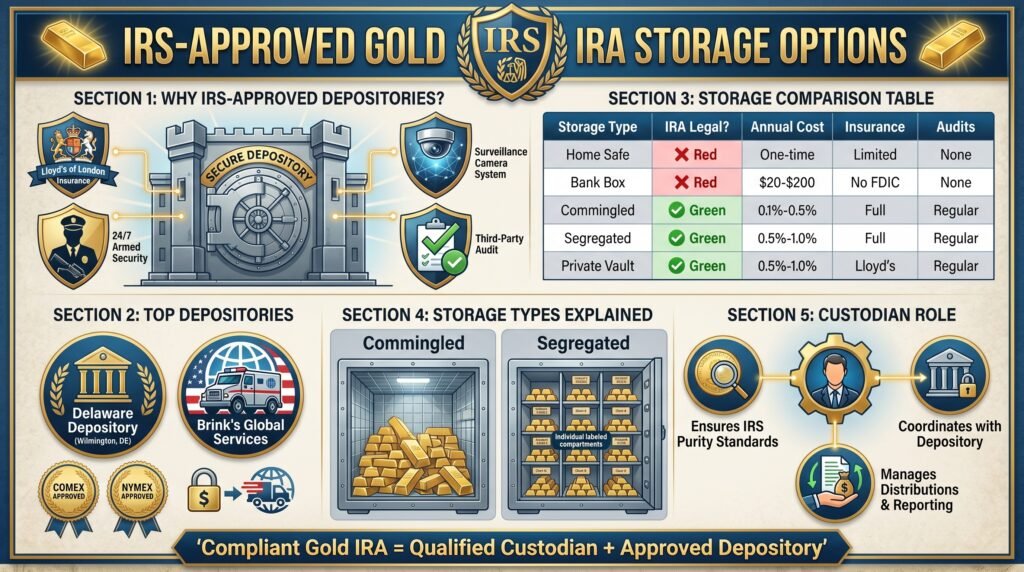
IRS-approved depositories are purpose-built facilities designed specifically to store precious metals under strict regulatory oversight. These are not ordinary bank vaults. They are specialized institutions that maintain Lloyd’s of London or comparable insurance coverage, 24/7 armed security, advanced surveillance systems, and regular third-party audits to verify holdings. For more information on storing precious metals, you can visit this guide on storing precious metals owned by your self-directed IRA.
Two of the most widely used IRS-approved precious metals depositories in the United States are the Delaware Depository and Brink’s Global Services. The Delaware Depository, located in Wilmington, Delaware, is one of the most respected in the industry; it is licensed, bonded, and insured, and it holds COMEX and NYMEX approval. These are not abstract credentials; they represent layers of verified accountability that protect your retirement assets.
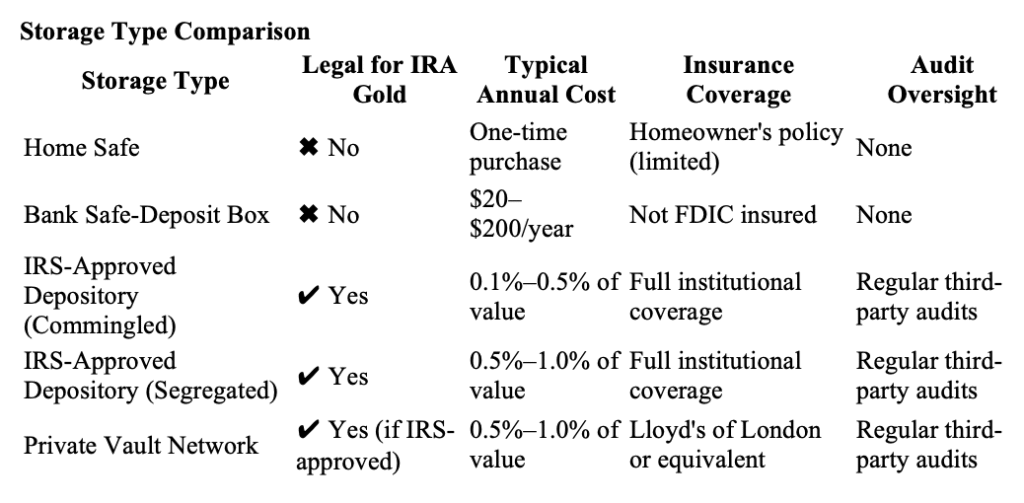
Most approved depositories offer two types of storage: segregated storage and commingled storage. Segregated storage means your specific gold bars or coins are stored separately and identified as yours alone. Commingled (or non-segregated) storage means your metals are stored alongside other clients’ metals of the same type and purity. Segregated storage typically costs more but provides a direct chain of ownership to your specific metals.
Both Birch Gold Group and Augusta Precious Metals are gold IRA companies that partner with Delaware Depository as well as Brink’s Global Services.
Decentralized Private Vault Storage as an Alternative
Some investors look beyond traditional depositories toward decentralized private vault networks, a growing segment of the precious metals storage industry. These facilities operate independently of the traditional banking system while still meeting IRS approval requirements for IRA storage.
Private vault networks like Citadel Global Depository Services offer storage across multiple geographic locations, which appeals to investors concerned about systemic risk or single-point-of-failure scenarios. Geographic diversification of your stored gold means that a localized disaster, political event, or institutional failure at one location does not put your entire holding at risk.
The costs for private vault storage vary, but investors should expect annual fees ranging from roughly 0.5% to 1% of the asset value for segregated storage, depending on the facility and total value stored. Commingled storage runs lower, often between 0.1% and 0.5% annually. These fees are typically billed through your IRA custodian.
How a Custodian Keeps Your Gold IRA Compliant
A qualified IRA custodian is not just a paperwork processor; they are the compliance backbone of your entire gold IRA. They are responsible for ensuring that every metal purchased meets IRS purity standards, that all transactions are properly reported, and that storage arrangements remain within approved facilities at all times. Without a custodian, a self-directed IRA cannot legally function.
Your custodian coordinates directly with the approved depository on your behalf, handling the logistics of metal transfers, storage fee payments, and annual account reporting to the IRS. When you want to take a qualified distribution from your gold IRA later in life, your custodian manages that process too, either liquidating the metals and sending cash, or in some cases arranging for physical delivery of the metals to you once the distribution is properly processed
How to Set Up a Compliant Gold IRA
Setting up a gold IRA the right way from the start eliminates the compliance risks that trap so many investors. The process is more straightforward than most people expect, but the details matter.
The first step is selecting a reputable self-directed IRA custodian or gold IRA company that works with a approved custodian that specializes in alternative assets, specifically precious metals.
Not all IRA custodians handle physical gold; traditional brokerage custodians like Fidelity or Vanguard typically do not. You need a custodian that has established relationships with IRS-approved depositories and experience managing precious metals accounts. For more insights, check out this article on storing your gold IRA.
Choosing a Reputable Gold IRA Company
Your Gold IRA company is not the same as your custodian; it is the dealer that guides you through the process, helps you select IRS-approved metals, and connects you with a custodian and depository. Choosing the right one upfront saves you from costly mistakes later.
Look for companies with long operating histories, transparent fee structures, and strong third-party reviews. A company that pressures you into making a quick decision or upsells you into rare or collectible coins is a red flag; collectibles are not IRS-approved for Gold IRAs and can disqualify your account.
Augusta Precious Metals is one example of an established precious metals provider that helps investors navigate the Gold IRA process, offering IRS-approved coins and bars along with educational resources for beginners who are just getting started with precious metals retirement planning.
Visit Augusta’s official site and receive a free gold IRA guide by clicking the banner below and filling out their short form.

Once your chosen gold IRA company is in place and your account is funded, either through a new contribution, a rollover from an existing IRA, or a 401(k) rollover, you work with an approved precious metals dealer to select qualifying metals. Your custodian then coordinates the purchase and directs the metals to your chosen IRS-approved depository. At no point should the metals pass through your hands.
Here is a step-by-step overview of the compliant gold IRA setup process:
- Choose a self-directed IRA company experienced in precious metals accounts and working with trusted custodians
- Open your self-directed IRA and complete required identity verification and account documentation
- Fund the account via a new contribution, IRA rollover, or 401(k) rollover
- Select an IRS-approved precious metals dealer to source qualifying metals
- Choose your IRS-approved depository and storage type (segregated or commingled)
- Direct your custodian to complete the purchase; metals ship directly to the depository
- Receive account confirmation and depository storage documentation for your records
Metals That Legally Qualify for a Gold IRA
Not every gold product qualifies for inclusion in an IRA. The IRS sets minimum purity standards that metals must meet, and only specific coins and bars make the cut. Gold must meet a minimum fineness of .995 (99.5% pure) to qualify, with one notable exception being the American Gold Eagle coin, which at .9167 fineness, is explicitly approved by the IRS despite falling below that threshold.
Home Storage Gold IRAs Are Illegal: Protect Your Retirement Now
The bottom line is simple: storing IRA-owned gold at home is illegal under IRS rules, full stop. No creative workaround, no home LLC structure, and no misreading of federal law changes that fact, as the Rhode Island couple learned in court. The only way to hold physical gold in a retirement account and keep all of your tax advantages intact is to work with a qualified custodian and store your metals at an IRS-approved depository. Your retirement is too important to gamble on a storage shortcut that the IRS has already litigated and won.
Visit Augusta’s official site and receive a free gold IRA guide by clicking the banner below.
Investment Minimums – Personal Considerations
Certain IRA companies have higher investment minimums than others. If you are a serious investor with a minimum of $50,000, you can take advantage of Augusta Precious Metals’ higher competitive prices, lifelong customer service, and educational resources.
If you require a lower barrier to entry, both National Gold Group and Birch Gold Group provide a $10,000 investment minimum.
National Gold Group provides exceptional price transparency and reliable buyback commitment. Birch Gold Group is one of the most established and trusted gold IRA companies, spanning over 20 years, and provides some of the lowest fees in the industry.
Decide which gold IRA company works for you and access their free gold IRA guide by clicking the banners below.

Birch Gold Group: Best Gold IRA for Established Trust & Low Fees

National Gold Group: Best Gold IRA for Transparency & Buyback
Frequently Asked Questions
Here are answers to the most common questions investors ask about home IRA gold storage rules and legal compliance.
Can I store my gold IRA at home?
Answer: No. The IRS prohibits home storage of IRA-owned gold. Taking physical possession of the metals, even in a personal safe, counts as a taxable distribution and can trigger income tax if you are under age 59½.
There is a 10% early withdrawal penalty imposed and disqualification of the entire IRA. IRA gold must be held at an IRS-approved depository through your custodian.
What is an IRS-approved depository for gold IRAs?
An IRS-approved depository is a specialized, regulated storage facility that meets the IRS’s definition of a qualifying institution for the custody of retirement account assets. These facilities maintain institutional-grade security, including 24/7 armed monitoring, advanced surveillance, full insurance coverage, and regular independent audits of their holdings.
Well-known IRS-approved depositories used by gold IRA investors include the Delaware Depository in Wilmington, Delaware, which holds COMEX and NYMEX approval, and Brink’s Global Services, one of the most recognized names in high-value asset transportation and storage.
Your gold IRA company will typically have established relationships with one or more of these facilities and will coordinate storage on your behalf.
Can I store personally owned gold at home?
Yes, if the gold was purchased with personal funds and is not part of any IRA or retirement account, you are the direct legal owner and can store it anywhere you choose.
A home safe, a bank safe-deposit box, or a private vault are all legal options for personally owned precious metals. The IRS restrictions on storage only apply to gold that is owned by a retirement account. The critical distinction is always legal ownership: IRA-owned gold belongs to the account, while personally purchased gold belongs directly to you.
What types of gold qualify for an IRA?
The IRS requires gold held in a self-directed IRA to meet a minimum fineness of .995 (99.5% purity). Qualifying gold products include the American Gold Buffalo coin (24 karat, .9999 fine), Canadian Gold Maple Leaf coins (.9999 fine), Austrian Gold Philharmonic coins (.9999 fine), and most IRS-approved gold bars and rounds produced by NYMEX- or COMEX-approved refiners.
The one notable exception to the .995 fineness rule is the American Gold Eagle coin. At .9167 fineness, it technically falls below the standard purity threshold, but the IRS explicitly approves it for IRA inclusion by statute, making it one of the most popular IRA-eligible gold coins available.
Collectible coins, rare numismatic coins, and gold jewelry do not qualify for IRA inclusion regardless of their gold content. When in doubt, your custodian and precious metals dealer can confirm whether a specific product meets IRS eligibility requirements before any purchase is made. Working with established dealers who specialize in IRA-eligible metals removes the guesswork entirely and keeps your account on solid legal ground.
For more information on why you shouldn’t store IRA precious metals at home, you can consult resources like Augusta Precious Metals by accessing their free gold IRA guide.
Find out whether gold IRAs are a good choice for your retirement needs. Access our Gold IRA calculator. Bookmark this page and perform real-time calculations as you read our reviews.
Click the banner below to access these calculators and start protecting your wealth today.

If you are ready to explore how physical precious metals can strengthen your retirement strategy, Augusta Precious Metals offers a full range of IRS-approved gold and silver products along with expert guidance to help you build a Gold IRA that works for your long-term goals. Click the banner below to get started.

Sources:
Gold IRA Rules and Regulations: LendEDU
Gold IRA storage rules: IRS requirements for storing precious metals: Yahoo!Finance
Investments in collectibles in individually directed qualified plan accounts: IRS.gov
Retirement plans FAQs regarding IRAs: IRS.gov
*Disclaimer: This article is written for educational purposes and should not be interpreted as financial advice. We may receive compensation for referrals made through this article.
Leave a Reply