Category: Gold Price and Investing Today

  • Top 4 Reasons Why Chasing the Gold Price is an Investing Mistake in 2026

    Top 4 Reasons Why Chasing the Gold Price is an Investing Mistake in 2026

    Quick Summary

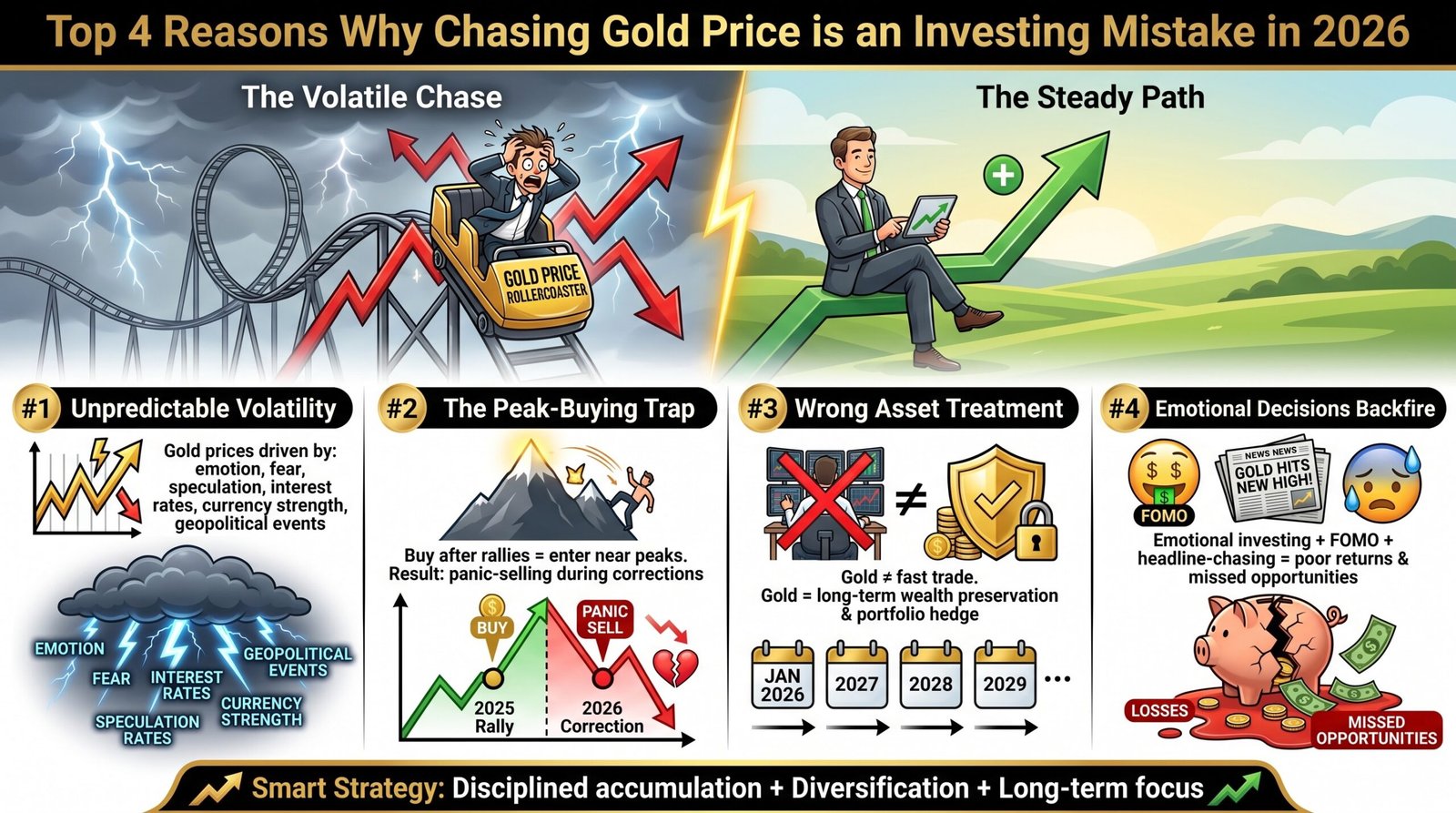
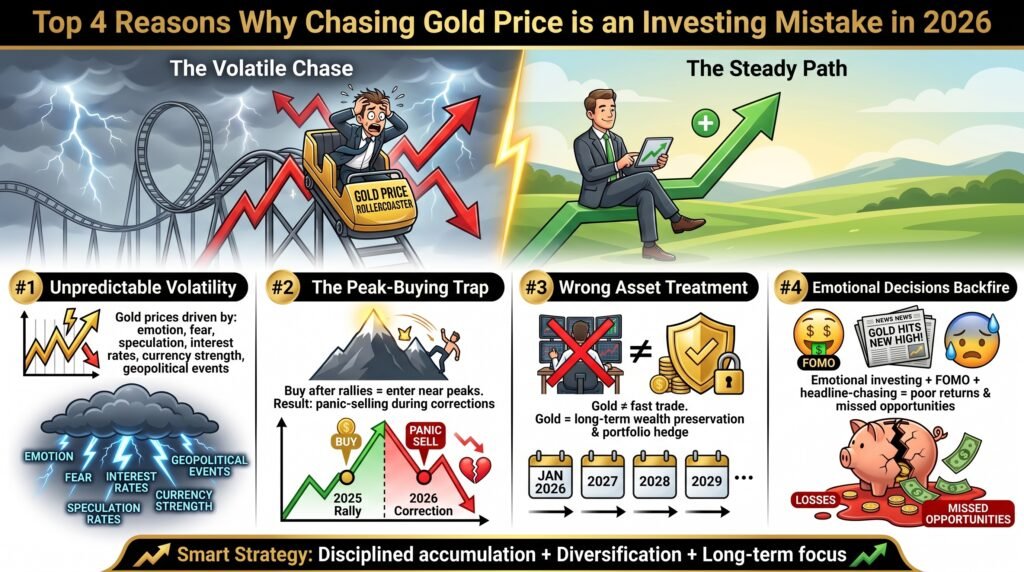
    Chasing short-term gold price moves is one of the biggest mistakes precious metals investors make. Gold prices are driven by emotion, fear, speculation, interest rates, currency strength, and geopolitical events — all of which create unpredictable volatility. Investors who buy after major rallies often enter near market peaks and risk panic-selling during corrections.

    Instead of treating gold like a fast-moving trade, the article explains why it works better as a long-term wealth preservation asset and portfolio hedge. Successful investors typically focus on disciplined accumulation, diversification, and long-term strategy rather than trying to “time” gold price spikes. The article also highlights how emotional investing, FOMO, and headline-driven decisions can lead to poor returns and missed opportunities elsewhere.

    Table of Contents

    1. Introduction
    2. Reason 1. Gold Should Not Be Treated as a Risk Asset.
    3. Reason 2. Gold Investing Requires a Deeper Understanding of the Investing Landscape
    4. Reason 3. Understanding Gold’s Strategic Purpose
    5. Reason 4. Making Portfolio Diversification a Priority. Not Price.
    6. Avoiding Gold Investing Mistakes

    Introduction

    Why are Americans often called ‘bubble chasers’? They wait until prices have already surged, read headlines about new all-time highs, feel that unmistakable pull of missing out, and then finally jump in, right before a topping, price stabilization, or a correction.

    Most of the time, Americans are deal-finders and are always on the lookout for a deal. Sadly, with investing, when finding a bargain matters the most, many uneducated investors buy at the top and panic sell at the bottom.
    Reason 1. Gold Should Not Be Treated as a Risk Asset.

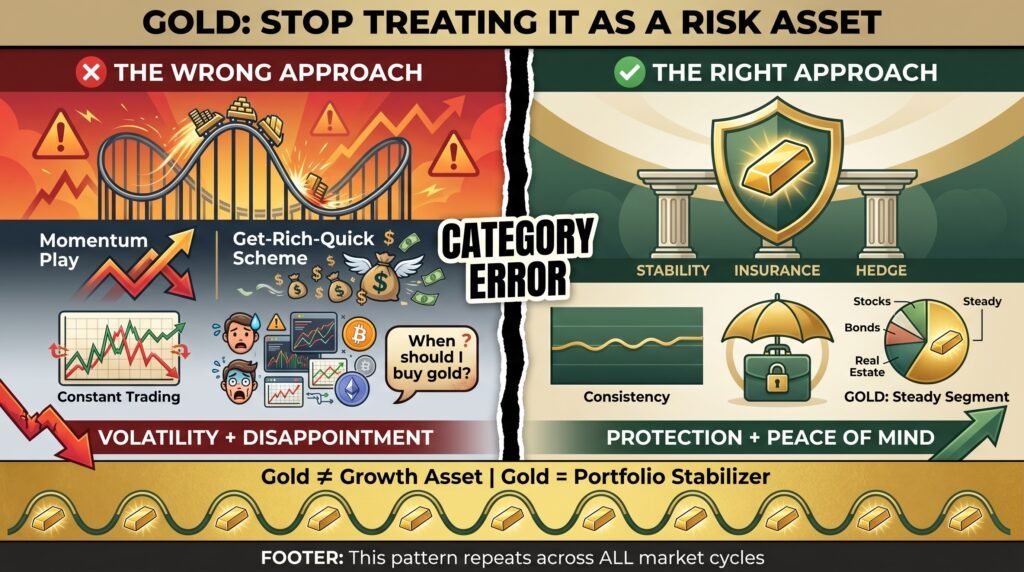
    This pattern repeats itself with remarkable consistency across market cycles.

    Gold investing should be one of the most straightforward components of a diversified portfolio. Gold provides stability, acts as insurance against currency devaluation, and offers a hedge during periods of genuine uncertainty.

    When investors start treating it like a momentum play or a get-rich-quick scheme, they transform what should be a stabilizing force into a source of unnecessary volatility and disappointment.

    The basic problem with chasing gold prices comes from the timing and the psychology that drives late-stage buying decisions.

    The obsession with timing entries and exits, predicting price spikes, and trading around market sentiment has led countless people to miss the actual point of owning this metal.

    The question “When should I buy gold?” fundamentally misunderstands what gold actually does in your financial life.

    The recent prevailing narrative treats gold like a momentum stock or cryptocurrency, something you jump in and out of based on technical charts and analyst predictions.

    Gold serves a completely different function than growth assets, and trying to trade it like one represents a basic category error that costs investors real money and genuine protection when they need it most.

    Reason 2. Gold Investing Requires a Deeper Understanding of the Investing Landscape

    Gold can best be characterized as wealth insurance. A long-held philosophy of gold ownership is ‘You don’t own gold to get rich. You own gold to keep from going broke.’

    On the contrary, I imagine investors who bought gold in 2023 in the $2000 range have benefited greatly from the price appreciation.

    However, you simply do not wait until the cost of insurance is at record highs to finally insure the car or house. That would be irrational. Correct? Well, the same goes for your wealth.

    The real question shouldn’t be ‘Will the gold price continue rising?’ The real questions are: ‘Will the dollar continue to lose value?’ ‘Are we in an inflationary or stagflation currency environment?’, ‘Is there continued economic uncertainty?’, ‘Is there global conflict and geopolitical instability?’, ‘Will the national debt and monetary expansion continue to grow?’.

    If you said yes to a majority of these questions, then the question of whether gold prices will continue to rise answers itself. In the affirmative. How fast or slow depends on the momentum of the answers from those prior questions.

    Two more crucial questions should settle the matter. First, from a long view of history, how many fiat currencies have lost significant value, have gone to zero, or gone negative? Feel free to Google that one now. Secondly, how many times has gold gone to zero? You will not need to Google that answer.
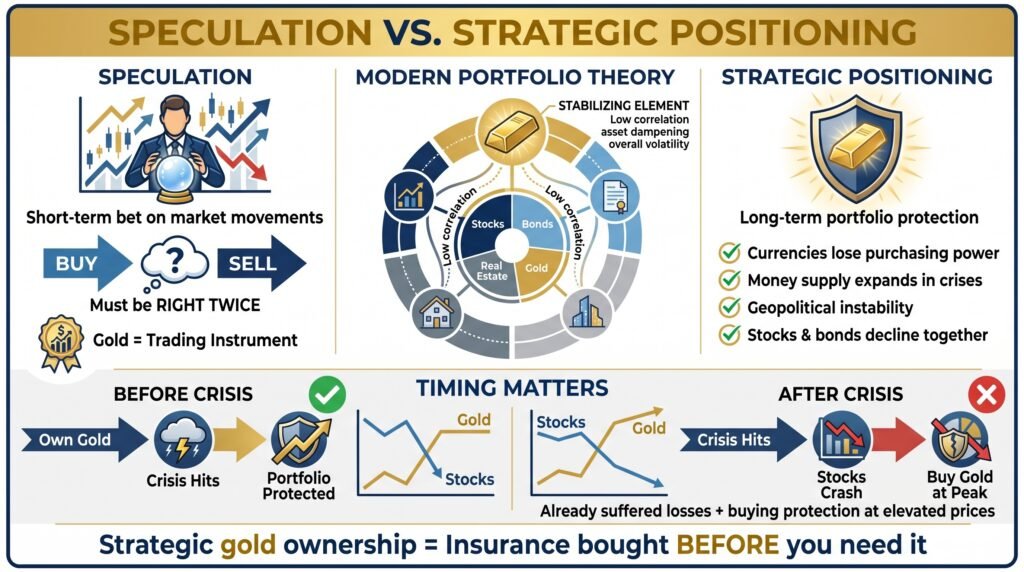
    Reason 3 -  Understanding Gold's Strategic Purpose
    Reason 3 – Understanding Gold’s Strategic Purpose

    Reason 3. Understanding Gold’s Strategic Purpose

    The distinction between speculation and strategic positioning might seem subtle, but these represent entirely different philosophies of investing. When you speculate on gold prices, you’re essentially making a bet on short-term market movements driven by sentiment, technical factors, and timing.

    This approach needs you to be right twice, when you buy and when you sell, and it positions gold as just another tradable instrument in your portfolio.

    Strategic gold ownership operates from a radically different premise. You’re acknowledging certain structural realities about modern financial systems.

    Currencies lose purchasing power over time.

    Governments expand money supplies during crises. Geopolitical tensions create financial instability.

    Traditional assets like stocks and bonds sometimes move in synchronized declines.

    The theoretical foundation here draws from decades of academic research on portfolio construction and risk management. Modern Portfolio Theory emphasizes the importance of combining assets with low correlation to reduce overall volatility.

    Gold’s historical behavior during market stress periods provides exactly this characteristic, but only if you own it before the crisis hits.

    Trying to buy gold after stocks have already crashed defeats the entire purpose; you’ve already suffered the equity losses, and you’re now buying protection at elevated prices.

    Reason 4. Making Portfolio Diversification a Priority. Not Price.

    If you are wheel-house as an investor is stocks and risk assets, you may need some guidance with gold investing. Gold is often seen as a ‘boring investment’. Of course, it is. It’s not supposed to be exciting.

    Insurance is bought to protect the sports car; it’s not meant to be as exciting as driving the sports car itself. And you wouldn’t drive that lovely sports car down the crowded highway without insurance, would you?

    However, the steady rise in the gold price in the last 3 years has provided some excitement for those who bought at the right time. They didn’t buy when gold was rocketing up in price. They bought gold because it was time to buy insurance and prepare for any time risk.

    Yes, bonds do provide some hedging protection. But bonds are not a hard asset like precious metals, real estate, fine art, or the like. Bonds also suffer from a similar drawback that stocks suffer from, counterparty risk. That party is the federal government.

    If we were living in a steady environment of fiscal responsibility, national debt solvency, zero inflation, and balanced budgets, then government bonds would probably be the only portfolio hedging asset you would need. But we do not live in this world and do not appear to be entering it at any point soon.

    Regardless of the political party or administration in power, both sides appear to have a steady record and insatiable appetite for overspending. Hence, owning an asset that a counterparty cannot manipulate the supply and value of is of paramount importance.

    Furthermore, certain gold investing vehicles can provide tax-deferred growth. Gold IRAs are a tax-advantaged way of owning physical gold and silver without the need or liability of storing the actual precious metal in your own residence.

    These gold IRA companies provide lifetime customer support, competitive price matches, buyback guarantees, low fees, and secured storage. Click the banner below to get Augusta Precious Metals’ free gold IRA checklist. Fill out their short form to get started.

    Avoiding Gold Investing Mistakes

    The first major mistake involves confusing gold exposure with gold ownership. Gold mining stocks, gold mutual funds, and gold ETFs all provide price exposure to gold, but they introduce counterparty risk and correlation to equity markets that physical gold ownership avoids.

    Mining stocks often underperform gold itself because of operational challenges, regulatory issues, and general equity market correlation.

    ETFs depend on institutional solvency and proper metal backing.

    These paper gold choices offer advantages in tax-advantaged retirement accounts and provide convenient trading. But they fundamentally differ from direct physical ownership in ways that matter for gold’s core strategic purposes.

    A comprehensive approach might include both physical holdings and paper exposure for different roles within your overall allocation.

    The second mistake involves inadequate attention to storage and security for physical gold. Home storage provides immediate access and eliminates storage fees, but it introduces theft risk and potential insurance complications.

    Professional vault storage offers high security and insurance, but it adds ongoing costs and requires trust in the storage provider.

    The optimal solution depends on position size, the person’s circumstances, and risk preferences.

    Gold IRAs are a tax-advantaged way of owning physical gold and silver without the need or liability of storing the actual precious metal in your own residence.

    These gold IRA companies provide lifetime customer support, competitive price matches, buyback guarantees, low fees, and secured storage. See the links below to find the right gold IRA company that fits your individual needs. Fill out their short contact form and receive a free gold IRA guide.

    Gold IRAs are a tax-advantaged way of owning physical gold and silver without the need or liability of storing the actual precious metal in your own residence.

    These gold IRA companies provide lifetime customer support, competitive price matches, buyback guarantees, low fees, and secured storage. See the links in the video description to find the right gold IRA company that fits your individual needs. Fill out their short contact form and receive a free gold IRA guide.

    The third mistake centers on buying gold from inappropriate sources at excessive premiums. Reputable dealers charge modest premiums over spot prices for standard bullion products.

    Less scrupulous operators charge far higher markups for “rare” or “collectible” coins that don’t offer extra benefits for investment purposes.

    Focus on recognized bullion products, American Eagles, Canadian Maple Leafs, or standard bars, from established dealers with transparent pricing.

    Augusta Precious Metals is a gold IRA company with over a decade in the industry of providing account rollover services. Augusta is one of the leading gold investing companies for trust, customer empowerment, and prices.

    Click the banner below to receive a free gold IRA integrity checklist from their official site. Fill out their sort contact form to get started.

    Frequently Asked Questions

    Is gold a bad investment?

    Not necessarily. Gold can serve as a hedge against inflation, economic uncertainty, and currency weakness. However, problems often arise when investors chase rapid price increases or treat gold as a short-term speculation vehicle instead of a long-term portfolio diversifier.

    Why is chasing the gold price risky?

    Gold prices can swing sharply due to changing interest rates, geopolitical tensions, investor sentiment, and currency movements. Investors who buy after large rallies may enter near temporary highs and suffer losses during pullbacks.

    What is the biggest mistake gold investors make?

    One of the biggest mistakes is emotional investing — buying because prices are surging or headlines create fear of missing out. This often leads to buying high and selling low during corrections.

    Is gold better for long-term investing?

    Many investors use gold primarily as a long-term store of value and portfolio hedge rather than a short-term trading asset. Long-term accumulation strategies generally reduce the risks associated with trying to time the market.

    Why doesn’t gold always rise during crises?

    While gold is considered a safe-haven asset, it can still fall during periods of market stress. Investors sometimes sell gold to raise cash, cover losses, or respond to rising interest rates and a stronger U.S. dollar.

    Does gold generate income like stocks or bonds?

    No. Physical gold does not pay dividends or interest. Returns depend entirely on price appreciation, which is why some investors view it as a hedge or insurance asset rather than a growth investment.

    Gold Leases, such as those provided by Monetary Metals, generate a fixed-income return competitive with the interest yield produced by bonds. The company provides a real yield on your gold investment, paid in actual gold. See the link here to learn more.

    Read our full list of reviews of the best gold IRA companies that we have carefully researched and vetted here.

  • Top 5 Real Reasons to Invest in Gold in 2026 (Price is NOT One of Them)

    Top 5 Real Reasons to Invest in Gold in 2026 (Price is NOT One of Them)

    Quick Summary

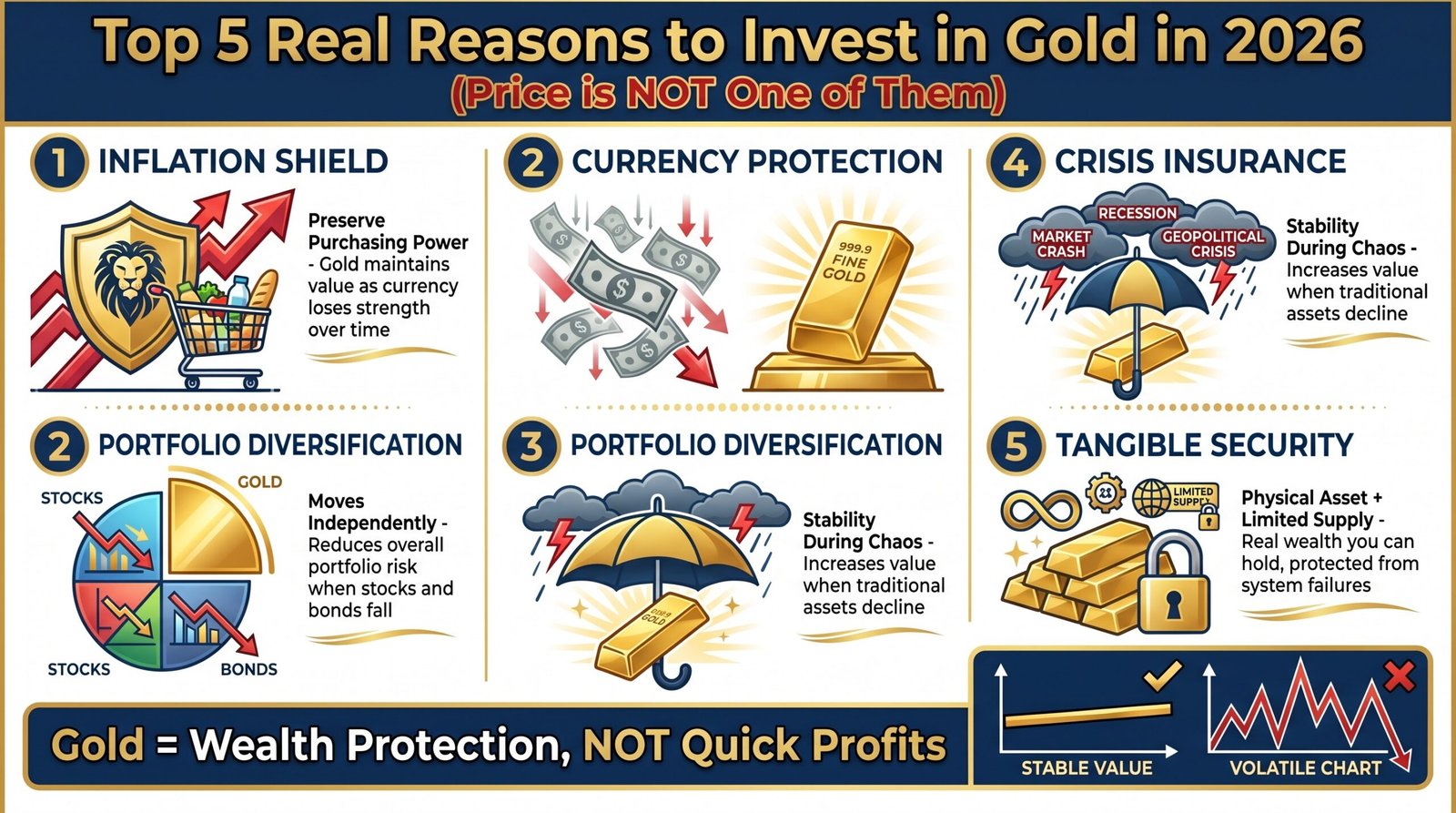
    Investing in gold is primarily about protecting wealth—not chasing high returns. The metal has historically served as a store of value, helping investors hedge against inflation, currency devaluation, and economic uncertainty. It also provides portfolio diversification, often moving independently from stocks and bonds, which can reduce overall risk.

    Gold becomes especially valuable during market crashes, recessions, and geopolitical instability, where it tends to hold or increase its value while traditional assets decline. Its tangible nature and limited supply further enhance its appeal as a long-term hedge against financial system risks.

    In short, gold isn’t about rapid growth—it’s about preserving purchasing power and stabilizing your portfolio during uncertain times.

    Table of Contents

    1. The Real Reasons Gold Belongs in Your Portfolio
      • Protection Against Currency Destruction
      • Uncorrelated Performance During Market Stress
      • Ownership Without Institutional Dependency or Counterparty Risk
      • Historical Crisis Performance
      • Universal Acceptance and Deep Liquidity
    2. Implementation Strategies That Actually Work
    3. Wealth Insurance Investing
    4. Key Takeaways
    5. Frequently Asked Questions

    The Real Reasons Gold Belongs in Your Portfolio

    1. Protection Against Currency Destruction

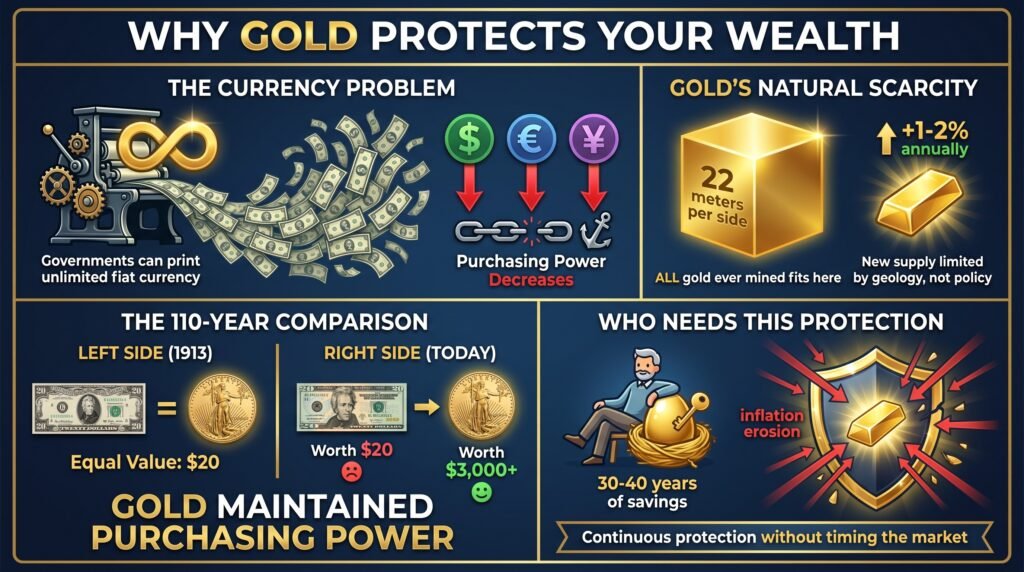
    The mathematical reality of fiat currency is straightforward. Governments can create unlimited amounts of it. This is literally how modern monetary systems function.

    When you hold dollars, euros, or any other paper currency, you own a claim on purchasing power that governments can dilute by expanding the money supply.

    Gold provides a counterbalance to this structural dynamic because of basic geology and economics. All the gold ever mined throughout human history would fit in a cube roughly 22 meters on each side.

    New gold production adds only about 1-2% to the total supply annually, constrained by the difficulty and expense of mining.

    This scarcity doesn’t depend on policy or government promises. Planetary formation billions of years ago determined it.

    The purchasing power comparison becomes stark when you examine long timeframes.

    In 1913, before the Federal Reserve’s creation, a $20 bill and a one-ounce gold coin (also worth $20 at the time) had equivalent value. Today, that same paper $20 buys considerably less than it did then, while the gold coin is worth well over $3,000.

    The gold maintained its purchasing power. The currency did not.

    This matters enormously for retirees living on savings accumulated over decades of work. If you’ve spent 30-40 years building a nest egg, currency debasement can silently erode that purchasing power even if your account balance looks stable.

    A portfolio allocation to gold directly addresses this risk without requiring you to forecast when inflation will accelerate or which policies will debase the currency.

    The protection operates continuously, quietly maintaining value while paper assets fluctuate.

    2. Uncorrelated Performance During Market Stress

    Most diversification strategies fail when you need them most because assets that normally move independently suddenly correlate during crises. Stocks and corporate bonds both declined in 2008 because both depend on corporate profitability and credit availability.

    Real estate and stocks both suffered because both depend on economic growth and credit conditions.

    Even international stocks provide less diversification than many realize because global equity markets increasingly move together.

    Gold genuinely behaves differently because it responds to different drivers. When stock markets decline because of recession fears, gold often rises as investors seek safety.

    When bond yields fall during flight-to-quality episodes, gold appreciates alongside them.

    When both stocks and bonds struggle during stagflation periods like the 1970s, gold can surge while traditional assets languish.

    The mechanism behind this low correlation relates to gold’s role as a monetary choice as opposed to a productive asset. Stocks and bonds represent claims on future cash flows generated by economic activity.

    Real estate generates rental income.

    These assets all join in the economic cycle.

    Gold doesn’t generate cash flows; it simply exists as a scarce, universally recognized store of value. However, we will discuss a means of investing in gold that does generate a yield very soon.

    This basic difference creates the diversification benefit.

    Research examining multi-decade periods confirms that adding gold allocations of 5-15% to traditional stock/bond portfolios reduces overall volatility while maintaining comparable returns. The mathematics work because gold’s independent price behavior smooths the portfolio’s total fluctuation.

    During periods when stocks surge, the gold allocation might lag, but during market crashes, gold’s stability or appreciation offsets equity losses.

    A common objection to gold and silver ownership is the opportunity cost of potential gains in the aforementioned risk assets.

    The answer to this is gold and silver leases. Gold and silver leases provide investors with the opportunity to gain a competitive interest rate that matches or exceeds the yield on bonds. Monetary Metals is a gold investment company that delivers a real interest yield on gold, paid in actual gold. 

    Click the banner below to learn more about Monetary Metals’ fixed-income products, and get started earning a competitive interest rate in addition to gold’s natural price appreciation. Fill out their short contact form to get started.

    3. Ownership Without Institutional Dependency or Counterparty Risk

    This characteristic deserves more attention than it typically receives. When you own physical gold coins or bars, you possess an asset that doesn’t depend on anyone else’s solvency, honesty, or competence.

    No counterparty can fail to deliver, no institution that must remain solvent, no government that must honor obligations.

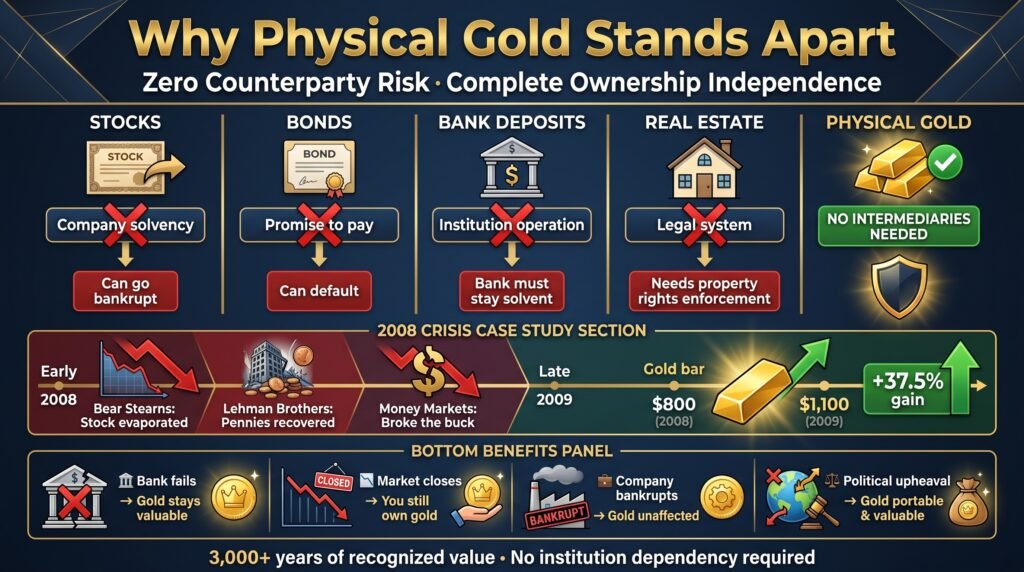
    Compare this to stocks, which represent partial ownership in companies that can go bankrupt. Or bonds, which are promises to pay that can default. Or bank deposits, which depend on the bank’s continued operation and the deposit insurance system’s funding.

    Or even real estate, which needs enforceable property rights and a functioning legal system to maintain title.

    Physical gold needs none of these intermediaries. The metal itself has intrinsic value recognized globally for thousands of years.

    If your bank fails, your gold stays valuable.

    If the stock market closes during a crisis, you still own your gold. If a company goes bankrupt, your gold is unaffected. If political upheaval disrupts property rights, gold stays portable and valuable.

    The 2008 financial crisis illustrated this distinction vividly. Bear Stearns shareholders watched their stock value evaporate.

    Lehman Brothers bondholders recovered pennies on the dollar. Money market funds “broke the buck,” returning less than investors deposited.

    Meanwhile, physical gold owners simply held an asset whose value actually increased during the chaos, rising from around $800 in early 2008 to over $1,100 by late 2009.

    This counterparty-free characteristic provides psychological benefits that extend beyond mathematical portfolio optimization.

    During market turmoil, when headlines scream about bank failures and corporate bankruptcies, physical gold ownership offers genuine peace of mind.

    You’re not wondering whether some institution will honor its obligations; you hold direct ownership of a globally recognized asset.

    4. Historical Crisis Performance

    Gold’s safe-haven reputation comes from documented performance across many crisis types. The pattern repeats consistently.

    When uncertainty rises and traditional assets stumble, gold tends to appreciate or at least maintain value.

    The 1970s stagflation period provides a particularly relevant case study for today’s environment. As oil shocks drove inflation higher and economic growth stagnated, stocks and bonds both struggled. The traditional 60/40 portfolio suffered meaningful losses in real terms.

    Gold, meanwhile, surged from $35 per ounce in 1971 to over $800 by 1980, preserving and growing purchasing power while other assets floundered.

    The 2008 financial crisis demonstrated gold’s crisis characteristics from a different angle. The initial market panic actually saw gold decline slightly alongside everything else as investors liquidated positions to meet margin calls.

    But as the crisis deepened and central banks responded with unprecedented monetary expansion, gold began a multi-year rally that nearly doubled prices between 2008 and 2011.

    Investors who owned gold before the crisis began enjoyed protection that late buyers missed.

    More recently, the COVID-19 pandemic created a sharp test of gold’s defensive properties. In the initial market crash of March 2020, the S&P 500 fell nearly 34% from peak to trough.

    Gold initially declined modestly but quickly recovered and pushed to new all-time highs above $2,000 per ounce by August 2020.

    The divergent performance provided exactly the diversification benefit that strategic gold positions deliver.

    Today, you are seeing massive gains in gold and silver as concerns about the dollar’s long-term solvency, the US national debt and deficits, and countries’ drawdown of US bonds start to grow.

    Also, the increasing mass accumulations of gold bullion by world central banks that have remained steady for the last 10 years have provided a stable floor under the gold price.

    5. Universal Acceptance and Deep Liquidity

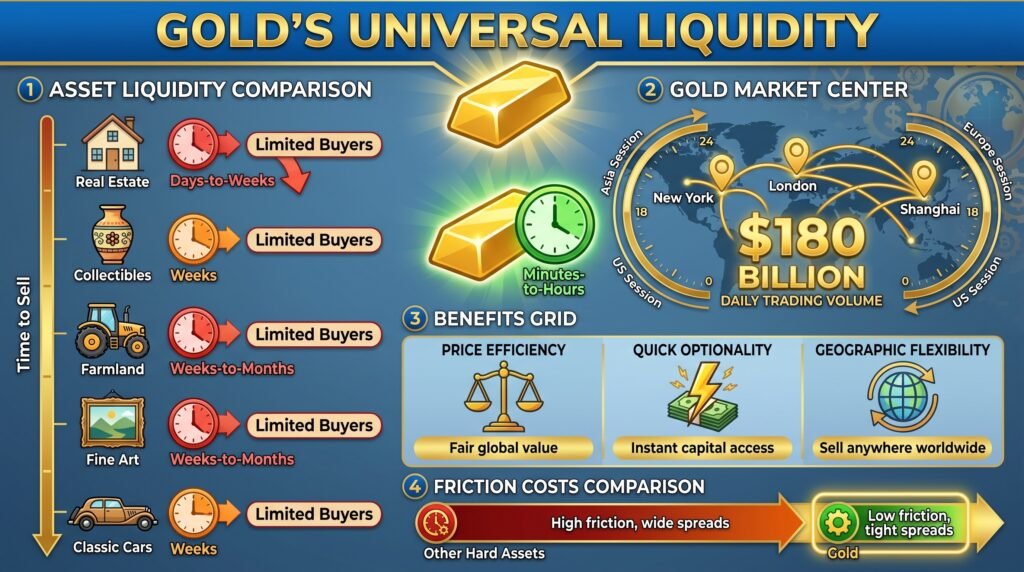
    Some assets offer excellent theoretical characteristics but lack practical liquidity when you actually need to transact. Collectibles might hold value, but finding buyers takes time.

    Certain real estate can be difficult to sell quickly.

    Even some financial instruments have limited markets with wide bid-ask spreads.

    Gold operates in a different universe entirely. The global gold market trades over $180 billion daily across many time zones and continents.

    London, New York, Shanghai, and other financial centers maintain continuous markets with transparent pricing and large liquidity.

    This depth means you can buy or sell meaningful positions without materially affecting the price or accepting unfavorable terms.

    The practical implications extend beyond just trading convenience. Universal liquidity creates price efficiency, ensuring you receive fair value based on global market conditions as opposed to local supply constraints.

    It provides optionality, allowing you to access capital quickly if circumstances change.

    And it offers geographic flexibility, since gold’s global recognition means you can sell in any major city worldwide.

    This liquidity characteristic distinguishes gold from other hard assets often proposed as inflation hedges. Farmland might protect against inflation, but selling acreage quickly at fair prices presents challenges.

    Classic cars or fine art might appreciate, but finding qualified buyers willing to pay full value needs time and effort.

    Gold’s liquidity eliminates these friction costs.

    Implementation Strategies That Actually Work

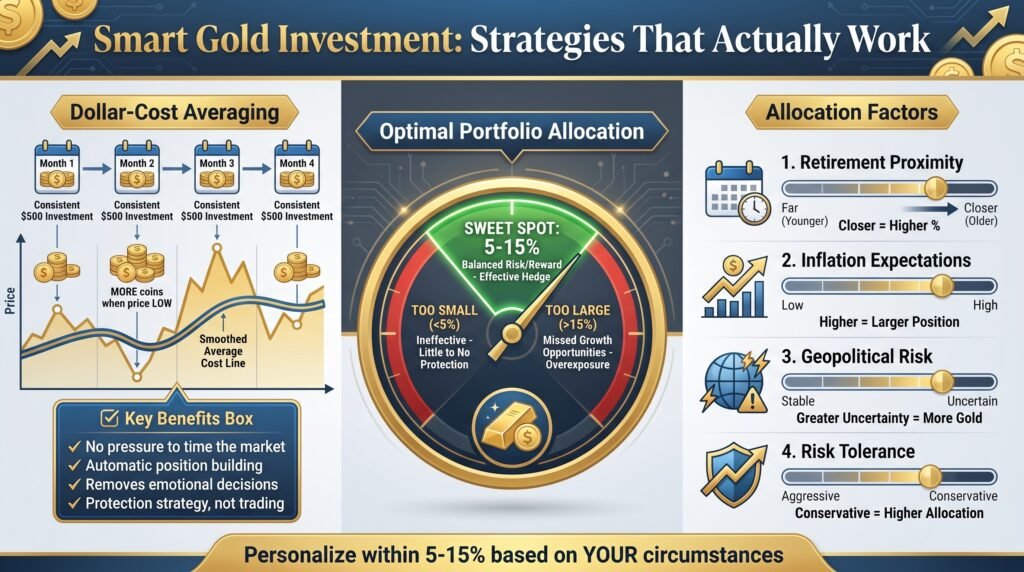
    Dollar-cost averaging provides the most straightforward approach for most investors. Rather than attempting a single perfectly-timed purchase, you commit to buying fixed dollar amounts at regular intervals, perhaps monthly or quarterly.

    This method automatically buys more ounces when prices are lower and fewer when prices are higher, smoothing your average cost over time.

    The psychological advantage of dollar-cost averaging shouldn’t be underestimated. You eliminate the pressure to forecast market bottoms or worry about buying before a correction. Instead, you’re systematically building a position regardless of short-term price movements.

    This aligns perfectly with gold’s strategic purpose; you’re gradually establishing protection, not trying to trade it.

    Portfolio allocation percentages need personal consideration based on your specific circumstances, but the 5-15% range appears in recommendations from various financial institutions and advisors for good reasons.

    Below 5%, the position may be too small to provide meaningful diversification benefits during market stress.

    Above 15%, you’re potentially allocating too much to a non-yielding asset at the expense of growth opportunities.

    Your allocation within that range should reflect several factors. Proximity to retirement matters; a closer retirement might justify higher allocations for protection.

    Inflation concerns play a role; higher inflation expectations support larger positions.

    Geopolitical risk assessment factors in, and greater uncertainty argues for more defensive positioning. Overall risk tolerance influences the decision; conservative investors might prefer higher gold allocations.

    Avoiding Common Implementation Mistakes

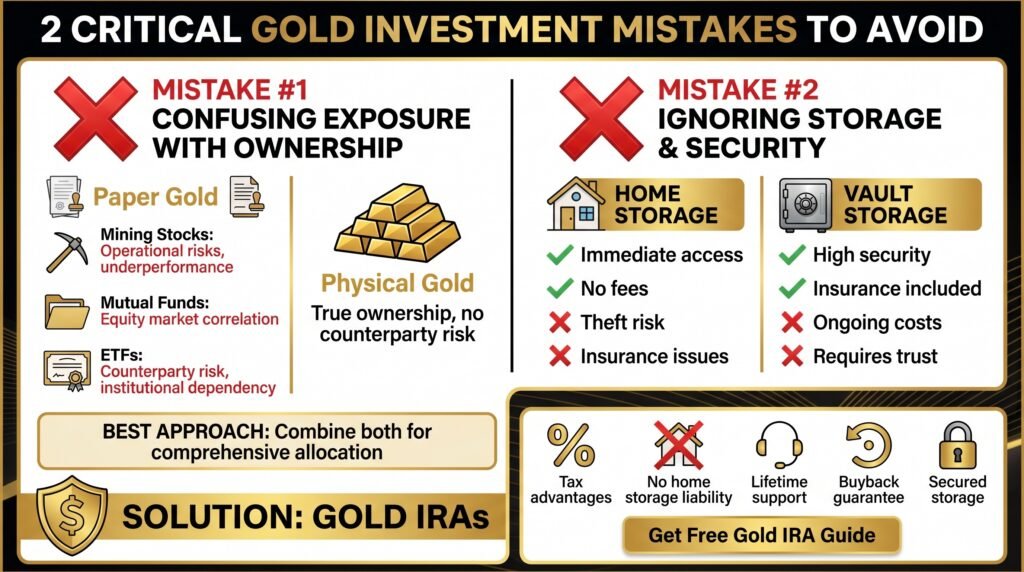
    The first major mistake involves confusing gold exposure with gold ownership. Gold mining stocks, gold mutual funds, and gold ETFs all provide price exposure to gold, but they introduce counterparty risk and correlation to equity markets that physical gold ownership avoids.

    Mining stocks often underperform gold itself because of operational challenges, regulatory issues, and general equity market correlation.

    ETFs depend on institutional solvency and proper metal backing.

    These paper gold choices offer advantages in tax-advantaged retirement accounts and provide convenient trading. But they fundamentally differ from direct physical ownership in ways that matter for gold’s core strategic purposes.

    A comprehensive approach might include both physical holdings and paper exposure for different roles within your overall allocation.

    The second mistake involves inadequate attention to storage and security for physical gold. Home storage provides immediate access and eliminates storage fees, but it introduces theft risk and potential insurance complications.

    Professional vault storage offers high security and insurance, but it adds ongoing costs and requires trust in the storage provider.

    The optimal solution depends on position size, the person’s circumstances, and risk preferences.

    Gold IRAs are a tax-advantaged way of owning physical gold and silver without the need or liability of storing the actual precious metal in your own residence.

    These gold IRA companies provide lifetime customer support, competitive price matches, buyback guarantees, low fees, and secured storage. See the links below to find the right gold IRA company that fits your individual needs. Fill out their short contact form and receive a free gold IRA guide.

    Gold IRAs are a tax-advantaged way of owning physical gold and silver without the need or liability of storing the actual precious metal in your own residence.

    These gold IRA companies provide lifetime customer support, competitive price matches, buyback guarantees, low fees, and secured storage. See the links in the video description to find the right gold IRA company that fits your individual needs. Fill out their short contact form and receive a free gold IRA guide.

    The third mistake centers on buying gold from inappropriate sources at excessive premiums. Reputable dealers charge modest premiums over spot prices for standard bullion products.

    Less scrupulous operators charge far higher markups for “rare” or “collectible” coins that don’t offer extra benefits for investment purposes.

    Focus on recognized bullion products, American Eagles, Canadian Maple Leafs, or standard bars, from established dealers with transparent pricing.

    Augusta Precious Metals is a gold IRA company with over a decade in the industry of providing account rollover services. Augusta is one of the leading gold investing companies for trust, customer empowerment, and prices.

    Click the banner below to receive a free gold IRA integrity checklist from their official site. Fill out their sort contact form to get started.

    Read our full list of reviews of the best gold IRA companies that we have carefully researched and vetted here.

    Wealth Insurance Investing

    Gold’s value in your portfolio has nothing to do with predicting price movements. The metal maintains purchasing power, reduces correlation to traditional assets, eliminates counterparty risk, provides crisis protection, and confirms liquidity.

    Trying to time gold purchases represents a basic misunderstanding of its strategic purpose.

    Implementation through dollar-cost averaging at suitable allocation percentages (5-15% depending on a person’s circumstances) provides the practical approach that aligns with gold’s characteristics. Physical ownership offers the final benefit set that paper choices can’t fully replicate, though both may play roles in a comprehensive strategy.

    The investment sophistication required to use gold properly involves recognizing that some assets exist for protection, diversification, and wealth preservation across generations as opposed to growth. Mastering this distinction elevates your entire approach to portfolio construction beyond simple return chasing toward genuine risk management.

    Key Takeaways

    Gold’s value in your portfolio has nothing to do with predicting price movements. The metal maintains purchasing power, reduces correlation to traditional assets, eliminates counterparty risk, provides crisis protection, and confirms liquidity.

    Trying to time gold purchases represents a basic misunderstanding of its strategic purpose.

    Implementation through dollar-cost averaging at suitable allocation percentages (5-15% depending on a person’s circumstances) provides the practical approach that aligns with gold’s characteristics. Physical ownership offers the final benefit set that paper choices can’t fully replicate, though both may play roles in a comprehensive strategy.

    The investment sophistication required to use gold properly involves recognizing that some assets exist for protection, diversification, and wealth preservation across generations as opposed to growth. Mastering this distinction elevates your entire approach to portfolio construction beyond simple return chasing toward genuine risk management.

    To get started on your gold investing journey, obtain a free investment guide from one of the gold IRA companies below. Whether you require a company with a low investment minimum to get started or are a serious investor with a larger portfolio to protect, a tax-advantaged gold IRA is a great vehicle to own physical gold without the need or liability of storage within your own home.

    Augusta Precious Metals: Best Gold IRA Company for Prices, Education, and Lifetime Customer Support. $50,000 Minimum.

    Birch Gold Group: Most Trusted Customer Service, Low Investment Minimums, and Low Fees. $10,000 Minimum

    Click the right banner for your individual needs. Fill out their short contact form on their site to get started.

    Free Gold IRA Guide
    Free Gold IRA Guide
    Free Gold IRA Guide
    Free Gold IRA Guide

    Frequently Asked Questions

    Can gold protect against inflation?

    Gold has historically maintained purchasing power during inflationary periods. The 1970s provide the clearest example, when inflation averaged over 7% annually, and gold surged from $35 to over $800 per ounce.

    More recently, during the 2021-2023 inflation spike, gold appreciated meaningfully while bond portfolios suffered losses.

    The protection mechanism works because gold’s supply increases slowly (only 1-2% annually from mining) while fiat currency supplies can expand rapidly.

    Should I buy physical gold or gold ETFs?

    Physical gold provides final ownership without counterparty risk, making it ideal for the strategic protection role discussed throughout this article. Gold ETFs offer convenience and work well in retirement accounts where physical ownership presents challenges.

    Many investors use both physical holdings for core strategic positions and ETFs for tactical allocations or retirement account exposure.

    The choice depends on your specific goals and circumstances.

    How much gold should I own in my portfolio?

    Most financial advisors and institutions recommend allocations between 5-15% of total portfolio value. Below 5%, the position may not provide meaningful protection during market stress.

    Above 15%, you’re potentially sacrificing too much growth potential from productive assets.

    Your specific allocation within that range should reflect your proximity to retirement, inflation concerns, risk tolerance, and overall financial situation.

    Is now a good time to buy gold?

    This question reflects the timing mindset that misses Gold’s strategic purpose. The relevant question focuses on whether you now have adequate protection against currency debasement, market volatility, and systemic risks.

    If you don’t have a gold position matching your target allocation, then yes, now is a suitable time to begin building one through dollar-cost averaging.

    If you already maintain your target allocation, then no extra purchases are needed regardless of current prices.

    Does gold pay dividends or interest?

    Unless you are investing in a gold lease, gold generates no income, which represents one of its key characteristics as opposed to a weakness. Assets that generate cash flows, such as stocks, bonds, and rental properties, depend on economic activity and institutional functioning.

    Gold’s value doesn’t need corporate profits, interest payments, or rental income.

    This independence from cash flow generation provides the diversification benefit that makes gold valuable for portfolio protection as opposed to growth.

    To get started on your gold investing journey, obtain a free investment guide from one of the gold IRA companies below. Whether you require a company with a low investment minimum to get started or are a serious investor with a larger portfolio to protect, a tax-advantaged gold IRA is a great vehicle to own physical gold without the need or liability of storage within your own home.

    Click the right banner for your individual needs. Fill out their short contact form on their site to get started.

    BIRCH GOLD GROUP - Free GOLD IRA KIT
    BIRCH GOLD GROUP – Free GOLD IRA KIT

  • Is Gold Still Worth It? War, Oil, Your Money, and Gold Investing in 2026

    Is Gold Still Worth It? War, Oil, Your Money, and Gold Investing in 2026

    Is Gold Still Worth It? War, Oil, and Your Money in 2026
    Is Gold Still Worth It? War, Oil, and Your Money in 2026

    Quick Summary

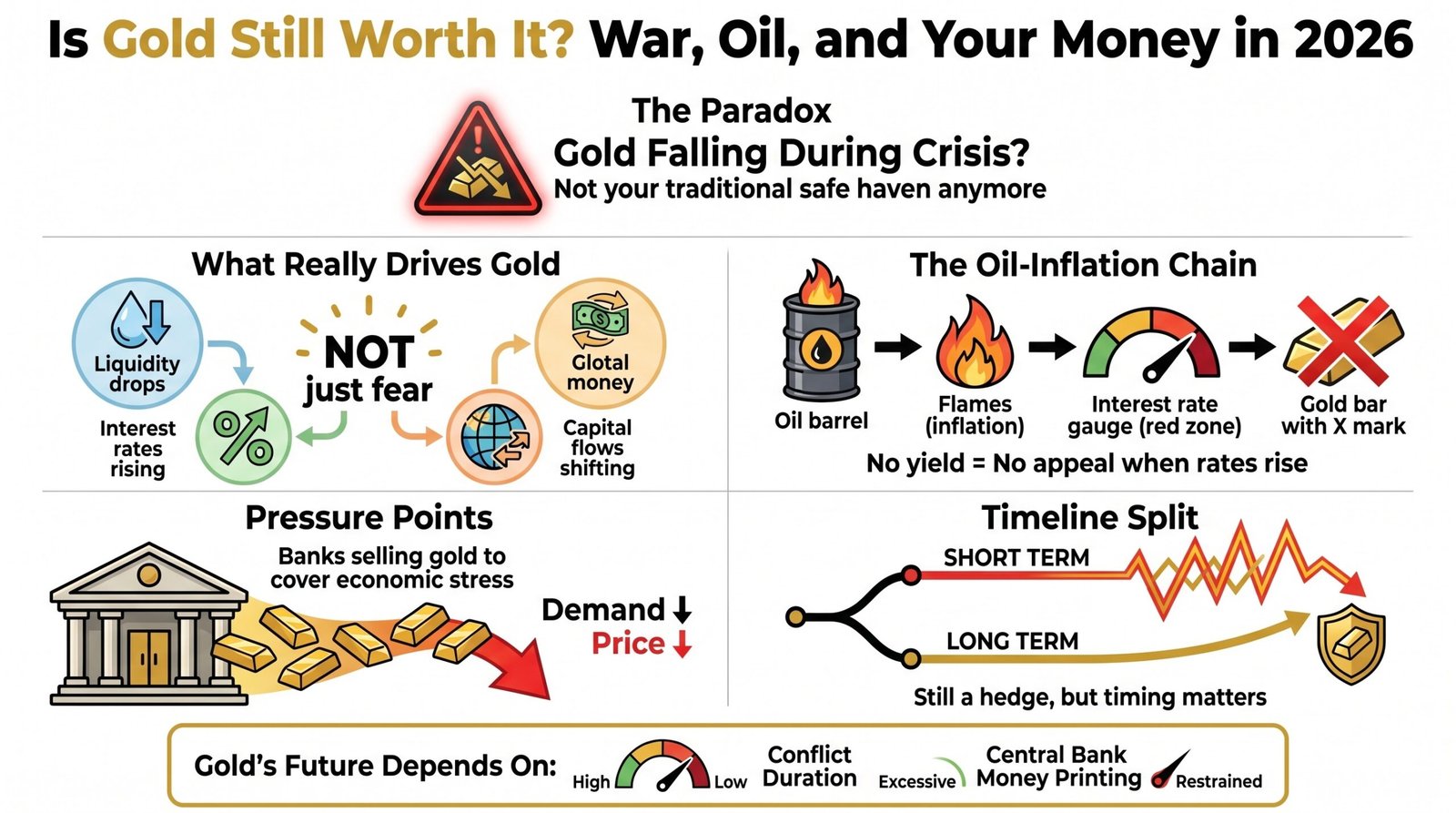
    Gold isn’t behaving like a traditional “safe haven” during the current war and oil shock. Prices can fall—even during crises—because gold is driven by liquidity, interest rates, and global capital flows, not just fear.

    A surge in oil prices is fueling inflation and higher interest rates, which hurts gold since it doesn’t produce yield.  Central banks and countries may sell gold to cover economic stress, reducing demand and pushing prices down.

    Gold still has a long-term role as a hedge, but short-term performance can be volatile and counterintuitive. Depending on the duration of the conflict and the level of central bank support in the form of monetary easing and money supply expansion will dictate the longer term price action of gold.

    Introduction

    Is gold still worth it? Like all things, it’s all about timing and context.

     “One of the strongest arguments for gold is that it acts as a hedge against geopolitical instability, wars, fragmentation, and loss of trust between countries.

    In those environments, investors look for assets that aren’t tied to any one government, and gold fits that role. It’s a neutral asset.

    But what’s interesting, and often misunderstood, is that gold doesn’t just go up every time there’s a crisis.

    You can actually see situations where geopolitical tensions rise, and gold initially spikes… but then either levels off or even declines.

    And that’s because gold isn’t just reacting to fear; it’s mainly reacting to variables like interest rates, the dollar, liquidity, and the world central bank’s reaction to the conflict.

    So even if a conflict increases uncertainty, if it also leads to higher real rates or a stronger dollar, that can offset or even overwhelm the bullish impact on gold.

    Which means the relationship between geopolitics and gold is real, but it’s not simple, and it’s definitely not one-directional.”

    The recent events of March 2026 perfectly illustrate this exact point:

    • Gold initially surged when the Middle East conflict escalated.
      → Early reaction: safe-haven buying.
    • But then gold fell sharply despite the ongoing war. Down 13–15% after the conflict began
    • Why? Because:
      • Rising oil → higher inflation expectations. But not Monetary inflation,
      • Central banks stay tighter with higher rates.
      • This leads to a Stronger dollar plus higher real yields
      • This leads to downward Pressure on gold.


    Geopolitics alone doesn’t drive gold. Macro conditions determine whether the move sticks.

     “Gold doesn’t just trade on fear — it trades on the macro response to that fear.”

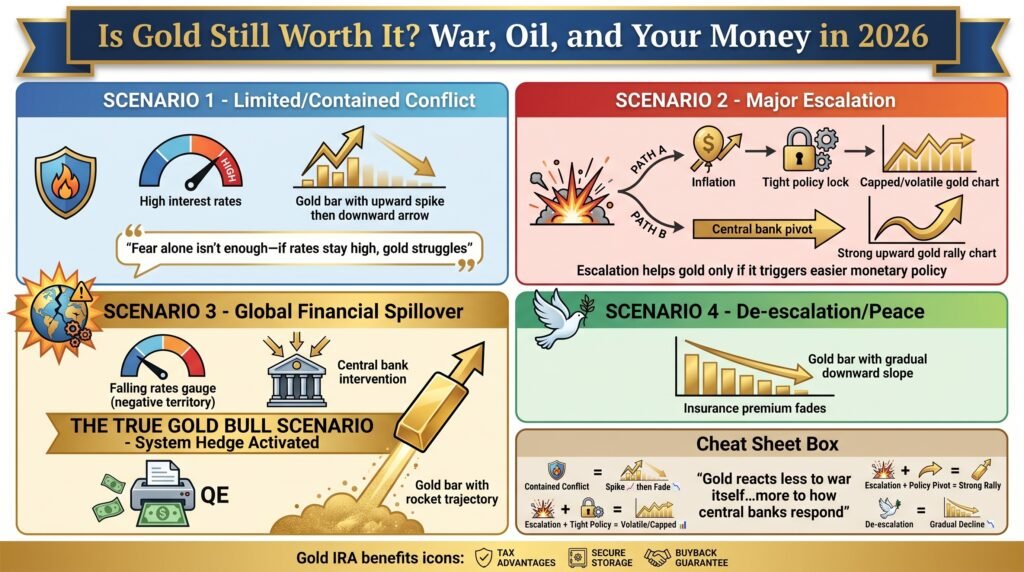
    Scenario 1 – Limited / Contained Conflict

    What happens:

    • Conflict remains regional with no major escalation.
    • Markets initially react with fear and then normalize.
    • Oil may spike briefly, then stabilize.

    Macro response:

    • Central banks stay cautious or slightly hawkish.
    • Real rates remain stable or slightly elevated.
    • USD stays relatively strong.

    🪙 Gold reaction:

    • Initial spike due to safe-haven demand.
    • Then plateaus or pulls back.

     “Fear alone isn’t enough — if rates stay high, gold struggles.”e to that fear.”

    Scenario 2 – Major Escalation – Regional War Expansion

    What happens:

    • Broader Middle East involvement.
    • Oil supply disruption is leading to a sharp spike in energy prices.
    • Global uncertainty increases significantly.

    Macro response leads to two possible paths…

    Path A –  Inflation Shock plus Tight Policy

    • Oil-driven inflation rises.
    • Central banks stay tighter for longer.
    • Real rates rise or stay elevated.

    👉 Gold Outcome..

    • Short-term surge.
    • Then suppressed or volatile.

    Path B: Crisis leads to a Central Bank Policy Pivot.

    • Growth slows sharply.
    • Financial stress emerges.
    • Central banks cut rates and inject liquidity.

    👉 Gold Outcome:

    Sustained a strong rally.

    Escalation helps gold only if it leads to easier monetary policy. The easing essentially increases the monetary supply, leading to inflation.

    Scenario 3 – Global Financial Spillover – This is the true “gold bull” scenario.

    What happens:

    • War triggers:
      • Banking stress.
      • Credit tightening.
      • Market instability.

    Macro response:

    Real rates fall (or go negative).

    Central banks intervene aggressively.

    Liquidity increases through QE or money printing.

    🪙 Gold reaction:

    • Strong, sustained upside.

    🎯 Key takeaway:

    This is where gold behaves exactly as advertised, as a system hedge.

    Scenario 4 – De-escalation – A Sustained Peace Resolution.

    What happens:

    • Tensions ease.
    • Oil prices fall.
    • Risk sentiment improves.

    Macro response:

    • Inflation expectations decline.
    • Real rates may stabilize or rise.
    • Risk assets outperform.

    Gold reaction:

    • Gradual decline or underperformance.

    Key takeaway:

    Gold loses its “insurance premium” when fear fades.

    A Simplified Cheat Sheet.

    1. A contained conflict equals Gold Spike, then fades.
    2. An escalation with tight monetary policy equals a volatile and capped gold price.
    3. An escalation with a tight monetary policy pivot equals a strong rally for gold.
    4. De-escalation of conflict equals a gradual decline and evening out of the gold price.

    Whichever of these scenarios is likely will largely depend on the duration and the amount of liquidity and national debt resulting from money supply growth.

    “Gold reacts less to the war itself… and more to how central banks respond to it.”

    To take advantage of the volatility of gold and silver before their eventual resurgence.

    Gold and silver IRAs are a tax-advantaged means of owning physical gold with the need or potential liability of storing the precious metal in your own residence. Gold IRA companies provide competitive price matches, lifetime customer service, secured storage, and solid buyback guarantees for their clients.

    Read or full list of reviews of the best gold IRA companies that we have carefully researched and vetted here.

    Augusta Precious Metals is a gold IRA company with over a decade in the industry of providing account rollover services. Augusta is one of the leading gold investing companies for trust, customer empowerment, and prices.

    Click the banner below to receive a free gold IRA integrity checklist from their official site. Fill out their sort contact form to get started.

    Why War Doesn’t Immediately Send Gold Higher

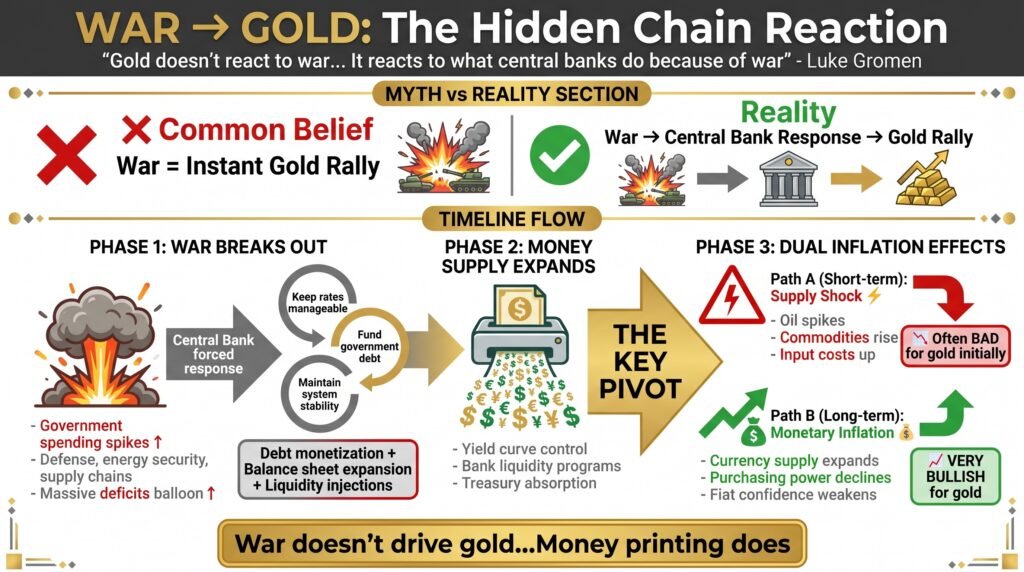
    Many investors think war automatically sends gold higher.But that’s not actually how it works.

    According to a macro investor named Luke Gromen: Gold doesn’t react to war…It reacts to what central banks do because of war.

    Here’s the chain reaction:

    War breaks out, governments spend massively, and deficits explode. Now, central banks have a problem: They can’t let interest rates rise too much…
    Or the system breaks under the debt.

    So, what do they do? They step in, add liquidity, and expand the money supply.

    But here’s the part most people miss: At first, war pushes oil higher, which drives inflation, which keeps the central bank’s monetary policy tight, so gold might actually stall or even drop early on.

    The real move happens later. When markets realize: Central banks have to ease…and money supply starts expanding. That’s when gold tends to break out in a big way.

    So, the takeaway is simple: War doesn’t drive gold…Money printing does.

    Phase 1, War Breaks Out, and Central Banks Are Forced to Respond

    When global conflict escalates, Governments increase spending on: Defense, Energy security, Supply chains, and Alliances to provide aid. This creates large fiscal deficits

    According to Gromen, central banks don’t operate independently in these scenarios.

    They are effectively forced to:

    • Keep interest rates from rising too much.
    • Ensure government debt remains fundable.
    • Maintain financial system stability.

    👉 This often leads to:

    • Debt monetization, direct or indirect.
    • Balance sheet expansion.
    • Liquidity injections.

    Phase 2 – Money Supply Expands

    This is the key pivot – War leads to deficits, then monetization and the resulting money printing.

    Even if not explicit Q.E., it can show up as: Yield curve control, implicit. The creation of Bank liquidity programs and/ or Treasury issuance is absorbed by the system.

    Phase 3 – Downstream Inflation Effects

    This creates two layers of inflation:

    1. Immediate – Supply Shock.

    • Oil spikes.
    • Commodity prices rise.
    • Input costs increase.

    👉 This is oil-driven inflation. Often bad for gold in the short term.

    2. Secondary – Monetary Inflation.

    • Currency supply expands.
    • Real purchasing power declines.
    • Confidence in fiat weakens.

    👉 This is monetary inflation, which is very bullish for gold.

    To get started on your gold investing journey by obtaining a free investment guide from one of the gold IRA companies below. Whether you require a company with a low investment minimum to gets started or are a serious investor with a larger portfolio to protect, a tax-advantaged gold IRA is a great vehicle to own physical gold without the need or liability of storage within your own home.

    Click the right banner for your individual needs. Fill out their short contact form on their site to get started.

    BIRCH GOLD GROUP - Free GOLD IRA KIT
    BIRCH GOLD GROUP – Free GOLD IRA KIT

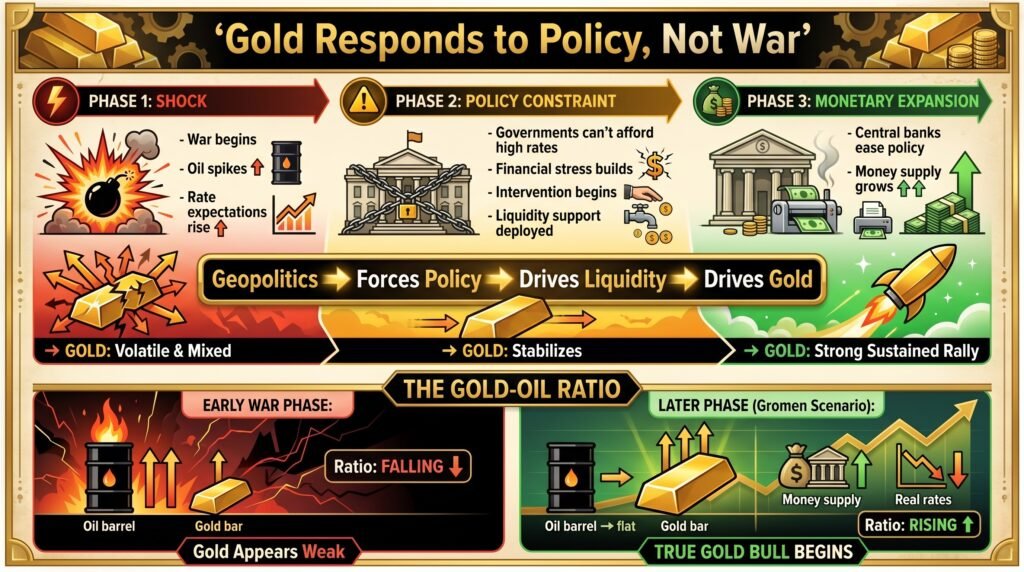
    Gold’s Role and Timeline of Gold Reaction

    Gold doesn’t respond to the war itself, it responds to the policy response to the war.

    Phase 1: Shock.

    • War begins.
    • Oil spikes.
    • Rates expectations rise.

    👉 Gold is volatile and mixed.


    Phase 2: Policy Constraint

    • Governments can’t afford high rates.
    • Financial stress builds.

    👉 Markets begin to anticipate:

    • Intervention.
    • Liquidity support.

    👉 Gold starts to stabilize.


    Phase 3: Monetary Expansion

    • Central banks ease – explicitly or implicitly.
    • Money supply grows.

    👉 Gold = strong, sustained rally.

     “Gold is driven by real rates, liquidity, and macro response — not just geopolitics.”

    Gromen’s view is essentially the endgame of that logic:

    • Geopolitics forces policy.
    • Policy drives liquidity.
    • Liquidity drives gold.

    Tie-In to Gold–Oil Ratio –  A Critical Connection

    This is where it all clicks:

    Early War Phase:

    • Oil rises in price.
    • Gold rises, but not as much as oil.

    The Ratio falls, Gold appears weak.

    Later Phase (Gromen Scenario):

    • Money supply rises.
    • Real rates are down.
    • Gold increases.
    • Oil stabilizes or falls.

    Ratio rises, True gold bull phase begins.

    Conclusion

    In summary, Gromen’s Big Macro Bet, if you condense his view:

    The U.S. and global system cannot sustain: High debt, High rates, AND geopolitical conflict. Something has to give…And that “something” is: Currency value declines due to money supply expansion

    Again, “War doesn’t just create inflation — it forces the system to print, and that’s when gold really moves.

    Another factor, the geopolitical fallout of the large US military interventions and the resulting divestment in the dollar as a result play into the bullish case for gold.

    With increasing geopolitical tensions, the desire by world governments and central banks to seek a neutral asset that does not carry the same counterparty risk as the US dollar will become more and more a priority. Only time will tell.

    But waiting is not an option as an investor. Preparation is. And one rule has remained true and constant over 5,000 years: gold has never gone to zero. Currencies have.

    To take advantage of the volatility of gold and silver before their eventual resurgence, see the links below to obtain a free guide from either Birch Gold Group or Augusta Precious Metals. Fill out their short contact form on their site to get started.

    Best Gold IRA for Low Investment Minimums and Fees

    Free Gold IRA Guide
    Free Gold IRA Guide

    Best Gold IRA for Prices, Customer Support, & Education

    Frequently Asked Questions

    Is gold still a good investment in 2026?

    Gold can still play a role as a long-term hedge against inflation and uncertainty, but it’s not reliable in the short term. Its performance depends heavily on interest rates, the dollar, and global liquidity—not just geopolitical events.


    Why is gold falling during a war?

    Because markets are reacting to economic mechanics, not headlines. Rising oil prices increase inflation and interest rates, which reduces gold’s appeal. At the same time, investors and governments may sell gold to raise cash.


    Does gold always go up during crises?

    No. While gold often rises during uncertainty, it can fall if:

    • Interest rates rise
    • The U.S. dollar strengthens
    • Investors need liquidity
      These factors can outweigh the “fear trade.”

    How do interest rates affect gold?

    Gold doesn’t pay income. When interest rates rise, bonds and cash become more attractive, pulling money away from gold.


    What role do central banks play in gold prices?

    Central banks are major buyers of gold, but during economic stress they may:

    • Slow purchases
    • Sell reserves
      This shift in demand can significantly impact prices.

    Is gold better than stocks or bonds?

    Not necessarily. Gold:

    • Doesn’t generate income
    • Relies on price appreciation alone

    Stocks and bonds provide returns through earnings or interest, making them more productive assets over time.


    Should you hold gold in your portfolio?

    Yes—in moderation. Gold works best as:

    • A diversification tool
    • A hedge against extreme scenarios

    But relying on it as a primary investment strategy is risky.


    What’s the biggest misconception about gold?

    That it always rises during crisis. In reality, gold follows liquidity and macroeconomic conditions, which can cause it to drop even when fear is high.