Quick Summary
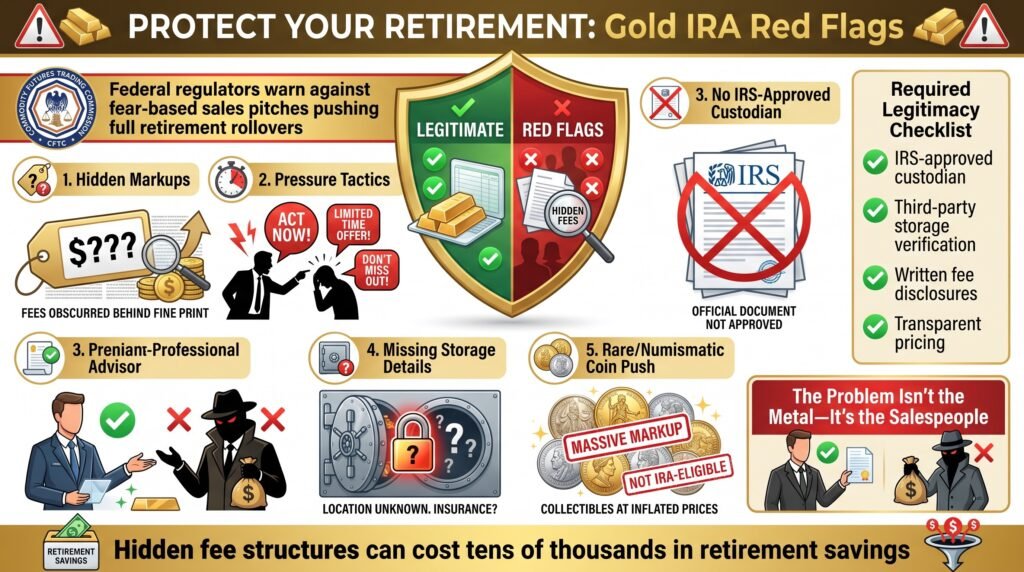
- Not all gold IRA companies operate transparently; hidden markups, commission-driven agents, and pressure tactics are common warning signs that your retirement savings are at risk.
- The CFTC has issued formal warnings about gold IRA schemes that push full retirement account rollovers into precious metals using fear-based sales pitches.
- Legitimate gold IRA investments require IRS-approved custodians, third-party storage, and clear written fee disclosures; any company that skips these steps is a major red flag.
- One of the most overlooked dangers is the push toward numismatic or “rare” coins, which carry massive markups and are generally not IRA-eligible under IRS rules.
- Keep reading to discover the nine specific warning signs, including one fee structure almost no one asks about that can quietly cost you tens of thousands of dollars.
The gold IRA industry has a serious problem, and it is not the metal itself; it is the salespeople selling it.
As economic uncertainty keeps more retirement-focused Americans looking for ways to protect their savings, the gold IRA market has grown, and so has the number of bad actors operating inside it.
Platforms like Augusta Precious Metals have highlighted how complex gold IRA structures make it easier for dishonest dealers to obscure fees, misrepresent IRS rules, and pressure investors into decisions they later regret. Understanding these red flags is not optional; it is essential for protecting your financial future.
If you are researching gold IRAs or advising clients who are, this guide breaks down every major warning sign in plain terms so you can make, or recommend, decisions with full clarity.
Table of Contents
- Quick Summary
- Guaranteed or “Risk-Free” Returns on Gold
- High-Pressure Tactics That Rush Your Decision
- Markups Far Above the Spot Price of Gold
- Pushing Rare or Numismatic Coins Over Bullion
- Unsolicited Gold IRA Offers Through Email, Phone, or Online Ads
- Frequently Asked Questions
1. Guaranteed or “Risk-Free” Returns on Gold
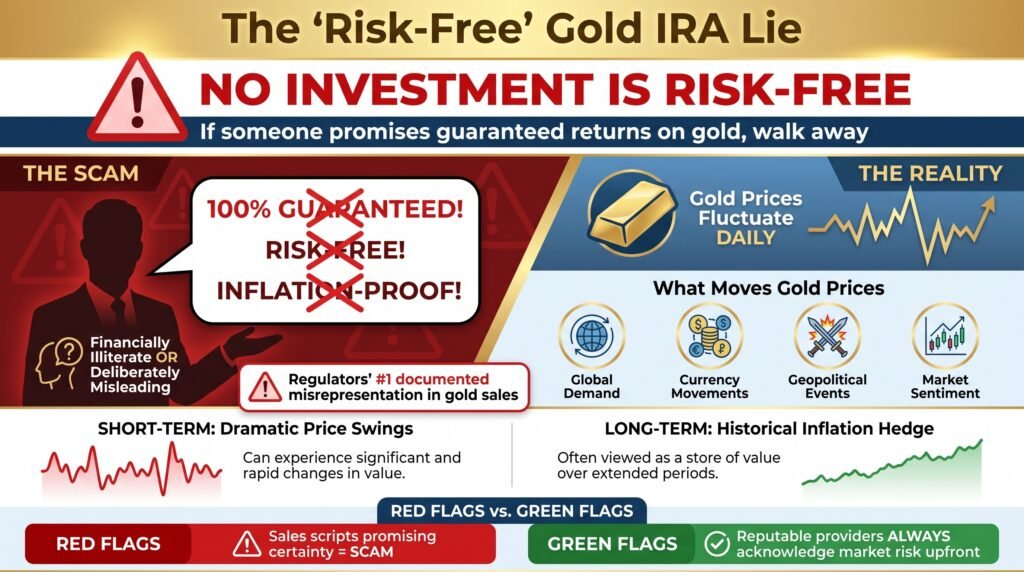
No investment is risk-free. Full stop. Gold prices fluctuate daily based on global demand, currency movements, geopolitical events, and market sentiment. Any company or sales agent who describes a gold IRA as a “guaranteed” or “risk-free” investment is either financially illiterate or deliberately misleading you, and neither option is acceptable when your retirement savings are involved. To understand more about these practices, you can read about gold and silver investing scams.
This is one of the most common misrepresentations documented by regulators. Sales scripts frequently include language designed to make gold sound uniquely protected or inflation-proof in absolute terms. While gold has historically served as a hedge against inflation over long time horizons, short-term price swings can be dramatic. The pitch of certainty is the lie. A reputable provider will always acknowledge market risk clearly and upfront.
2. High-Pressure Tactics That Rush Your Decision
If a gold IRA company is pushing you to act today, that pressure is a sales weapon, not a service. Legitimate investments do not expire overnight, and no credible financial product requires a same-day decision on your retirement savings.
Why Urgency Is a Weapon, Not a Service
High-pressure sales tactics in the gold IRA space typically sound like: “This price is only available until the end of business today,” or “The window to protect your IRA is closing fast.” These statements are engineered to bypass your rational evaluation process. The CFTC has specifically flagged scenarios where investors were encouraged to complete rollovers quickly without fully understanding the costs or structure involved, a pattern that consistently results in financial harm.
Pressure combined with fear is especially effective on retirement-age investors who feel they are running out of time to protect their savings. Sales agents in commission-driven environments are trained to exploit that anxiety. Recognizing the tactic for what it is- a closing technique, not a genuine warning- gives you the power to step back and evaluate objectively.
What Legitimate Dealers Do Instead
Reputable gold IRA companies encourage you to take your time, review all documents, consult an independent financial advisor, and ask as many questions as you need. They provide written materials, clear fee schedules, and straightforward answers without manufactured urgency. If a company welcomes your questions and does not rush a single step of the process, that is a green flag, and it is rarer than it should be.
3. Markups Far Above the Spot Price of Gold
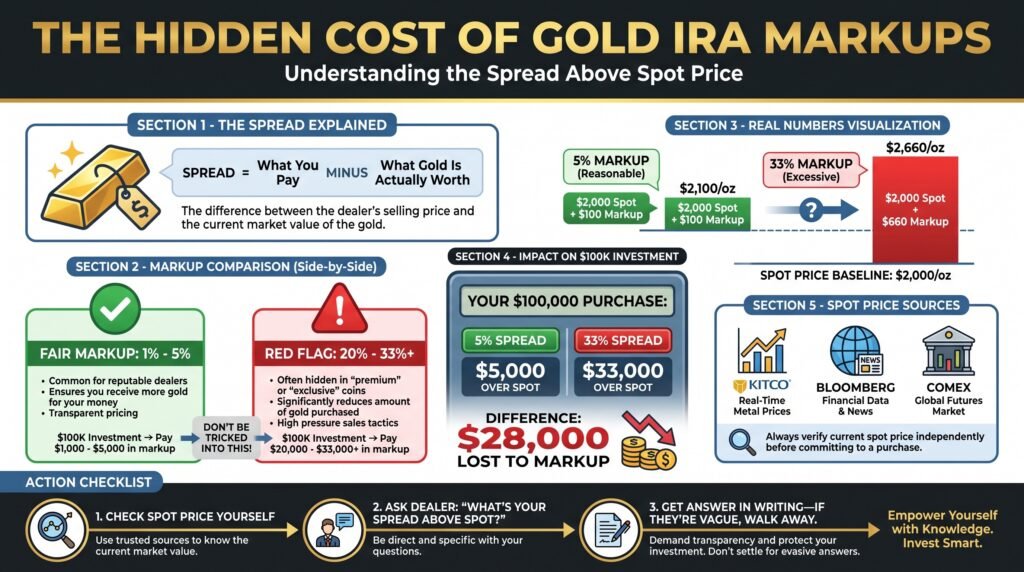
The spread, the difference between what you pay for gold and what it is actually worth on the open market, is where many investors quietly lose significant money without ever realizing it. Most gold IRA companies are not eager to discuss this number. That silence should tell you something.
Reputable dealers typically charge a spread somewhere in the range of 1% to 5% above the spot price for standard bullion products. When that number climbs to 20%, 30%, or higher, which happens more often than most investors expect, the math on your investment changes dramatically before your gold even arrives in storage.
Real-World Markup Example:
Spot price of gold: $2,000 per troy ounce
Dealer price with 5% spread: $2,100 per ounce: reasonable and transparent
Dealer price with 33% spread: $2,660 per ounce: a red flag requiring immediate scrutiny
On a $100,000 purchase, that difference represents $28,000 in hidden costs before any fees are applied.
What Is the Spot Price and Why It Matters
The spot price is the current market price at which gold can be bought or sold for immediate delivery. It is publicly available in real time through financial platforms like Kitco, Bloomberg, and the COMEX exchange. Every gold IRA transaction should be priced in direct reference to this number. When a company is vague about how their pricing relates to spot, or refuses to show you the calculation, walk away.
How to Check If You Are Being Overcharged
Before committing to any gold IRA purchase, pull the current spot price from a neutral third-party source. Then ask your dealer directly: “What is your spread above spot price on this product?” A trustworthy company will answer immediately and in writing. If the response is evasive, indirect, or buried in marketing language about “exclusive pricing,” treat that as a serious warning sign and request full written disclosure before proceeding.
Augusta Precious Metals is one example of an established precious metals provider that helps investors navigate the Gold IRA process.
Receive a free gold IRA company checklist by clicking the banner below. Fill out their short form to get started.
4. Pushing Rare or Numismatic Coins Over Bullion
One of the most sophisticated bait-and-switch tactics in the gold IRA industry involves steering investors away from standard bullion coins and toward “rare,” “exclusive,” or “collector” coins, also known as numismatic coins. The pitch often sounds compelling: these coins are supposedly more valuable, harder to find, or even protected from government seizure. Nearly all of these claims are misleading at best.
What the sales agent is less likely to mention is that numismatic coins carry markups that can reach 100% or more above their actual metal content value, and that the IRS generally does not allow collectible coins inside a gold IRA. Pushing these products into a retirement account structure is not just a financial red flag; it can create serious tax compliance problems for the investor.
The Difference Between Numismatic and Bullion Coins for IRA Investors
Bullion coins derive their value primarily from their precious metal content. Their price tracks closely with the spot price of gold or silver. Numismatic coins derive value from rarity, historical significance, and collector demand, factors that are highly subjective, illiquid, and nearly impossible to verify independently without expert appraisal. Be aware of potential gold and silver investing scams when considering these options.
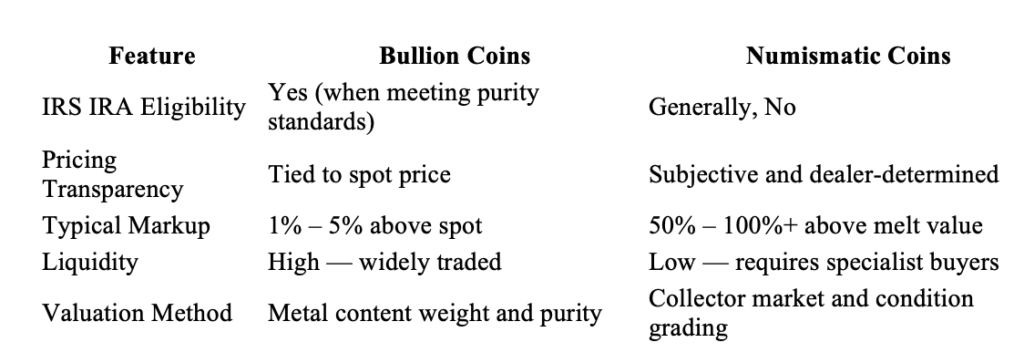
IRS-approved bullion coins for gold IRAs include the American Gold Eagle (at specific purity levels), the Canadian Gold Maple Leaf, the Austrian Philharmonic, and gold bars or rounds meeting a minimum purity standard of .995 fine gold. If a dealer is pushing anything outside of these clearly defined categories, ask for the specific IRS code citation that makes that product eligible, and expect a very uncomfortable silence in response.
Why Collectible Coins Are a Common Bait-and-Switch Tool
The profit margin on numismatic coins is vastly higher than on standard bullion. A sales agent earning commission has enormous financial incentive to move you toward a $3,000 “rare” coin with $800 in actual gold content rather than a standard bullion coin priced at a 3% premium. The language around these products is carefully crafted to make exclusivity feel like protection. It is not. It is a margin play at your expense.
Any unsolicited mention of coins being “rare,” “limited edition,” “government seizure-proof,” or “insider access” products should trigger immediate skepticism. These phrases exist in sales scripts specifically because they work on investors who are not yet familiar with how gold IRA eligibility rules actually function.
5. Unsolicited Gold IRA Offers Through Email, Phone, or Online Ads
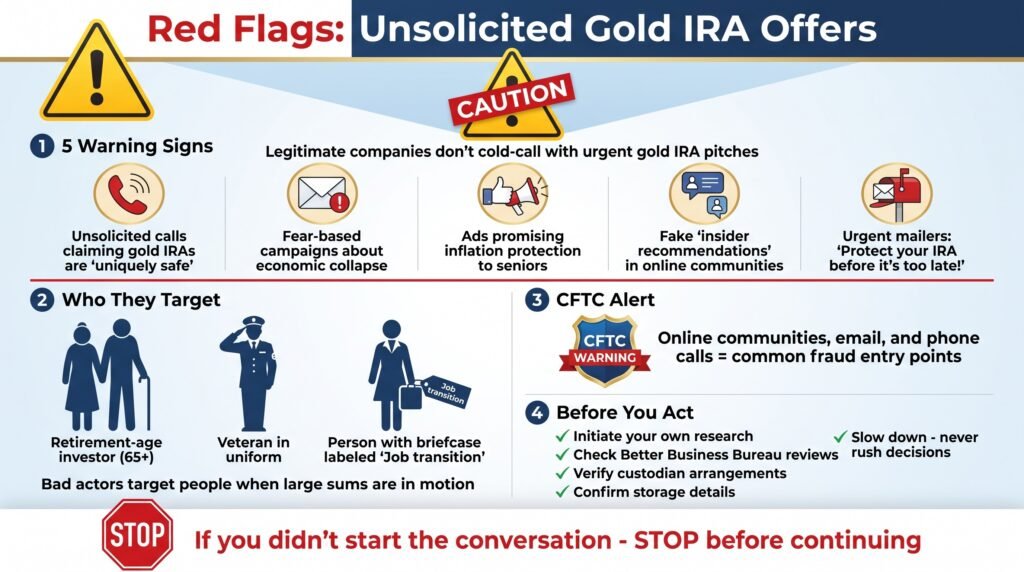
Legitimate financial companies do not cold-call retirement investors with urgent gold IRA pitches. If you received an offer you did not seek out, through a phone call, an unsolicited email, a social media advertisement, or an online community post, treat it with significant caution. The CFTC has specifically identified targeted marketing through online communities, email outreach, and phone calls as a common entry point for gold IRA fraud schemes.
- Unsolicited phone calls promoting gold IRAs as uniquely safe retirement vehicles
- Email campaigns using economic fear language to drive rollover decisions
- Social media ads targeting older adults with promises of inflation protection
- Online community posts presenting gold IRA companies as insider recommendations
- Mailers or postcards with urgent language about protecting your IRA “before it’s too late”
The targeting is not random. Bad actors in this space specifically pursue retirement-age investors, veterans, and individuals who have recently experienced job changes or major life transitions, moments when large sums of money are in motion and decisions are being made quickly. If you did not initiate the conversation, slow down before you continue it.
Even if the company behind an unsolicited offer turns out to be legitimate, the tactic itself reflects a sales culture that prioritizes acquisition over your best interests. Start your own research on your own terms. Independent reviews, third-party verification through the Better Business Bureau, and direct confirmation of custodian and storage arrangements should always come before any money moves.
Learn about 4 additional, but lesser-known, red flags to be aware of when selecting a gold IRA company here.
If you want a full gold IRA integrity checklist from one of the most reputable companies within this space, access their checklist by clicking the banner below and fill out their short contact form to get started.

Frequently Asked Questions
The questions below address the most common points of confusion among investors researching gold IRAs, including several areas where deliberate misinformation is most frequently encountered.
Each answer reflects current IRS rules and regulatory guidance. Where rules may have changed, or personal circumstances affect the answer, consultation with an independent tax or financial professional is always the recommended next step before taking action.
What is a Gold IRA and how does it differ from a regular IRA?
A gold IRA is a self-directed individual retirement account that holds physical precious metals, such as gold bullion coins or bars, instead of or in addition to traditional paper assets like stocks, bonds, and mutual funds. It operates under the same IRS tax rules as a traditional or Roth IRA, including the same contribution limits, distribution rules, and required minimum distribution schedules.
The key structural difference is that a gold IRA requires a specialized IRS-approved custodian who is set up to manage alternative assets, and it requires an approved third-party depository to physically store the metals. You cannot use a standard brokerage account to hold physical gold inside an IRA, and you cannot store IRA-owned gold yourself.
The tax treatment of a gold IRA depends on whether it is structured as a traditional IRA or a Roth IRA. In a traditional gold IRA, contributions may be tax-deductible, and growth is tax-deferred until withdrawal. In a Roth gold IRA, contributions are made with after-tax dollars, and qualified withdrawals in retirement are tax-free.
One critical distinction that is frequently misrepresented by gold IRA sales agents: a gold IRA does not offer any special or additional tax advantages beyond those of any other IRA structure. The tax benefits come from the IRA wrapper, not from the gold itself. Any pitch suggesting otherwise is inaccurate.
Are Gold IRAs a safe investment?
Gold IRAs are not inherently safe or unsafe; the answer depends entirely on how they are structured, who is managing them, and what products are inside the account. Physical gold held inside a properly structured self-directed IRA with an IRS-approved custodian and an approved depository is a legitimate retirement investment. The danger is not the metal. The danger is the industry built around selling it, where misleading tactics, hidden markups, and pressure-based sales practices create significant financial risk for investors who do not know what to look for.
Over very long-time horizons, gold has preserved purchasing power reasonably well, but it has also experienced extended periods of flat or declining value. A well-managed gold IRA with transparent fees, IRS-eligible products, and realistic expectations about performance can serve a legitimate diversification role inside a retirement portfolio. An overpriced, poorly disclosed gold IRA sold through high-pressure tactics can quietly destroy retirement savings.
What is the spot price of gold and why does it matter when buying?
The spot price of gold is the current market price at which one troy ounce of gold can be bought or sold for immediate delivery on the open market. It is determined continuously by trading activity on major commodities exchanges, including the COMEX division of the New York Mercantile Exchange and the London Bullion Market Association.
The spot price is publicly available in real time through financial data platforms including Kitco, Bloomberg, and Reuters, and it changes throughout the trading day based on global supply and demand dynamics, currency movements, interest rate expectations, and broader market sentiment. Understanding these dynamics can help you avoid gold investing scams.
For gold IRA investors, the spot price is the essential reference point for evaluating every purchase. The spread, the amount above spot that a dealer charges for a specific coin or bar, is where your actual cost lives. A reputable dealer will charge a transparent, documented spread typically in the range of 1% to 5% above spot for standard bullion products.
When that spread is hidden, vague, or dramatically higher than market norms, the investor absorbs the difference as an immediate loss on the value of their investment. Before completing any gold IRA purchase, pull the current spot price from a neutral third-party source and calculate exactly what premium above spot you are being asked to pay, then get that number confirmed in writing.
How do I know if a gold IRA company is legitimate?
Gold IRA Company Legitimacy Checklist:
✓ Verifiable physical business address confirmed through independent sources
✓ Named leadership with traceable professional backgrounds
✓ Accredited with the Better Business Bureau with a clear complaint history
✓ Listed and reviewed on Business Consumer Alliance
✓ No enforcement actions in CFTC or SEC regulatory databases
✓ Named IRS-approved custodian that can be contacted independently
✓ Named approved storage depository with documented fee schedule
✓ Full written fee disclosure provided before any transaction
✓ Spread above spot price disclosed in writing on request
✓ No pressure tactics, manufactured urgency, or fear-based language
Legitimacy in the gold IRA space is confirmed through independent verification, not through a company’s own marketing materials, website testimonials, or the confidence of its sales agents. Any company can build a professional-looking website and script a compelling phone pitch. What separates legitimate operations from fraudulent ones is their willingness to be verified externally at every level of their business.
The Better Business Bureau and Business Consumer Alliance are your first stops. Search the company name, not just the brand, but any parent company or doing-business-as names associated with it. Read the full complaint history, not just the rating. A company with an A+ rating but thirty unresolved complaints about billing disputes or delivery problems is telling you something important through that complaint record that the letter grade does not capture.
Next, confirm the custodian. Every gold IRA requires an IRS-approved custodian, and a legitimate company will name that custodian immediately and without hesitation.
Finally, run the company name and its principals through the CFTC’s enforcement database and the SEC’s EDGAR and enforcement records. Regulatory actions, consent orders, and fraud findings are public record. If anything comes up, walk away without further engagement. If nothing comes up, you have at least confirmed the absence of a documented regulatory history, which combined with all other verification steps, gives you a reasonable foundation for further evaluation.
If you want a complete gold IRA company integrity checklist, receive Augusta Precious Metals detailed guide by clicking the banner below to get started.

Sources:
Augusta Precious Metals – 5 Questions to Ask Before Choosing a Gold IRA Company
USA Today: Gold and silver investing scams: Red flags and how to protect yourself
https://www.usatoday.com/story/money/investing/gold-and-silver-investing-scams/88744022007/
*Disclaimer: This article is written for educational purposes and should not be interpreted as financial advice. We may receive compensation for referrals made through this article.
Leave a Reply