Quick Summary
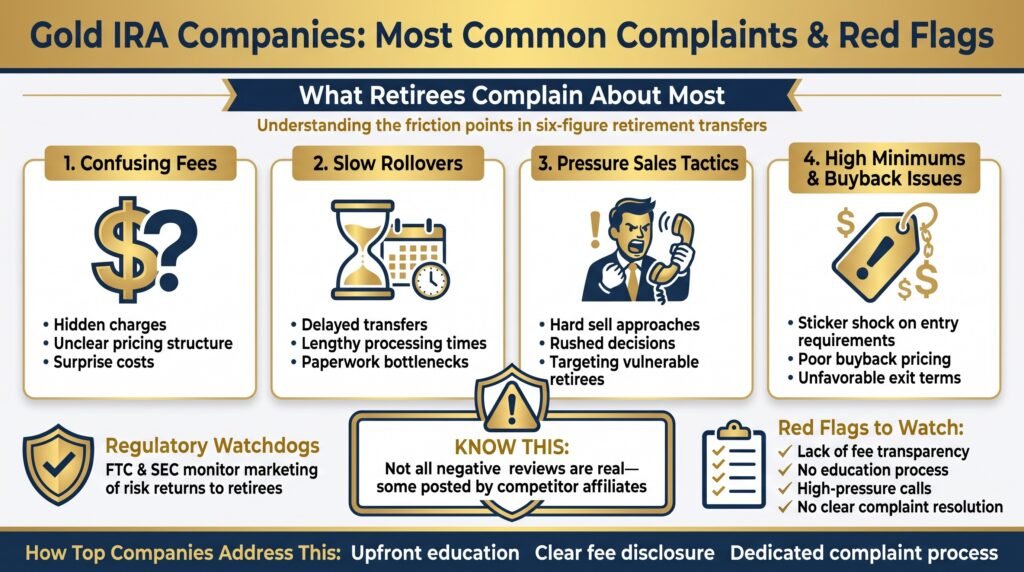
Gold IRA companies get complaints about the same handful of issues: confusing fees, slow rollovers, pressure-sale tactics, and sticker shock over minimum investments.
If you’ve started researching gold IRAs, you’ve probably stumbled across a mixed bag of reviews, some glowing, some furious. That’s normal for any company handling six-figure retirement transfers.
Augusta Precious Metals has built its reputation partly by addressing these friction points head-on, which makes it a useful lens for understanding what actually goes wrong in this industry and what doesn’t.
Key Takeaways
-Knowing which red flags to watch for before you invest can save you from the headaches that generate most of these complaints in the first place
-The most common complaints about Gold IRA companies involve fee transparency, rollover delays, buyback pricing, and sales pressure on retirees
-Not every negative review reflects a real customer experience; some come from affiliate marketers promoting competitors
-Regulators like the FTC and SEC watch how gold IRA companies market risk and returns, especially to retirees
Table of Contents
- Why Do These Complaints Happen in the First Place?
- Red Flags That Signal a Problem Gold IRA Company
- How to Tell a Real Complaint From Noise
- Who Regulates Gold IRA Companies?
- The Case for a Reputable Gold IRA Company
- Frequently Asked Questions
Why Do These Complaints Happen in the First Place?
Most gold IRA complaints trace back to one of two root causes: a company that didn’t communicate clearly, or an investor who didn’t ask enough questions before signing. Understanding which one you’re dealing with helps you separate a legitimate red flag from a simple misunderstanding.
Lack of Investor Education Before Buying
A surprising number of complaints stem from investors who didn’t fully grasp what a gold IRA involves before they opened one.
They didn’t realize storage fees were ongoing, didn’t know required minimum distributions still applied, or assumed gold prices only move upward.
Companies that invest time in educating clients before the sale tend to generate far fewer of these complaints down the line.
Aggressive Sales Tactics Targeting Retirees
Retirees sitting on large 401(k) balances are an attractive target for high-pressure sales reps, and some gold IRA companies lean on urgency to close deals fast.
Phrases like “prices are about to spike” or “this offer expires today” push people toward decisions they haven’t fully thought through. Regulators pay close attention to this kind of marketing precisely because it preys on people who can’t afford to make a costly mistake with retirement funds.
Overpriced Collectible Coins vs. Bullion
Some dealers push numismatic or “collectible” coins that carry markups far higher than standard bullion, often without clearly explaining the difference to the buyer.
A one-ounce gold bullion coin might carry a modest premium over spot price, while a collectible version of a similar coin can cost 30% to 50% more with little added resale value. Investors who later try to sell these coins and discover their real market value often file complaints about being misled.
Misleading “Safe Investment” Marketing
Gold is frequently marketed as a hedge against inflation and economic uncertainty, which is true to a point.
But some companies blur the line between “hedge” and “guaranteed safe,” leading investors to believe their principal can’t lose value.
When gold prices dip and the investor’s balance drops with it, the gap between marketing promises and market reality becomes a common source of complaints.
Supply Chain Delays Affecting Delivery
Physical gold and silver have to be minted, verified, and shipped, and when demand spikes or mint production slows, delivery times stretch out.
This isn’t always something a dealer can control, but companies that don’t set realistic delivery expectations upfront end up fielding complaints that could have been avoided with a simple heads-up.
Red Flags That Signal a Problem: Gold IRA Company
Not every complaint points to a bad actor, but certain patterns should make you pause before handing over your retirement savings. Watch for these warning signs during your research and sales conversations.
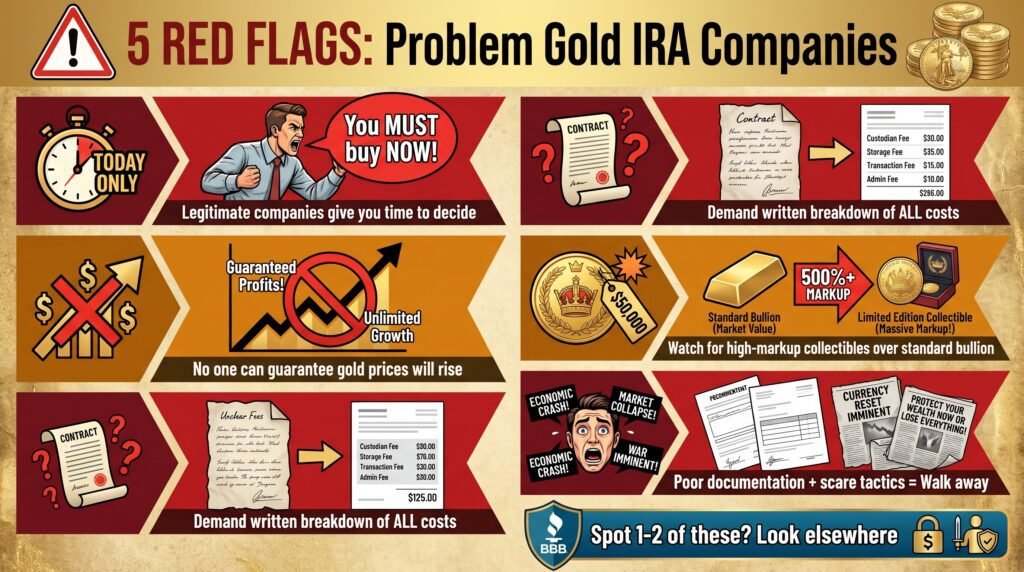
Phrases Like “You Must Buy Today”
Legitimate gold IRA providers understand that a six-figure retirement decision deserves time and consideration. If a sales rep insists you need to act immediately or lose out on pricing, treat that as a signal to slow down, not speed up.
Guaranteed Profit or Appreciation Claims
No one can guarantee gold prices will rise. Any company promising fixed returns or guaranteed appreciation is making a claim that doesn’t match how commodity markets actually work, and it’s worth walking away from that conversation entirely.
No Written Breakdown of Fees
If a company can’t or won’t give you a full, itemized list of setup fees, annual custodian fees, storage costs, and buyback terms in writing, that’s a problem. Verbal promises don’t hold up when a dispute arises later.
Heavy Push Toward Collectible Coins
If a rep consistently steers you toward “rare” or “limited edition” coins instead of standard bullion, ask why. Collectible coins often carry markups that benefit the dealer far more than they benefit your retirement account.
Poor Documentation and Fear-Based Selling
Reputable companies document every transaction clearly and give you time to review paperwork before you sign.
If you notice missing confirmations, vague contracts, or a rep who leans on fear about economic collapse to rush your decision, those are patterns worth taking seriously.
Taken together, these red flags show up again and again in the complaint data across BBB listings and consumer forums.
Spotting even one or two during your research process is often enough reason to look elsewhere. For more insights, consider reviewing common gold IRA complaints to better inform your decision.
How to Tell a Real Complaint From Noise
Not every negative review deserves equal weight. Some complaints reflect genuine service failures; others come from frustrated investors who misunderstood the product, or from affiliate marketers with a financial incentive to promote a competitor.
Learning to filter signal from noise saves you from writing off a solid company over a handful of unreliable reviews.
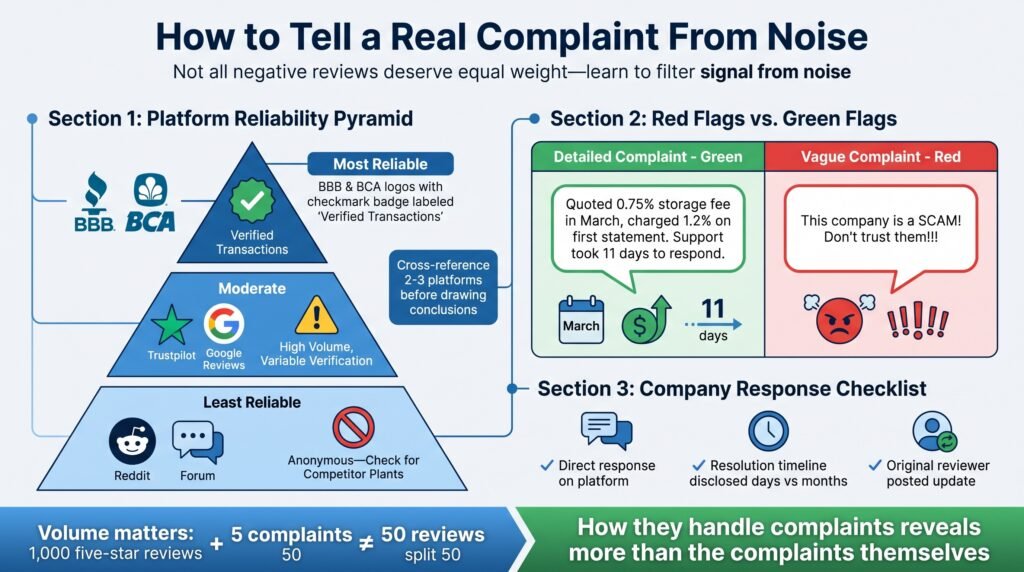
Check the Platform: BBB, Trustpilot, or Random Forum?
-Better Business Bureau (BBB) and Business Consumer Alliance (BCA) ratings typically require verified transactions, making them more reliable
-Trustpilot and Google Reviews offer a large volume of feedback but vary in verification standards
-Reddit threads and anonymous forums can include useful firsthand accounts, but they’re also where competitor-planted complaints are most likely to show up
Start with verified platforms before trusting anonymous posts. A BBB profile with an A+ rating and a long track record of responses carries more weight than a single angry Reddit comment.
It’s also worth checking how many total reviews a company has versus how many complaints.
A company with thousands of five-star reviews and a handful of complaints looks very different from one with a few dozen reviews split evenly between praise and frustration.
Cross-reference complaints across at least two or three platforms before concluding. Patterns that show up consistently across BBB, Trustpilot, and independent forums are far more telling than a single isolated post.
Look for Detail vs. Vague Emotional Venting
A credible complaint usually includes specifics: dates, dollar amounts, names of representatives, and a clear sequence of events. Vague complaints that say little more than “terrible company, stay away” without any supporting detail are harder to verify and easier to dismiss.
Specific complaints are also easier for the company to investigate and respond to, which brings up the next filter.
Ask yourself whether the complaint reads like a factual account or an emotional reaction. Both can be valid, but factual, detailed complaints deserve more weight when you’re deciding whether a pattern of real problems exists.
-Detailed complaint: “I was quoted a 0.75% annual storage fee in March but was charged 1.2% in my first statement, and support took 11 days to respond to my email.”
-Vague complaint: “This company is a scam, don’t trust them.”
See If the Company Responded and Resolved the Issue
How a company handles a complaint often matters more than the complaint itself. A professional, timely response that resolves the issue suggests a company takes accountability seriously. Silence, or a defensive, dismissive reply, suggests the opposite.
- Look for a direct response from the company on the review platform itself
- Check whether the resolution timeline is disclosed (days vs. months)
- See if the original reviewer updated their post after the company responded
Almost every large financial or precious metals company receives some complaints simply due to the volume of transactions they handle.
The real test isn’t whether complaints exist; it’s whether the company treats each one as a chance to fix a problem or brushes it aside
Who Regulates Gold IRA Companies?
Gold IRA companies don’t operate in a regulatory vacuum. Several federal and state bodies oversee different pieces of how these companies market, sell, and handle precious metals transactions.
Federal Trade Commission (FTC) and Deceptive Advertising
The FTC monitors deceptive advertising and unfair business practices, which covers misleading “guaranteed returns” claims or false scarcity tactics used to pressure buyers. Companies that cross this line risk formal enforcement action, not just bad reviews.
SEC Oversight of Investment Conduct
The Securities and Exchange Commission monitors investment-related conduct and investor protection more broadly. While physical gold itself isn’t a security, how a company markets gold as part of a retirement strategy can fall under SEC scrutiny.
This matters most when a company blurs the line between selling a physical commodity and offering investment advice without proper licensing.
CFTC Involvement With Metals Trading Products
The Commodity Futures Trading Commission steps in if a company offers leveraged metals trading products or futures-based investments rather than straightforward physical bullion purchases.
This is less common in standard gold IRA setups but worth knowing about if a company offers anything beyond simple physical metal purchases.
State Attorneys General and Consumer Fraud Claims
Beyond federal regulators, state attorneys general can investigate consumer fraud complaints filed by residents of their state.
This adds another layer of accountability, particularly for complaints involving deceptive sales practices targeting elderly or retired investors.
Regulators across all these bodies pay particularly close attention to how companies advertise risk, returns, and investment safety when the target audience is retirees managing their life savings.
Click the banner below to receive a free gold IRA integrity checklist from their official site. Fill out their short contact form to get started.

The Case for a Reputable Gold IRA Company
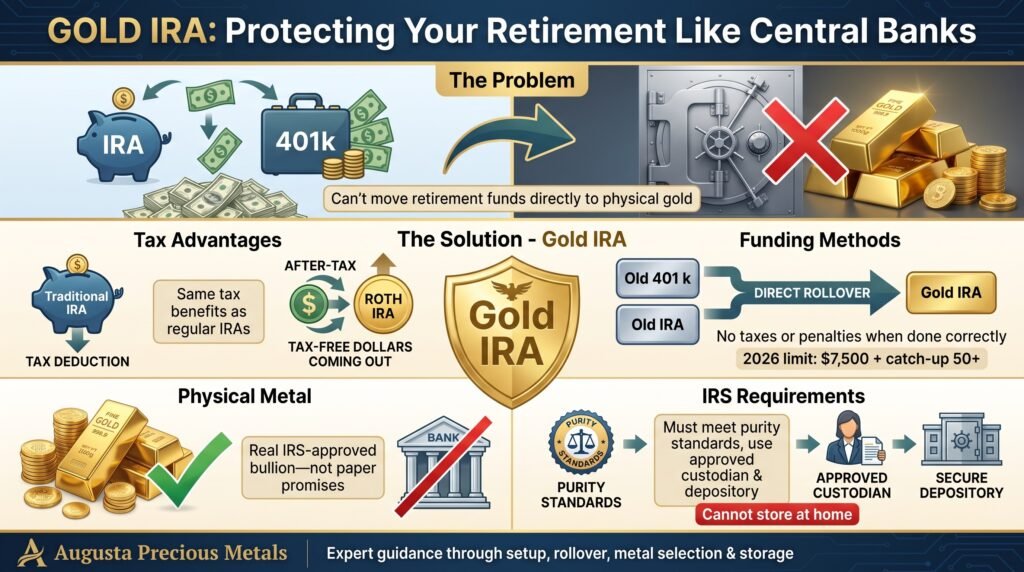
The challenge for many people is that most of their wealth sits in retirement accounts, such as IRAs and 401(k)s, where it can’t simply be moved into a safe full of bullion. That is where a gold IRA comes in.
A gold IRA is a self-directed individual retirement account that holds physical precious metals instead of, or in addition to, traditional paper assets. It offers several features worth understanding:
Tax advantages. A gold IRA follows the same tax framework as other IRAs. In a traditional gold IRA, contributions may be tax-deductible, and growth is tax-deferred until withdrawal.
You gain exposure to physical metal without the immediate tax hit you could face if you simply sold other investments to buy gold.
Rollovers and transfers. Many savers fund a gold IRA by rolling over or transferring funds from an existing IRA or an old 401(k), such as one from a former employer. When done correctly as a direct rollover, this generally doesn’t trigger taxes or penalties.
For direct contributions, ordinary annual IRA limits apply (for 2026, $7,500, with an additional catch-up contribution for those 50 and older).
Physical metal, outside the banking system. Unlike gold-focused funds or mining stocks, a gold IRA holds actual IRS-approved bullion and coins. There is no counterparty promising to deliver value, which is the same quality that appeals to central banks.
IRS rules to know: The metals must meet IRS purity standards, and they must be held by an approved custodian and stored in an approved depository. You can’t keep IRA metals at home. A qualified provider helps you navigate these requirements so mistakes don’t trigger penalties.

Where Augusta Precious Metals Fits
Setting up a gold IRA involves several moving parts: choosing a self-directed IRA custodian, completing the rollover paperwork, selecting eligible metals, and arranging secure storage. That is where a specialist can help.
Augusta Precious Metals is a precious metals firm that helps individuals open and fund tax-advantaged gold and silver IRAs and walks them through each of those steps.
Their approach emphasizes education, so that you understand what you’re buying, what it costs, and how it fits into your overall retirement picture before you commit. Augusta is a leading gold-investing company known for trust, customer empowerment, and competitive prices.

If you already hold some gold and silver and want a second opinion on whether you’re positioned properly, Augusta can review your situation.
If you hold none and your savings are concentrated in dollar-denominated assets, a conversation about a gold IRA is a reasonable first step toward building a plan that covers both the present and whatever comes after a possible reset or revaluation.
Augusta Precious Metals Testimonials

Click the banner below to receive a free Gold IRA integrity checklist from their official site. Fill out their short contact form to get started.
Frequently Asked Questions
These quick answers cover the questions that come up most often once investors start comparing gold IRA companies.
Are Gold IRA Complaints a Sign the Industry Is a Scam?
No. Almost every large financial or precious metals company receives some complaints simply due to transaction volume.
What matters is whether complaints show a pattern of unresolved issues or whether the company responds quickly and fixes problems.
What’s the Average Resolution Time for a Gold IRA Complaint?
Resolution time varies by company and complaint type, but well-run companies typically respond within days rather than weeks. A slow or absent response is a bigger warning sign than the complaint itself.
When you’re researching a company, check the response timestamps on its BBB or Trustpilot profile to get a sense of how quickly issues typically get addressed.
Look specifically for:
-A documented response from the company within the review thread itself
-A clear explanation of what caused the issue
-Confirmation from the original reviewer that the problem was resolved
Can I Lose All My Money in a Gold IRA?
Gold can lose value, but losing your entire investment isn’t typical unless you’re dealing with outright fraud.
More commonly, losses come from a combination of market dips, high fees, and steep markups rather than the metal itself disappearing.
Market risk: gold prices fluctuate based on economic conditions
Fee drag: ongoing storage and custodian fees reduce net returns over time
Markup risk: overpaying upfront for collectible coins makes it harder to break even
Diversifying within your broader retirement portfolio, rather than putting everything into gold, reduces the impact of any single risk factor.
Work with a company that’s transparent about all three risk categories before you commit funds.
How Do I File a Complaint Against a Gold IRA Company?
Start with the company’s own customer service process, then escalate to the Better Business Bureau or Business
Consumer Alliance if the issue isn’t resolved.
For suspected fraud or deceptive marketing, you can also file a report with the FTC or your state attorney general’s office.
What’s the Difference Between Bullion and Collectible Coins?
Bullion coins are valued primarily based on their metal content and carry a relatively small markup over spot price.
Collectible or numismatic coins carry additional value tied to rarity or condition, which often means a much higher markup with less predictable resale value.
For a straightforward retirement hedge, bullion is typically the more transparent and liquid choice.
Click the banner below and fill out their short contact form on their site to get started.
*Disclaimer: This article is written for educational purposes and should not be interpreted as financial advice. We may receive compensation for referrals made through this article.
Leave a Reply