Key Takeaways
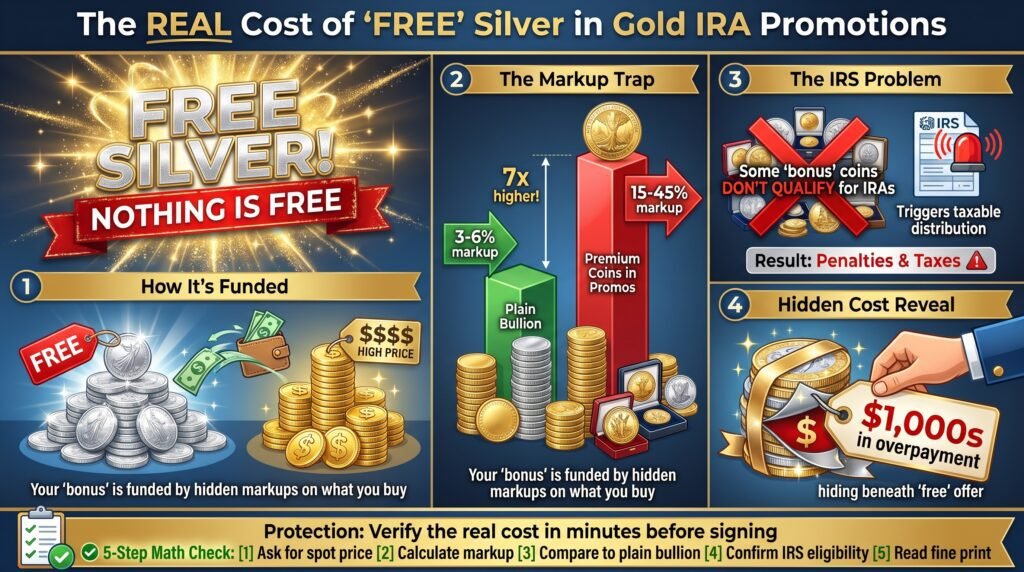
Free silver promotions are funded by markups on premium coins, not given away out of generosity.
Premium coins can carry 15-45% markups over spot price, far above the 3-6% typical on plain bullion.
Some coins offered in “bonus” bundles don’t even qualify for IRA accounts under IRS rules, which can trigger a taxable distribution.
Resources like this breakdown on gold IRA fees and promotions can help you spot the real cost behind a “free” offer before you sign anything.
A simple five-step math check can tell you in minutes whether a free silver deal is a good one or a trap.
That shiny pitch about “free silver” when you open a Gold IRA almost always comes with strings attached that cost you more than the silver is worth.
Dealers know that the word “free” grabs attention, and they build entire marketing campaigns around it. But the silver isn’t falling out of the sky. It’s paid for somewhere else in the transaction, usually buried inside the price of the gold or silver coins you’re buying.
Understanding exactly how that works is the difference between getting a fair deal and quietly overpaying by thousands of dollars.
Table of Contents
- The “Free” Silver Trick Dealers Don’t Explain
- How Some Dealers Fund Your “Free” Bonus
- Could Your Free Silver Bonus Tank Your IRA?
- Regulators Are Already Watching These Offers
- 5 Sales Pitches That Should Raise a Red Flag
- What Texas Investors Need to Know
- The Case for a Reputable Gold IRA Company
- Frequently Asked Questions
The “Free” Silver Trick Dealers Don’t Explain
Precious metals dealers didn’t invent the “buy this, get that free” model, but they’ve perfected it for retirement accounts. The pitch sounds generous: roll over your 401(k) or IRA, and the company throws in a set amount of silver at no extra charge. It feels like a bonus. In reality, it’s a pricing lever.
Free Silver Is a Marketing Tool, Not a Gift
Every ounce of “free” silver a dealer hands you gets paid for somewhere. Dealers don’t operate charities; they operate businesses with margins built into every coin they sell.
When a company offers free silver, that cost gets absorbed into the price of the gold or silver you’re purchasing, usually through a higher markup on premium or semi-numismatic coins rather than plain bullion.
Two Versions: IRA Bonus vs. Home Delivery Lure
These offers typically show up in two forms. The first is an IRA bonus, where opening or funding a retirement account with precious metals unlocks a silver bonus scaled to your rollover size.
The second is a home delivery lure, where buying physical silver or gold for personal storage comes with “bonus” coins shipped to your door. Both work the same way under the hood: the free item is funded by markup on the paid item.
Why the Silver Itself Isn’t the Problem
It’s worth being clear that silver bullion itself isn’t the issue here. American Silver Eagles, for example, are legitimate, IRA-eligible coins under federal law.
The problem isn’t the metal; it’s the pricing structure wrapped around it, and whether the coins used to fund your “free” bonus are overpriced, ineligible for your IRA, or both.
How Some Dealers Fund Your “Free” Bonus
To understand the real cost of a free silver offer, you need to know how dealer premiums work across different coin categories. The gap between what’s fair and what’s inflated is wider than most buyers realize.
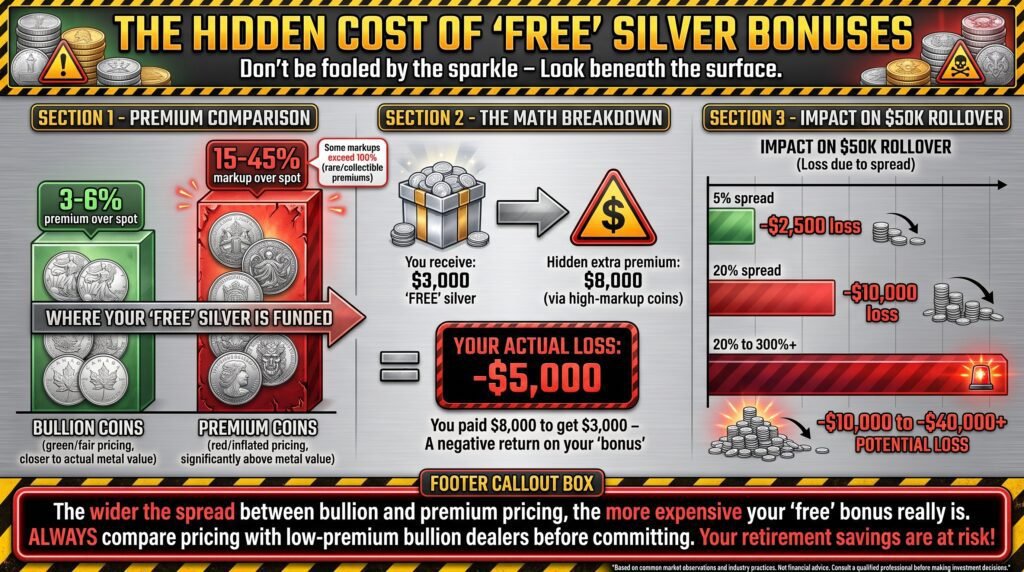
Bullion Coins Carry a 3-6% Premium Over Spot
Standard bullion American Gold Eagles typically sell for 3% to 6% above the spot price of gold. That premium covers minting, distribution, and dealer margin, and it’s considered the baseline cost of owning physical gold in a straightforward, liquid form.
Premium Coins Carry a 15-45% Markup
Premium coins are a different animal entirely. Proof Eagles, semi-numismatic issues, and graded coins can carry markups of 15% to 45% over spot.
That’s the category dealers most often use to fund free silver bonuses, because the extra margin gives them room to “give away” metal while still turning a profit.
Court records from state enforcement actions have shown some premium coin lines marked up over 100% above spot.
When a dealer pushes you toward a premium or graded coin as part of a bonus bundle, that premium gap is exactly where your “free” silver gets paid for.
A Real Math Example: $3,000 in Silver for $8,000 in Hidden Fees
Here’s a documented example of how this plays out. One tested offer promised a $3,000 silver bonus, but the premium coins used to fund that rollover carried an extra $8,000 in markup compared to plain bullion pricing.
In other words, the buyer paid $8,000 more than necessary to receive $3,000 worth of “free” silver.
- Advertised bonus: $3,000 in silver
- Extra premium paid to fund it: $8,000
- Net cost to the buyer: $5,000 more than a plain bullion purchase
That’s not a bonus. That’s a $5,000 loss dressed up as a gift.
Dealer Spreads Can Range From 20% to Over 300%
On a $50,000 rollover, even a five-point drop in pricing efficiency wipes out $2,500 worth of metal. A twenty-point drop erases $10,000.
Spreads between bullion and premium-coin pricing can run anywhere from 20% to well over 300%, depending on the product line and how aggressively a dealer is pushing numismatic or graded coins. The wider that spread, the more expensive your “free” silver really is.
Could Your Free Silver Bonus Tank Your IRA?
Beyond overpaying, there’s a second risk that’s even more serious: some coins used in bonus promotions don’t legally qualify for IRA ownership at all.
IRS Rule 408(m): The Collectibles Ban
Under Internal Revenue Code Section 408(m)(1), if your IRA acquires a collectible, the IRS treats that purchase as a distribution equal to the collectible’s full cost. That’s not a penalty on future growth; that’s an immediate taxable event the day the coin enters your account.
Which Coins Actually Qualify for an IRA
Section 408(m)(3) carves out specific exceptions. Gold coins defined in 31 USC 5112(a)(7)-(10), silver coins under 5112(e), platinum coins under 5112(k), certain state-issued coins, and bullion meeting required fineness levels all qualify.
Required purity sits at 99.5% for gold, 99.9% for silver, and 99.95% for platinum and palladium.
What Happens the Day an Ineligible Coin Enters Your Account
Semi-numismatic issues, graded slabs, and pre-1933 gold priced for its collectible grade fall outside that carve-out.
If one of those coins lands in your IRA, custodians are required to reject it at the depository door under IRC 408(m), and if it somehow gets through, it’s treated as a deemed distribution the moment it enters the account. A free silver bonus doesn’t fix that problem. It can’t.
Why American Silver Eagles Pass the Test
American Silver Eagles are explicitly IRA-eligible under 31 USC 5112(e), making them one of the safer bonus options if a dealer offers them.
The lesson here isn’t that free silver is inherently risky; it’s that you need written confirmation of eligibility on every single coin in a bonus bundle before you agree to anything.
Regulators Are Already Watching These Offers
Free silver promotions haven’t escaped the attention of federal and state regulators. Several agencies have published specific guidance aimed at helping investors spot inflated pricing dressed up as a bonus, and at least one major dealer has already faced consequences for how it handled these offers.
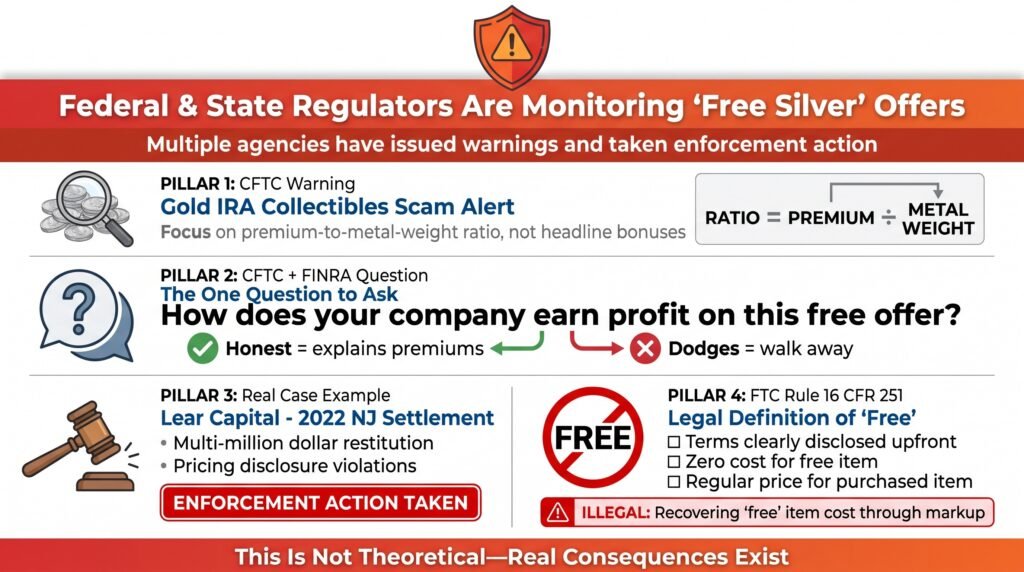
What the CFTC’s “Gold IRA Collectibles Scam” Warning Says
The Commodity Futures Trading Commission runs an investor education series called “Learn and Protect,” which includes a piece titled The Gold IRA Collectibles Scam alongside another called Gold and Silver Frauds Do the Math.
The core message in both is simple: the ratio between a coin’s premium and its actual metal weight is the number that matters most, not the headline bonus a dealer advertises.
The Question CFTC and FINRA Say You Must Ask
In joint guidance, the CFTC and FINRA advise investors to directly ask a dealer how the company earns its profit, “especially if it appears to be giving away precious metal or offering other big freebies.”
That one question tends to cut through the marketing fast, because a dealer offering a straight answer will point to coin premiums, while one dodging the question is worth walking away from.
Lear Capital’s 2022 New Jersey Settlement
This isn’t theoretical. In 2022, the New Jersey Bureau of Securities entered a consent order against Lear Capital that included multi-million-dollar restitution to New Jersey investors tied to precious-metals pricing disclosures.
It’s a clear example of how pricing practices around bonus and premium coin sales have drawn real regulatory scrutiny, not just investor complaints.
The FTC’s Rule on “Free” Offers
The Federal Trade Commission has its own rule governing how the word “free” can legally be used in advertising.
Under 16 CFR Part 251, terms for a free item must be “set forth clearly and conspicuously at the outset,” and consumers are entitled to pay nothing for the free item and no more than the regular price for whatever they’re buying alongside it.
Critically, the FTC guidance states that a dealer should not recover the cost of a free item by marking up the item being purchased, which is exactly the practice regulators have flagged in several precious-metals cases.
5 Sales Pitches That Should Raise a Red Flag
Dealers rely on a handful of recurring phrases to make free silver offers sound more generous and more urgent than they really are. Recognizing these patterns before you’re on the phone with a salesperson puts you in a much stronger position.
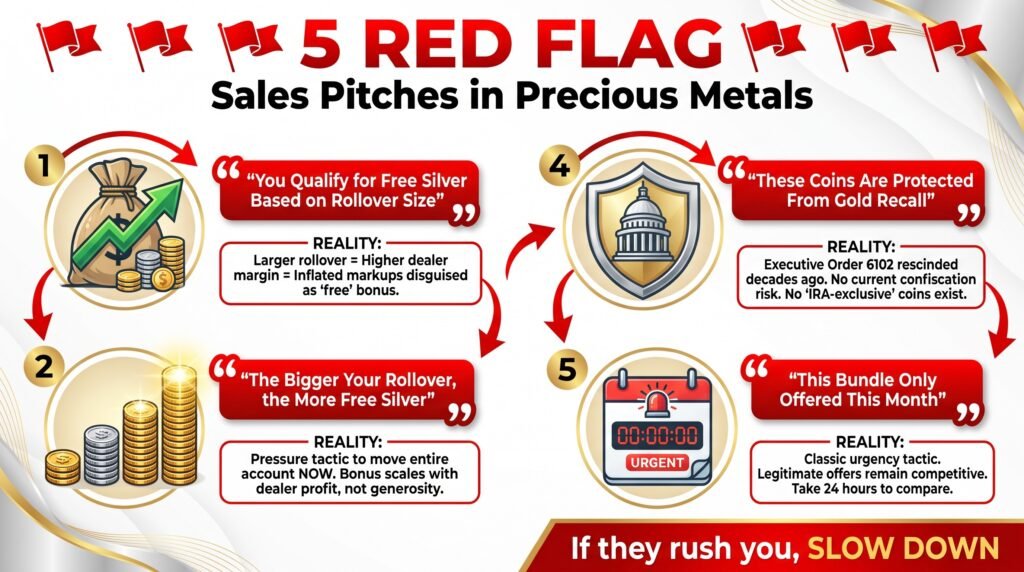
1. “You Qualify for Free Silver Based on Rollover Size”
This framing makes the bonus sound like a reward for how much you’re moving over, when in reality it just means the dealer has more margin to work with on a larger order.
The bigger your rollover, the more premium they can bake into the coins they sell you, and the more “free” silver they can afford to hand back as a percentage of that inflated markup.
2. “The Bigger Your Rollover, the Freer Silver”
This is the scale framing taken a step further, often used to pressure buyers into moving their entire account right now instead of taking a measured approach.
The bonus scales because dealer margin scales, not because the company is being more generous with larger relationships. If anything, a bigger rollover deserves more scrutiny, not less, since more of your retirement money is riding on the pricing being fair.
3. “These Coins Hold Value Better Than Bullion”
This justification gets used to explain why premium or semi-numismatic coins are included in the bonus bundle instead of plain bullion.
It sounds reasonable on the surface, but it conveniently ignores that premium coins come with resale markets that are far thinner than standard bullion, and that the extra price you paid upfront doesn’t always translate into extra value when you go to sell.
Plain bullion remains the cheapest and most liquid way to hold gold or silver in an IRA, and there’s no reliable data showing that premium coins consistently outperform bullion over time within a retirement account.
4. “These Coins Are Protected From a Gold Recall”
Some dealers push certain coins, often older or pre-1933 issues, as being somehow protected from a future government gold confiscation. This claim traces back to Executive Order 6102, which was rescinded decades ago.
There is no current US Treasury policy addressing a modern seizure risk, and no legitimate reason to pay a steep premium based on a confiscation scenario that no longer applies.
It’s worth noting that the US Mint does not issue any coins specifically designated for IRA use, so any coin marketed as an “IRA-exclusive” or “IRA-safe” edition should be treated with skepticism.
5. “This Bundle Is Only Offered This Month”
Urgency is one of the oldest sales tactics in the book, and precious-metals dealers use it the same way as everyone else.
Framing a bonus as an exclusive, limited-time release pressures buyers into skipping the comparison shopping and math-checking steps that actually protect them. A legitimate offer will still be reasonably competitive next week, and if a dealer is rushing you, that’s reason enough to slow down.
Rule of thumb: if a dealer won’t give you 24 hours to compare quotes elsewhere, the “limited-time” bonus probably isn’t limited at all; it’s just pressure.
What Texas Investors Need to Know
Texas has its own quirks when it comes to precious-metals IRAs, some favorable and some that don’t actually change anything about the underlying federal rules.
Understanding which protections are real and which are marketing points specific to the state helps Texas-based investors avoid confusion when a dealer brings up in-state storage or tax advantages.
The bottom line is that while Texas offers some unique infrastructure for bullion storage, it doesn’t override or soften any of the IRS rules governing what can go into your IRA.
Texas Has No State Income Tax, But the IRS Still Does
Article 8, Section 24 of the Texas Constitution bans a state personal income tax, which means Texas residents don’t pay state tax on a deemed IRA distribution.
That sounds like good news, and it is, but it doesn’t eliminate federal tax exposure. If an ineligible coin triggers a deemed distribution under IRC 408(m), that distribution is still taxed federally at ordinary income rates regardless of which state you live in.
IRC 408(m) applies to Texas residents exactly the same way it applies to everyone else in the country. There’s no state-level exemption or loophole that changes the eligibility rules for what counts as an acceptable IRA coin.
The 10% Early Withdrawal Penalty Still Applies
On top of the federal income tax owed on a deemed distribution, account owners under age 59.5 face an additional 10% early withdrawal penalty under IRC Section 72(t).
That penalty applies nationwide, including in Texas, and it stacks directly on top of whatever ordinary income tax is owed on the distributed amount.
The Texas Bullion Depository Won’t Fix a Bad Coin Choice
Texas is home to the Texas Bullion Depository in Leander, which stores IRA-eligible bullion through Lone Star Tangible Assets, a company that received IRS non-bank trustee approval in 2023.
It’s a legitimate and well-regarded storage option. But storing a coin at the Texas Bullion Depository does not turn a numismatic or semi-numismatic coin into an eligible one, and it does nothing to offset an inflated dealer premium. Eligibility is determined by the coin itself under IRC 408(m)(3), not by where it’s physically stored.
Where to File a Complaint in Texas
Texas residents who run into a precious-metals dealer registered as a securities-related entity can file complaints with the Texas State Securities Board, which handles investor complaints and publishes its own investor alerts on precious-metals fraud.
For deceptive sales practices more broadly, the Consumer Protection Division of the Texas Attorney General handles complaints under the Texas Deceptive Trade Practices Act.
To learn more: 8 Steps to Check If a Free Silver Offer Is Really Worth It, When You Should Say No to a Free Silver Deal, and more, read the detailed article here.
The Case for a Reputable Gold IRA Company
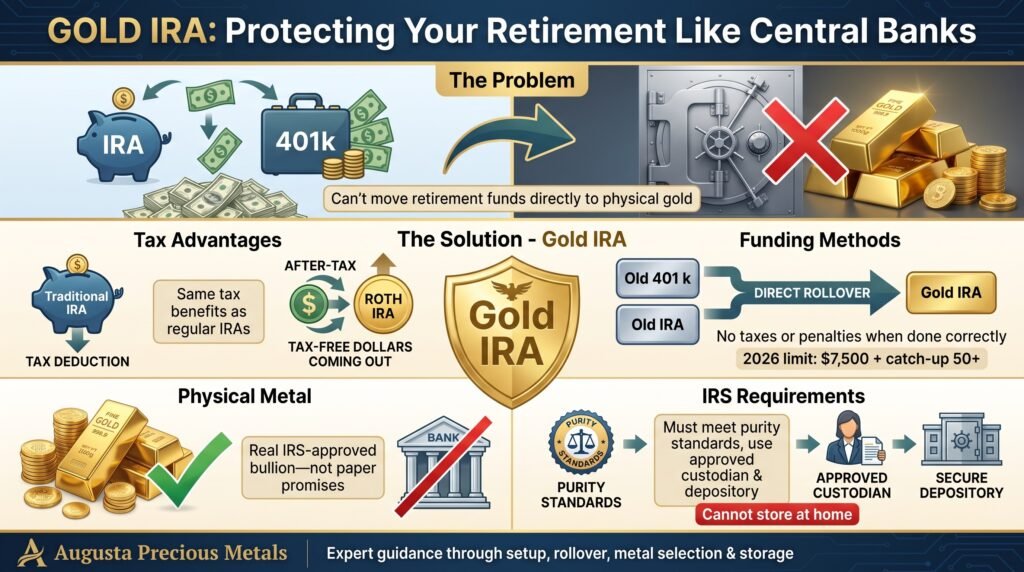
If central banks are hedging, individual savers can consider doing the same. The challenge for many people is that most of their wealth sits in retirement accounts, such as IRAs and 401(k)s, where it can’t simply be moved into a safe full of bullion. That is where a gold IRA comes in.
A gold IRA is a self-directed individual retirement account that holds physical precious metals instead of, or in addition to, traditional paper assets. It offers several features worth understanding:
Tax advantages. A gold IRA follows the same tax framework as other IRAs. In a traditional gold IRA, contributions may be tax-deductible, and growth is tax-deferred until withdrawal.
You gain exposure to physical metal without the immediate tax hit you could face if you simply sold other investments to buy gold.
Rollovers and transfers. Many savers fund a gold IRA by rolling over or transferring funds from an existing IRA or an old 401(k), such as one from a former employer. When done correctly as a direct rollover, this generally doesn’t trigger taxes or penalties.
For direct contributions, ordinary annual IRA limits apply (for 2026, $7,500, with an additional catch-up contribution for those 50 and older).
Physical metal, outside the banking system. Unlike gold-focused funds or mining stocks, a gold IRA holds actual IRS-approved bullion and coins. There is no counterparty promising to deliver value, which is the same quality that appeals to central banks.
IRS rules to know. The metals must meet IRS purity standards, and they must be held by an approved custodian and stored in an approved depository. You can’t keep IRA metals at home. A qualified provider helps you navigate these requirements so mistakes don’t trigger penalties.

Where Augusta Precious Metals Fits
Setting up a gold IRA involves several moving parts: choosing a self-directed IRA custodian, completing the rollover paperwork, selecting eligible metals, and arranging secure storage. That is where a specialist can help.
Augusta Precious Metals is a precious metals firm that helps individuals open and fund tax-advantaged gold and silver IRAs and walks them through each of those steps.
Their approach emphasizes education, so that you understand what you’re buying, what it costs, and how it fits into your overall retirement picture before you commit. Augusta is one of the leading gold investing companies for trust, customer empowerment, and prices.

If you already hold some gold and silver and want a second opinion on whether you’re positioned properly, Augusta can review your situation.
If you hold none and your savings are concentrated in dollar-denominated assets, a conversation about a gold IRA is a reasonable first step toward building a plan that covers both the present and whatever comes after a possible reset or revaluation.
Click the banner below to receive a free gold IRA integrity checklist from their official site. Fill out their short contact form to get started.

Frequently Asked Questions
These are the questions investors ask most often when a Gold IRA company dangles a free silver bonus in front of them. Short, direct answers tend to be the most useful here, since the details matter more than the marketing.
Keep these answers handy the next time a dealer brings up a bonus offer, since the same core facts apply regardless of which company is making the pitch.
Is free silver from a Gold IRA company actually free?
No. The silver is paid for through higher markups on the gold or silver coins you’re purchasing, usually premium or semi-numismatic coins rather than plain bullion.
The CFTC and FINRA specifically advise investors to ask how a dealer affords to give away precious metal, since the answer always traces back to pricing elsewhere in the deal.
Think of it less as a gift and more as a repackaged discount, one where you’re the one funding the discount through an inflated purchase price.
How do dealers afford to give away silver?
Dealers fund free silver bonuses through the premium built into other coins in your order, often 15% to 45% over spot for premium or graded coins, compared to just 3% to 6% for standard bullion.
That extra margin covers the cost of the bonus while still leaving the dealer a profit.
In one documented case, a $3,000 silver bonus was funded by an $8,000 markup on the coins purchased to fund it, meaning the buyer paid $8,000 extra to receive $3,000 worth of “free” metal.
Can free silver coins disqualify my IRA?
Yes, if the coins used in the bonus bundle don’t meet IRS eligibility rules under IRC 408(m)(3). Semi-numismatic issues, graded slabs, and collectible-grade coins fall outside the eligible categories, and if one enters your IRA, it triggers a deemed distribution on the day it’s acquired.
What premium should I expect to pay on IRA-eligible gold coins?
Standard bullion gold coins, like American Gold Eagles, typically carry premiums of 3% to 6% over spot price. Anything significantly higher than that range deserves a direct explanation from the dealer before you proceed.
Premium or collectible coins can run 15% to 45% over spot, and in some documented cases, markups have exceeded 100%.
Are American Silver Eagles safe to hold in an IRA?
Yes. American Silver Eagles are explicitly IRA-eligible under 31 USC 5112(e), making them one of the more straightforward bonus options if a dealer includes them as part of a promotion.
Click the banner below and fill out their short contact form on their site to get started.
*Disclaimer: This article is written for educational purposes and should not be interpreted as financial advice. We may receive compensation for referrals made through this article.
Leave a Reply