Quick Summary: The Free Silver Catch
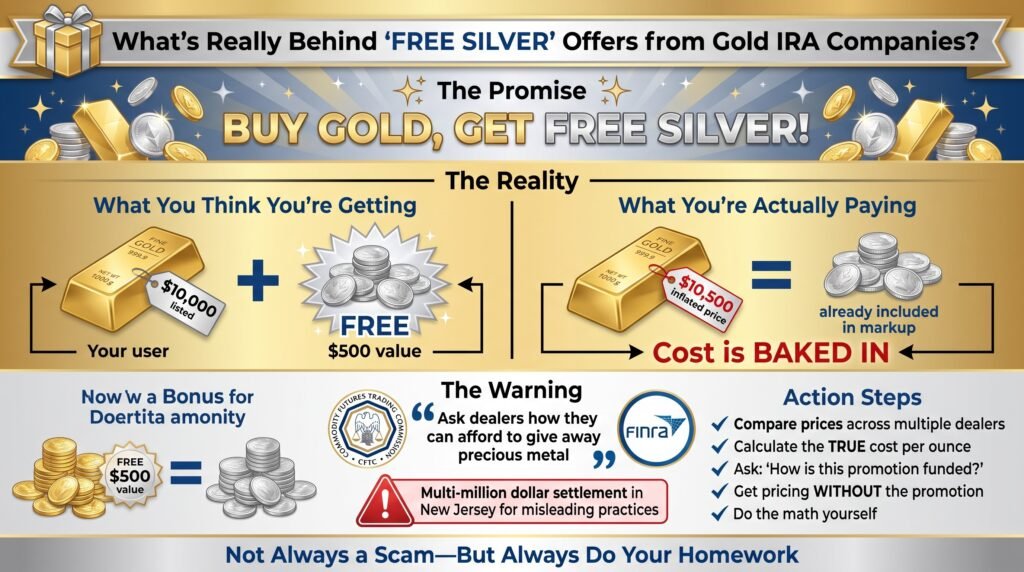
Before diving into the mechanics, here’s the short version: free silver offers are real, but they’re not gifts. They’re pricing structures where a dealer inflates the cost of what you’re buying to cover the “bonus” they’re handing you.
The CFTC and FINRA have jointly warned investors to ask dealers directly how they can afford to give away precious metal, because the honest answer is always the same: it’s baked into your purchase price.
Regulators have also taken action against companies using these bonus structures in misleading ways, including a multi-million-dollar settlement in New Jersey.
None of this means free silver offers are automatically scams, but it does mean you need to run the math yourself before accepting one.
Table of Contents
- 8 Steps to Check If a Free Silver Offer Is Really Worth It
- When You Should Say No to a Free Silver Deal
- How Flat Fees Quietly Drain Smaller Accounts
- 5 Mistakes That Turn a Deal Into a Loss
- The Bottom Line: Free Silver Isn’t Free, It’s a Trade
- The Case for a Reputable Gold IRA Company
- Frequently Asked Questions
8 Steps to Check If a Free Silver Offer Is Really Worth It
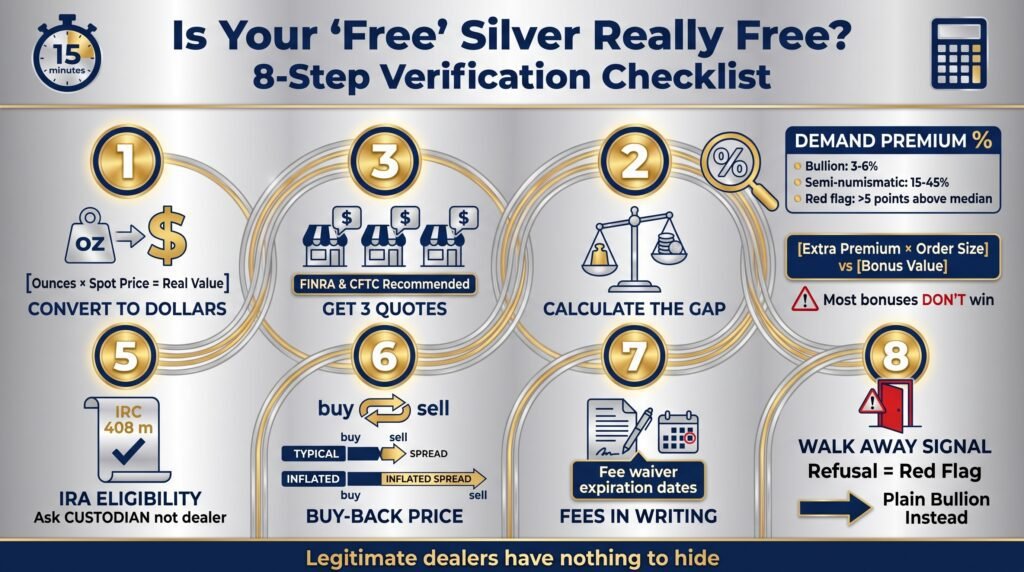
Running the numbers on a free silver offer doesn’t require a finance degree. It takes about fifteen minutes and a handful of direct questions to the dealer. Here’s the process worth following every time.
1. Convert the Bonus to Dollars, Not Ounces
Start by multiplying the bonus quantity by the current spot price of silver. A “free” bonus advertised in ounces sounds impressive, but converting it to a dollar figure gives you something concrete to compare against the extra premium you’re being asked to pay.
2. Demand the Raw Premium Percentage
Ask the dealer for the exact percentage markup over spot on every coin in the bundle, not just a vague reassurance that the pricing is “fair” or “competitive.” A dealer who can’t or won’t give you a straight percentage is avoiding the one number that actually tells you what you’re paying for.
- Bullion coins: expect roughly 3-6% over spot
- Premium or semi-numismatic coins: expect 15-45% over spot, sometimes higher
- Anything marketed as rare, graded, or exclusive: ask for the exact number, don’t assume
If the premium on a bundled coin lands more than five points above the median premium for that type of coin elsewhere, treat it as a flag that the bundle is inflated to cover the bonus.
3. Get Quotes From Two Other Dealers the Same Day
Call or request written quotes from at least two other dealers for the identical coins and quantities, ideally on the same day since spot prices shift. This single step exposes inflated bundles faster than almost anything else, because a fairly priced offer will look similar across multiple dealers, while an inflated one will stand out immediately.
FINRA and the CFTC specifically recommend this comparison step as a baseline defense against misleading precious-metals pricing.
4. Calculate the Premium Gap
Multiply the extra premium points by your total order size, then compare that number directly against the dollar value of the bonus you calculated in step one. If the extra premium costs more than the bonus is worth, and in most real-world examples it does, you’re not getting a deal; you’re funding your own gift.
5. Confirm IRA Eligibility in Writing
Ask the custodian, not just the dealer, to confirm in writing that every coin in the bundle qualifies under IRC 408(m). Custodians have no incentive to misrepresent eligibility the way a commission-driven salesperson might, which makes this step an important independent check.
If a dealer resists involving the custodian in this conversation, that resistance alone is worth paying attention to.
6. Ask for a Buy-Back Price on Everything
Request the dealer’s buy-back price on every single item in the bundle, including the “free” silver.
A coin that’s expensive to buy but cheap to sell back tells you everything about where the real markup is hiding.
Bullion coins typically clear at published, predictable spreads, while premium coins often have thin resale markets that don’t reflect what you originally paid.
7. Get Every Fee and Waiver Deadline in Writing
Before signing anything, get a complete written list of every fee, cost, commission, and the full agreed retail price. Pay close attention to any fee waivers tied to the promotion, and get the exact date each waiver expires along with what the fee becomes afterward.
A waived first-year fee that quietly reactivates in year two is a common way bonus offers claw back their value over time.
8. Walk Away If Any Step Gets Refused
If a dealer refuses to provide a straight answer at any point in this process, whether it’s the raw premium percentage, the buy-back price, or written fee disclosures, that refusal is itself the answer.
A legitimate dealer selling a reasonably priced product has no reason to hide these numbers from you. At that point, the better move is usually to request a plain bullion order at published market premiums instead of the bundled promotion.
Plain bullion remains the most straightforward and defensible way to hold precious metals in an IRA, free silver bonus or not.
When You Should Say No to a Free Silver Deal
Free silver promotions aren’t universally bad, but they’re a poor fit for certain investors and certain situations. Knowing which category you fall into before you’re on a sales call saves you from a decision you can’t easily undo.
The common thread across all of these situations is that the hidden premium cost lands hardest on people with the least room to absorb it.
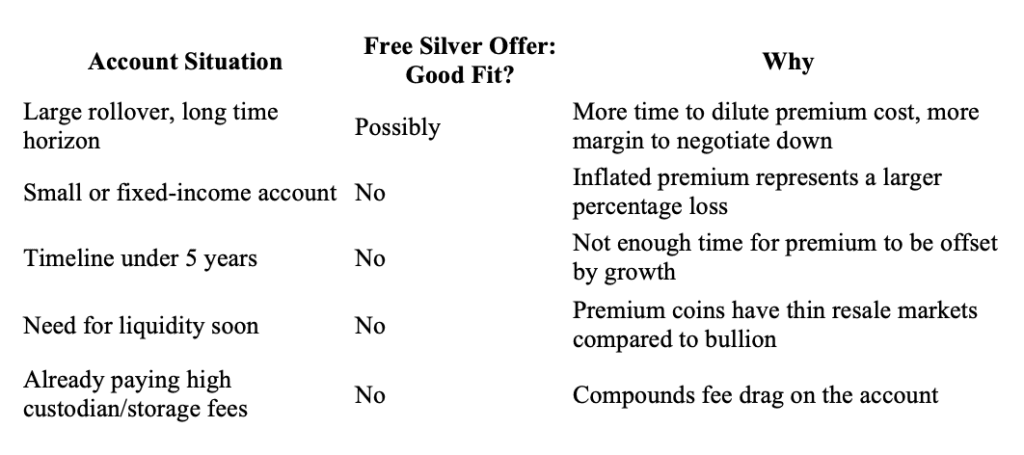
Small or Fixed-Income Accounts
Every extra dollar of inflated premium on a small or fixed-income account hits your recurring retirement income later, when you can least afford it. A bundled premium of $10,000 on an account that only holds $50,000 or $60,000 total represents a large, permanent loss relative to the account’s overall size, not a minor rounding error.
Short Investment Timelines Under 5 Years
If you’re planning to start taking distributions within five years or less, a free silver bonus is especially risky.
Dealer premium on premium coins never has time to get diluted by market appreciation over a short horizon, which means you’re far more likely to sell at or near the inflated price you paid rather than recovering it through growth.
If You May Need Cash Fast
Buyers who might need liquidity sooner rather than later should think carefully before accepting a premium-heavy bonus bundle.
Premium-priced coins typically have thin resale markets, while standard bullion coins clear at published, predictable spreads.
Selling into the bid side of the market only recovers the metal’s spot value, not the premium you originally paid, so liquidity needs and premium coins don’t mix well.
Accounts Already Stretched by Fees
If your account is already carrying noticeable custodian and storage fees, adding a heavy front-end premium on top compounds the problem rather than offsetting it.
Recurring fees erode small accounts faster in percentage terms than large ones, and layering an inflated coin premium onto an already fee-stretched account accelerates that erosion even further.
How Flat Fees Quietly Drain Smaller Accounts
Most Gold IRA providers charge flat dollar fees rather than percentage-based ones, covering account setup, annual custodian services, and metal storage. That flat structure sounds fair on paper, but it hits accounts of different sizes very differently.
The math here isn’t complicated, but it’s easy to overlook when you’re focused on the excitement of a free silver bonus. A flat fee takes a much bigger bite out of a smaller balance than it does out of a larger one, and that gap compounds year after year as the fee keeps getting charged.
Combine that fee drag with an inflated premium from a bonus bundle, and you’ve got two separate forces working against the same small account at the same time. Neither one shows up clearly until you actually run the numbers side by side.
- Setup fees, annual custodian fees, and storage fees are typically charged as flat dollar amounts, not percentages
- Fee amounts vary by provider and are often not published upfront
- Custodian, storage, and administration fees continue reducing your account balance every single year it’s open
- Smaller accounts feel the same flat fee as a much bigger percentage loss
Why a $225 Fee Hurts a $10,000 Account More Than a $100,000 One
Here’s a concrete example. A $225 annual fee represents 2.25% of a $10,000 account, but only 0.22% of a $100,000 account. That’s a ten-times difference in the real-world impact of the exact same dollar fee, depending entirely on how large your account is when the fee gets charged.
How a 5-Point Efficiency Drop Costs You $2,500 on $50,000
Pricing inefficiency works the same way, just on a bigger scale. On a $50,000 rollover, a five-point drop in pricing efficiency, meaning you paid five percentage points more in premium than you needed to, eliminates $2,500 worth of metal from your account.
A twenty-point drop eliminates $10,000. These aren’t hypothetical numbers; they’re the direct result of choosing a premium coin bundle over plain bullion pricing.
$50,000 rollover example: a 5-point premium gap costs you $2,500 in lost metal. A 20-point gap costs you $10,000. That’s money gone before your investment has a chance to grow.
Run both of these calculations side by side, the flat fee percentage and the premium efficiency gap, before accepting any bonus offer. Together they tell you whether a free silver promotion is actually putting you ahead or quietly putting you behind.
5 Mistakes That Turn a Deal Into a Loss
Even cautious investors fall into a handful of predictable traps when evaluating free silver promotions. These mistakes tend to repeat across dealers and offers, so it’s worth memorizing them before you ever pick up the phone.
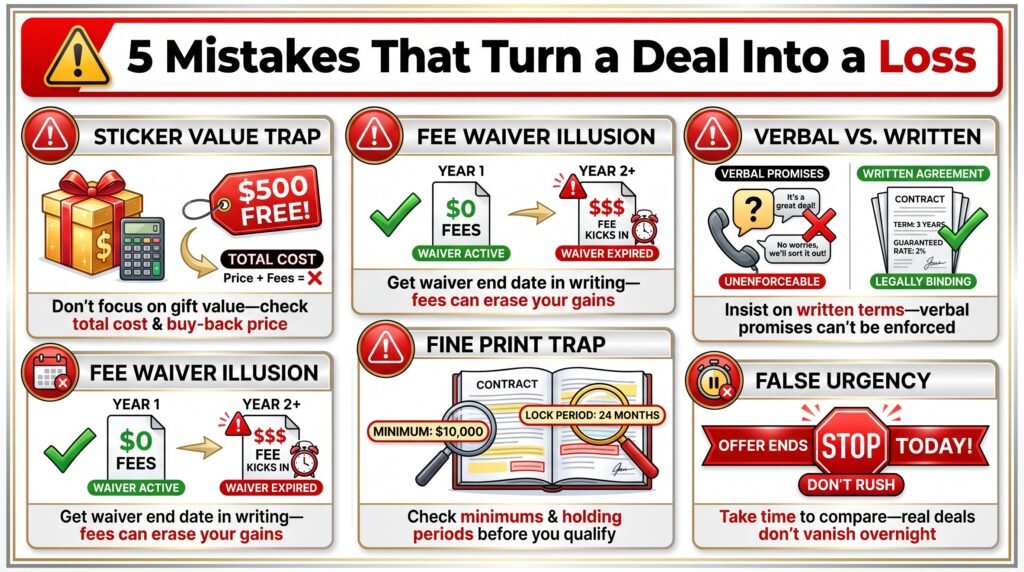
1. Focusing on the Gift’s Sticker Value
It’s easy to get fixated on the advertised value of the free silver instead of looking at the total price you’re paying and the buy-back price you’d receive later. The sticker value of the bonus is designed to catch your attention, not to tell you whether the overall deal makes financial sense.
Total cost and buy-back price are the two numbers that actually matter. Everything else is framing.
2. Assuming a Fee Waiver Lasts Forever
Many promotions include a waived first-year fee bundled in with the free silver offer. The mistake is assuming that waiver is permanent instead of checking exactly when it expires and what the fee becomes once it reactivates.
Get the exact waiver end date in writing, along with the fee amount that kicks in afterward. A waiver that quietly ends in month thirteen can erase a chunk of the value you thought you were getting from the original promotion
3. Skipping the Fine Print on Minimums and Holding Periods
Some free silver offers require a minimum purchase amount or a minimum holding period before the bonus actually becomes yours.
Skipping this fine print means you might not qualify for what you thought you signed up for, or you might be locked into holding metal longer than you planned just to keep the bonus.
4. Accepting Verbal Terms Instead of Written Ones
A salesperson explaining the terms of an offer over the phone is not the same as having those terms in writing. Verbal promises are easy to make and difficult to enforce, especially months later when a fee reactivates or a buy-back price turns out to be lower than expected.
Always insist on getting the complete offer, fees, premiums, and buy-back terms, in writing before you commit any money.
5. Rushing Because the Offer “Ends Soon”
Urgency is a sales tool, not a financial reality. Deciding quickly because an offer claims to be ending soon short-circuits the comparison shopping and math-checking process that actually protects your retirement savings.
A reasonably priced offer will still be reasonably priced next week. If a dealer won’t let you take even a day or two to verify the numbers, that pressure alone tells you something important about the deal.
The Bottom Line: Free Silver Isn’t Free, It’s a Trade
Free silver promotions aren’t scams by default, but they’re never truly free either. Every ounce of bonus silver is funded by markup somewhere in your purchase, and your job as the investor is to figure out exactly how much that markup costs before you agree to it.
Run the five-step math check, get everything in writing, confirm IRA eligibility with your custodian directly, and you’ll know within minutes whether a specific offer is a reasonable trade or an expensive mistake dressed up as a gift.
To learn more about “free” silver trick dealers don’t explain,5 sales pitches that should raise a red flag, and more, read the detailed article here.
Click the banner below to receive a free gold IRA integrity checklist from their official site. Fill out their short contact form to get started.
The Case for a Reputable Gold IRA Company
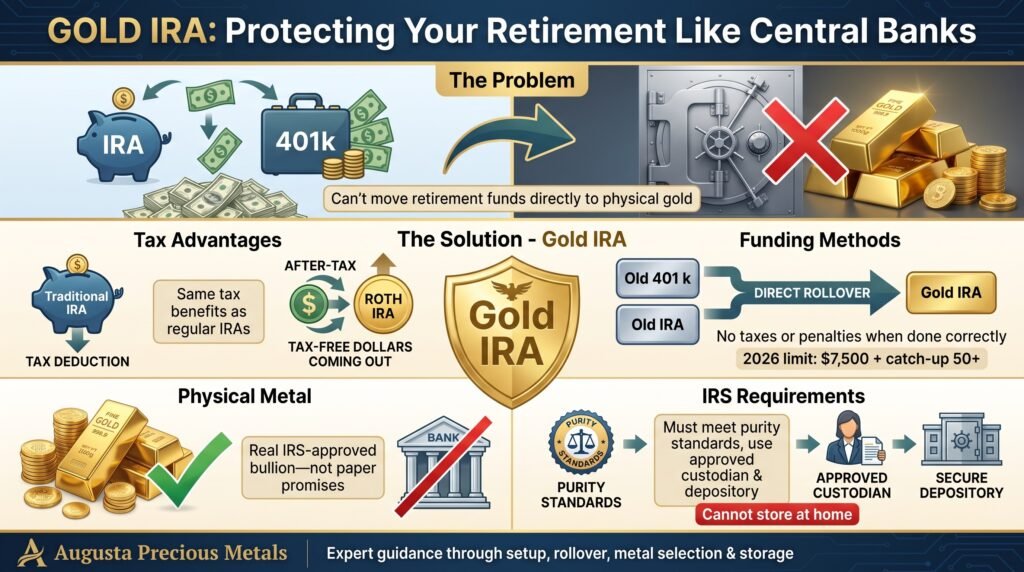
The challenge for many people is that most of their wealth sits in retirement accounts, such as IRAs and 401(k)s, where it can’t simply be moved into a safe full of bullion. That is where a gold IRA comes in.
A gold IRA is a self-directed individual retirement account that holds physical precious metals instead of, or in addition to, traditional paper assets. It offers several features worth understanding:
Tax advantages. A gold IRA follows the same tax framework as other IRAs. In a traditional gold IRA, contributions may be tax-deductible, and growth is tax-deferred until withdrawal.
You gain exposure to physical metal without the immediate tax hit you could face if you simply sold other investments to buy gold.
Rollovers and transfers. Many savers fund a gold IRA by rolling over or transferring funds from an existing IRA or an old 401(k), such as one from a former employer. When done correctly as a direct rollover, this generally doesn’t trigger taxes or penalties.
For direct contributions, ordinary annual IRA limits apply (for 2026, $7,500, with an additional catch-up contribution for those 50 and older).
Physical metal, outside the banking system. Unlike gold-focused funds or mining stocks, a gold IRA holds actual IRS-approved bullion and coins. There is no counterparty promising to deliver value, which is the same quality that appeals to central banks.
IRS rules to know. The metals must meet IRS purity standards, and they must be held by an approved custodian and stored in an approved depository. You can’t keep IRA metals at home. A qualified provider helps you navigate these requirements so mistakes don’t trigger penalties.

Where Augusta Precious Metals Fits
Setting up a gold IRA involves several moving parts: choosing a self-directed IRA custodian, completing the rollover paperwork, selecting eligible metals, and arranging secure storage. That is where a specialist can help.
Augusta Precious Metals is a precious metals firm that helps individuals open and fund tax-advantaged gold and silver IRAs and walks them through each of those steps.
Their approach emphasizes education, so that you understand what you’re buying, what it costs, and how it fits into your overall retirement picture before you commit. Augusta is one of the leading gold investing companies for trust, customer empowerment, and prices.

If you already hold some gold and silver and want a second opinion on whether you’re positioned properly, Augusta can review your situation.
If you hold none and your savings are concentrated in dollar-denominated assets, a conversation about a gold IRA is a reasonable first step toward building a plan that covers both the present and whatever comes after a possible reset or revaluation.
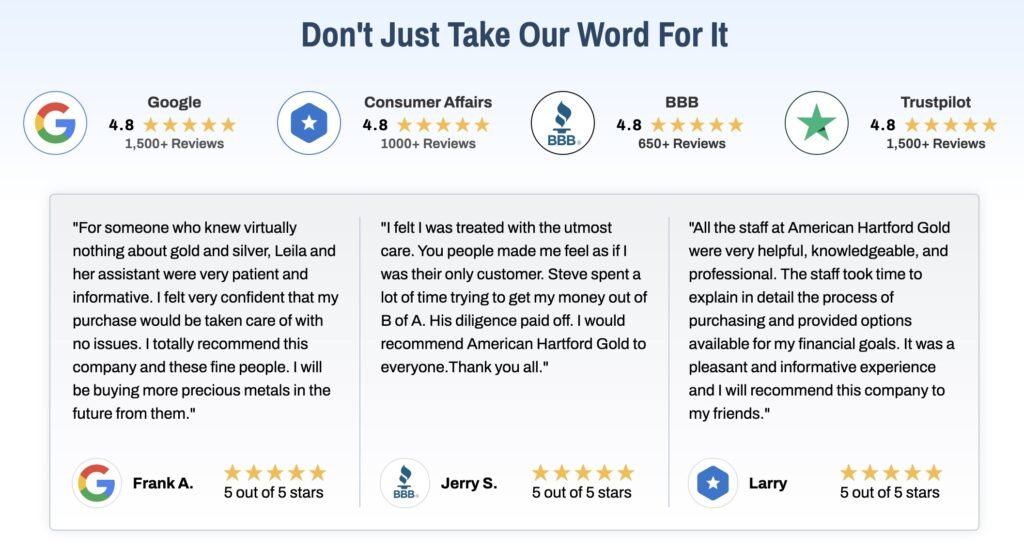
Augusta Precious Metals Testimonials
Click the banner below to receive a free gold IRA integrity checklist from their official site. Fill out their short contact form to get started.
Frequently Asked Questions
These are the questions investors ask most often when a Gold IRA company dangles a free silver bonus in front of them. Short, direct answers tend to be the most useful here, since the details matter more than the marketing.
Keep these answers handy the next time a dealer brings up a bonus offer, since the same core facts apply regardless of which company is making the pitch.
What should I ask before accepting a free silver promotion?
Ask for the raw premium percentage on every coin involved, the buy-back price on all items including the free silver, written confirmation of IRA eligibility from your custodian, and a complete list of fees and when any waivers expire.
If a dealer hesitates or refuses to answer any of these directly, treat that as your answer.
Does the Texas Bullion Depository make numismatic coins IRA-eligible?
No. Storing coins at the Texas Bullion Depository does not change a coin’s eligibility status under IRC 408(m), and it doesn’t offset an inflated dealer premium either. Eligibility is determined by the coin itself, not by where it’s physically stored.
What penalty do I face if my IRA holds an ineligible coin?
An ineligible coin triggers a deemed distribution taxed at ordinary federal income rates, plus a 10% early withdrawal penalty under IRC 72(t) if you’re under age 59.5. Texas residents avoid state income tax on that distribution under the Texas Constitution, but the federal tax and penalty still apply in full.
How can I verify a gold dealer’s pricing is fair?
Get written quotes from at least two other dealers for the identical coins and quantities on the same day, then compare the premium percentages directly.
A quote landing more than five points above the median is a clear signal that the bundle is priced to cover a bonus rather than to reflect fair market value.
Click the banner below and fill out their short contact form on their site to get started.
*Disclaimer: This article is written for educational purposes and should not be interpreted as financial advice. We may receive compensation for referrals made through this article.
Leave a Reply