Quick Summary
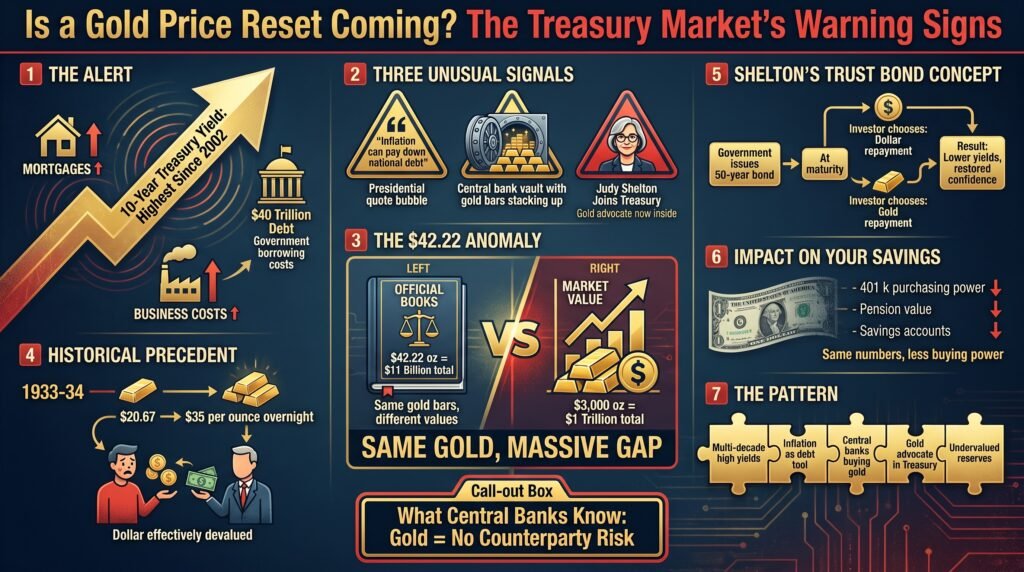
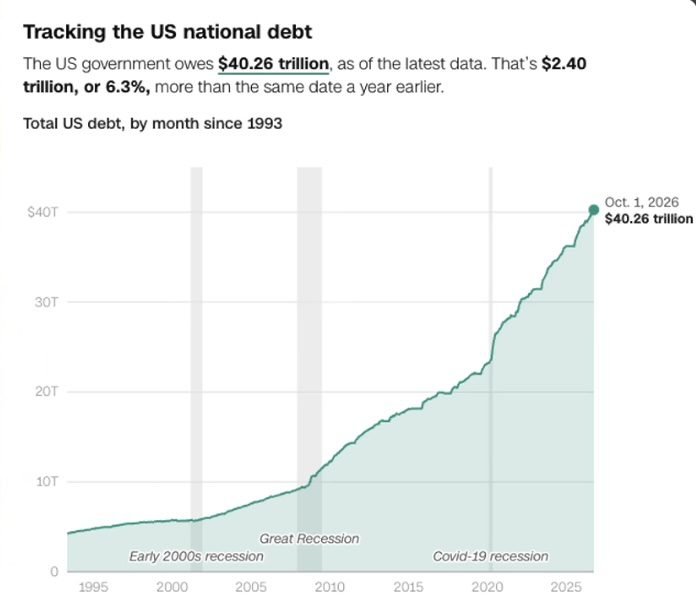
The interest rate on America’s 10-year Treasury note has climbed to its highest level since 2002. Government bonds are not the most exciting topic, but that single number touches almost everything in your financial life. It influences mortgage rates, what businesses pay to borrow, how much Washington owes on its roughly $40 trillion of debt, and over time, what each dollar you own can buy.
The 24-year high isn’t even the strangest part. At the same moment, three other developments have emerged that are rarely discussed together:
- The President has openly said that inflation can help pay down the national debt.
- Central banks are buying gold even as bond yields rise.
- The Treasury has brought on Judy Shelton, an economist who has long argued for a bigger role for gold in the monetary system.
Taken separately, each looks like a headline. Taken together, they look more like a pattern. Let’s walk through it.
Table of Contents
- Quick Summary
- Why the 10-Year Yield Matters to You
- The Strange Behavior of Gold: Central Banks Buying Gold
- Enter Judy Shelton
- The $42.22 Question
- “The Quiet Part Out Loud”
- Putting the Pieces Together
- Positioning Yourself: The Case for a Gold IRA
- Before You Act: A Few Honest Caveats
- The Bottom Line
- Frequently Asked Questions
Why the 10-Year Yield Matters to You
The 10-year Treasury yield is essentially the rate investors demand to lend money to the U.S. government for a decade. When investors demand more, the effects spread. Mortgage rates are heavily influenced by Treasury yields. Higher borrowing costs for businesses can mean slower growth, less hiring, and in some cases layoffs. Financing gets more expensive for nearly everyone.
The effect is especially large for the government itself. When interest rates sat at or near zero, a debt of this size was manageable because it cost very little to carry. That era is over. A homebuyer who dislikes an 8% mortgage can walk away. The government cannot. Its existing debt has to be rolled over and refinanced at today’s higher rates, and it must keep asking investors for new loans. Increasingly, investors are answering: yes, but you’ll have to pay us more.
The Strange Behavior of Gold: Central Banks Buying Gold
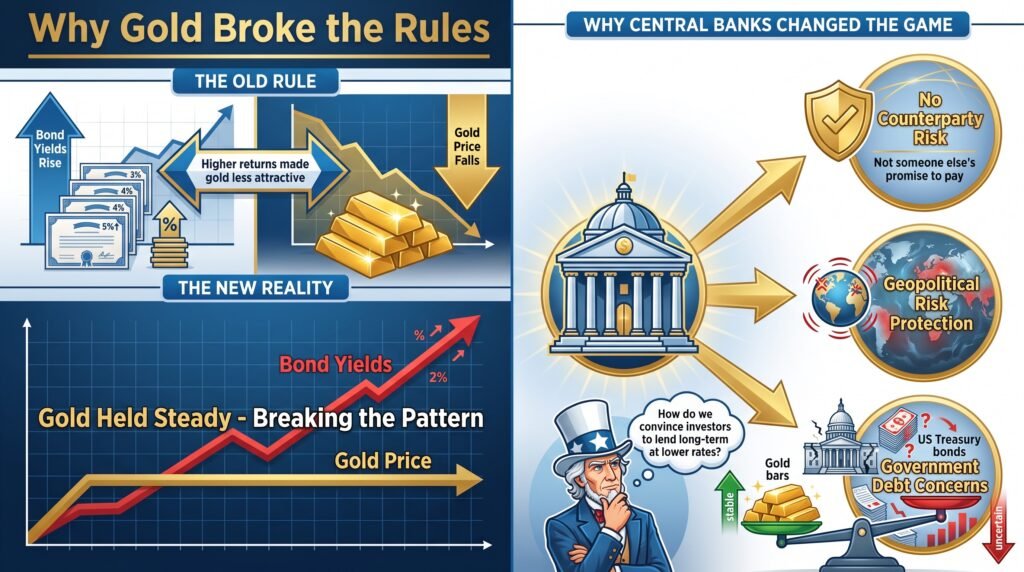
When bond yields rise, gold often sells off, because a bond that pays a higher return makes a metal that pays nothing less attractive. This time, gold has held remarkably steady.
We have noted in a previous article that the old rules between the gold price and real rates are starting to mean less and less. But this isn’t necessarily the reason at the moment.
Central banks help explain the steady gold price floor and action. Rather than loading up on higher-yielding bonds, many have talked openly about gold’s growing importance in their reserves. The reasons they cite are geopolitical risk and government debt risk.
Physical gold carries no counterparty risk, meaning it isn’t someone else’s promise to pay. For institutions that manage national reserves, that matters more than a few extra percentage points of yield.
This puts the United States in an awkward position. What could it offer investors that would raise their confidence, bring rates down, and make them comfortable lending for 10 or 30 years?

Enter Judy Shelton
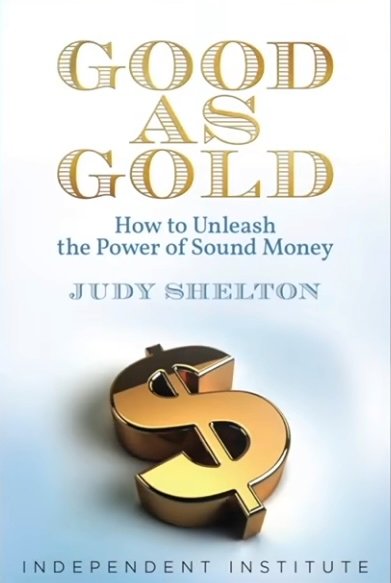
Last week, the Treasury named Judy Shelton as a counselor to Treasury Secretary Scott Bessent. Shelton is a monetary economist and one of the more prominent voices arguing that the United States should reconsider gold’s role in its monetary system.
Her best-known idea is not a return to the gold standard, and it has nothing to do with spending gold at the grocery store. It is a Treasury “trust bond.” The concept works like this:
- The government issues a long-dated bond, say a 50-year note.
- At maturity, the investor chooses between being repaid in dollars or in a predetermined amount of gold.
- Because the gold option protects against dollar erosion, investors worried about purchasing power would be more comfortable accepting a lower yield.
In other words, gold becomes a confidence-building feature for government debt. Her appointment doesn’t mean these bonds are coming tomorrow, and it doesn’t signal a return to a gold standard. But an idea that many dismissed as fringe is now closer to the center of the policy conversation than it has been in decades.
This could resolve the fiscal dominance problem and looming debt cliff that the US government has been bracing for since the post-COVID price hikes due to the massive amount of money creation generated during this crisis.
The $42.22 Question
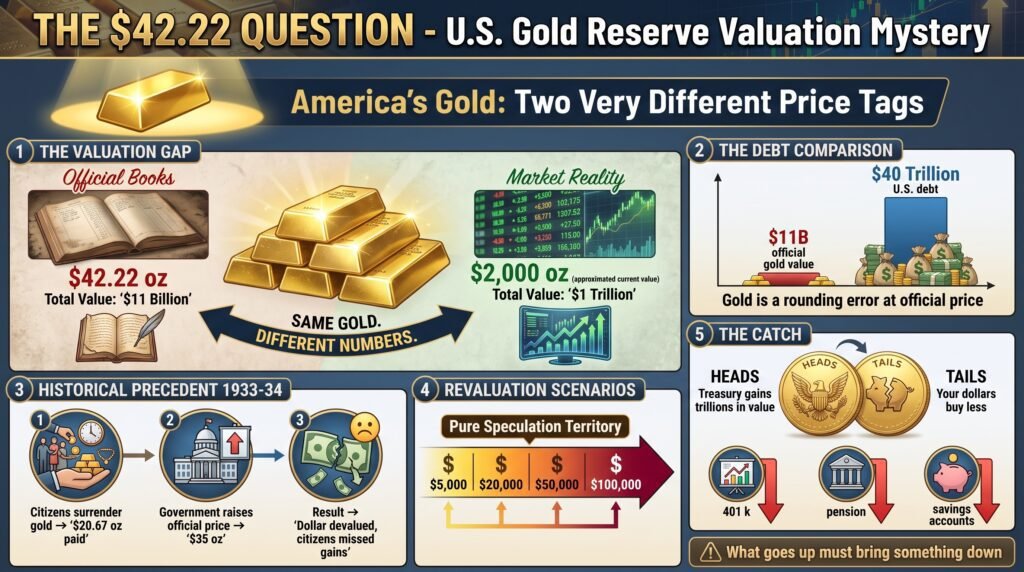
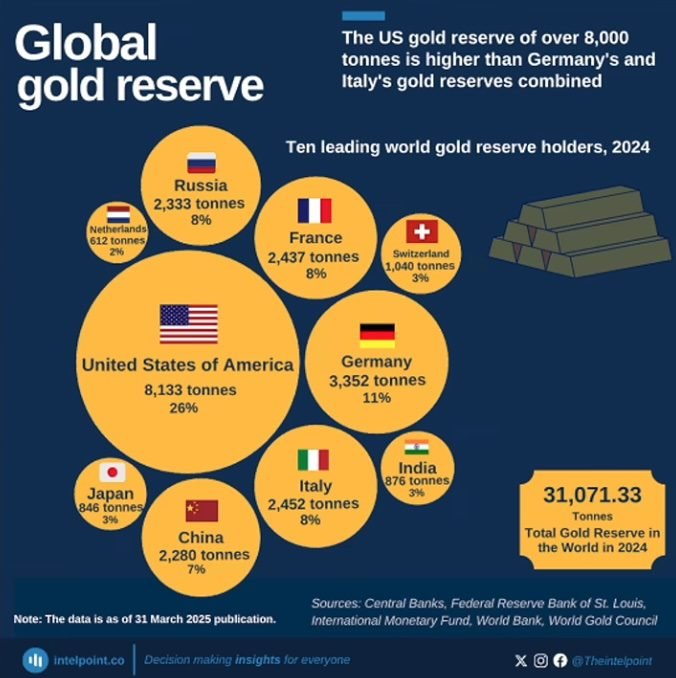
If the government ever wanted to back anything with gold, where would it get the gold? On paper, the United States holds the largest gold reserves in the world. The way those reserves are valued, though, is bizarre.
On the Treasury’s books, gold is still carried at an official price of $42.22 per ounce, a figure set decades ago and never updated. At that price, the entire U.S. gold stockpile is worth roughly $11 billion, a rounding error against $40 trillion of debt. Value the same ounces at today’s market price and the total is closer to a trillion dollars.
The U.S. didn’t acquire more gold. Only the number attached to it changed. The inverse correlation between the gold price and inflation has long been recognized and established.
This is why some observers wonder what would happen if the official price were ever adjusted. Revaluing the reserves could let the Treasury recognize hundreds of billions, perhaps trillions, in balance-sheet value almost overnight.
There is precedent. In 1933 and 1934, the U.S. required citizens to turn in most gold bullion at the official price of about $20.67 per ounce, and then raised the official price to $35. People who handed over their gold were paid at the old rate and missed the gain, and the dollar was effectively devalued. Certain rare and numismatic coins were exempt, which is why anyone buying gold should work with someone who understands the relevant laws and rules.
Nobody knows what a modern revaluation would look like, or whether one will ever happen. Estimates float around from $5,000 to $100,000 per ounce, and they are all speculation. What can be said is that there are two sides to any such trade. If gold is revalued upward, dollars are worth less in relative terms. Your 401(k), pension, annuity, checking and savings accounts might show the same numbers, or even bigger ones, while buying you considerably less.
“The Quiet Part Out Loud”
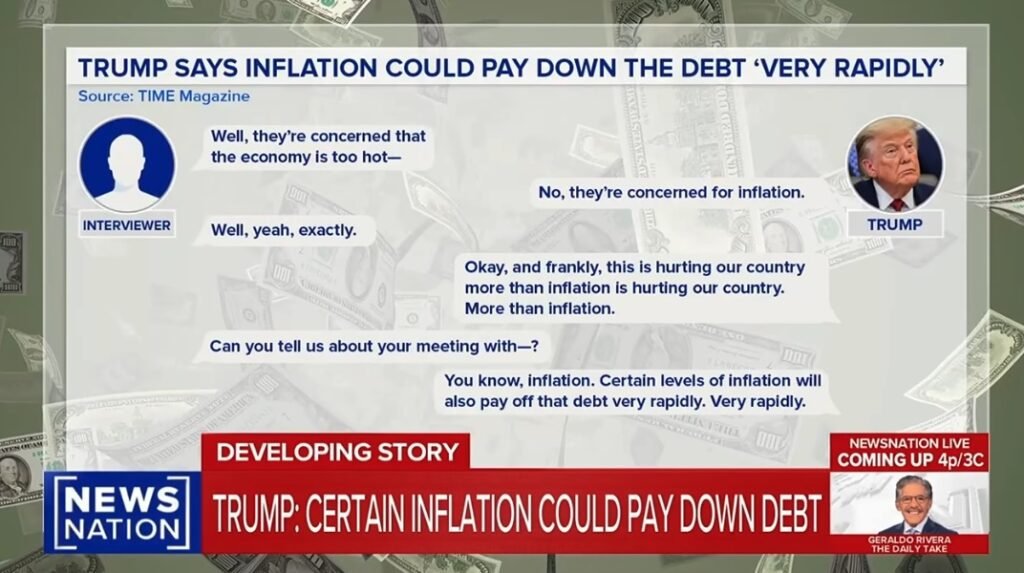
Which brings us to inflation. This past week, President Trump said that certain levels of inflation would pay off the national debt “very rapidly.”
The logic is simperfectly timedists have long recognized it. The $40 trillion debt is fixed in nominal terms. If prices rise and the dollar loses purchasing power, the government repays its obligations with cheaper dollars. The debt doesn’t disappear; its real value shrinks. Governments throughout history have used inflation as a quiet way to manage heavy debt loads.
The catch is that the same erosion hits everyone holding dollars. What helps the borrower hurts the saver. A few percentage points of inflation a year may not sound dramatic, but compounded over a 20- or 30-year retirement, it can cut purchasing power dramatically. Anyone who lived through the inflation of the last few years has seen a preview.
Putting the Pieces Together
Consider the clues:
- Treasury yields are at multi-decade highs, and debt costs are rising.
- Policymakers are openly acknowledging inflation as a tool for managing the debt.
- Central banks are accumulating physical gold rather than chasing yield.
- A long-time advocate of gold-linked policy has joined the Treasury.
- U.S. gold reserves sit on the books at a tiny fraction of their market value.
None of this proves that a gold revaluation or a gold-backed bond is on the way. That remains to be seen. But the clues line up in a way that is hard to ignore. Central banks, the most sophisticated holders of reserves in the world, are not treating gold as a mere diversifier. They appear to be positioning for a world in which paper promises carry more risk than they used to.
If you hold dollars and dollar-denominated assets, those holdings are doing fine today. The question is how much of your financial life depends entirely on one currency’s purchasing power over the next 10, 20 or 30 years.
Positioning Yourself: The Case for a Gold IRA
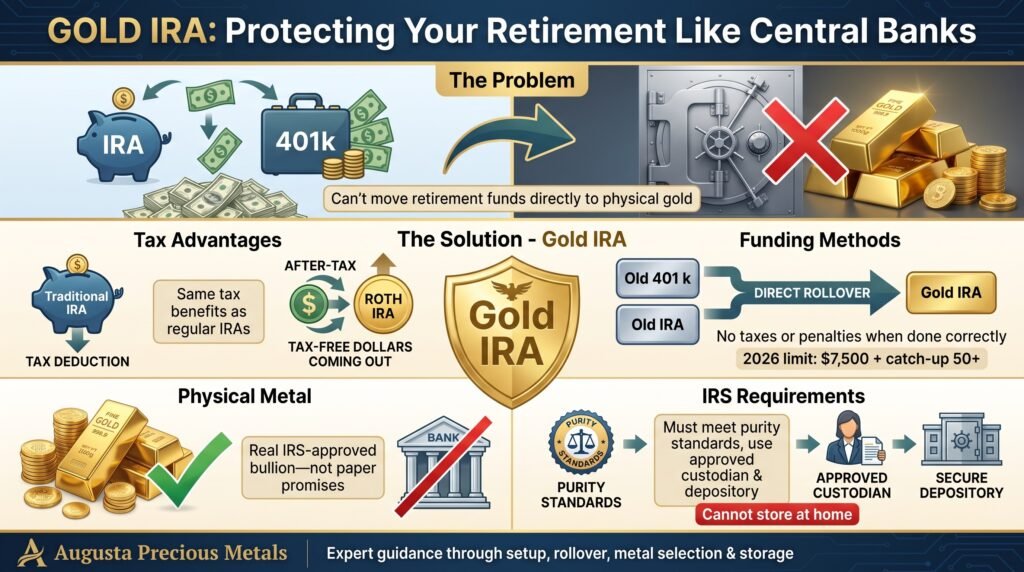
If central banks are hedging, individual savers can consider doing the same. The challenge for many people is that most of their wealth sits in retirement accounts, such as IRAs and 401(k)s, where it can’t simply be moved into a safe full of bullion. That is where a gold IRA comes in.
A gold IRA is a self-directed individual retirement account that holds physical precious metals instead of, or in addition to, traditional paper assets. It offers several features worth understanding:
Tax advantages. A gold IRA follows the same tax framework as other IRAs. In a traditional gold IRA, contributions may be tax-deductible and growth is tax-deferred until withdrawal. In a Roth gold IRA, you contribute after-tax dollars and qualified withdrawals can be tax-free. Either way, you gain exposure to physical metal without the immediate tax hit you could face if you simply sold other investments to buy gold.
Rollovers and transfers. Many savers fund a gold IRA by rolling over or transferring funds from an existing IRA or an old 401(k), such as one from a former employer. When done correctly as a direct rollover, this generally doesn’t trigger taxes or penalties. For direct contributions, ordinary annual IRA limits apply (for 2026, $7,500, with an additional catch-up contribution for those 50 and older).
Physical metal, outside the banking system. Unlike gold-focused funds or mining stocks, a gold IRA holds actual IRS-approved bullion and coins. There is no counterparty promising to deliver value, which is the same quality that appeals to central banks.
IRS rules to know. The metals must meet IRS purity standards, and they must be held by an approved custodian and stored in an approved depository. You can’t keep IRA metals at home. A qualified provider helps you navigate these requirements so mistakes don’t trigger penalties.

Where Augusta Precious Metals Fits
Setting up a gold IRA involves several moving parts: choosing a self-directed IRA custodian, completing the rollover paperwork, selecting eligible metals, and arranging secure storage. That is where a specialist can help.
Augusta Precious Metals is a precious metals firm that helps individuals open and fund tax-advantaged gold and silver IRAs and walks them through each of those steps.
Their approach emphasizes education, so that you understand what you’re buying, what it costs, and how it fits into your overall retirement picture before you commit. Augusta is one of the leading gold investing companies for trust, customer empowerment, and prices.

If you already hold some gold and silver and want a second opinion on whether you’re positioned properly, Augusta can review your situation.
If you hold none and your savings are concentrated in dollar-denominated assets, a conversation about a gold IRA is a reasonable first step toward building a plan that covers both the present and whatever comes after a possible reset or revaluation.
Click the banner below to receive a free gold IRA integrity checklist from their official site. Fill out their short contact form to get started.

Before You Act: A Few Honest Caveats
A balanced view matters here.
–Gold is not risk-free. Prices can fall as well as rise, sometimes sharply, and gold pays no interest or dividends.
–Costs matter. Gold IRAs typically involve custodian fees, storage fees, and dealer markups or spreads. However, many gold IRA companies provide lower fees or a waiver of fees dependent on the investment amount.
–Don’t go all in. Many financial professionals suggest limiting precious metals to a modest share of a portfolio. The right amount depends on your age, goals, and other holdings.
–A revaluation is speculative. Nothing announced so far commits the U.S. to a gold bond or a revaluation, and any estimate of a future gold price is a guess.
Having a means of tracking the price of gold and the rate of inflation is crucial to track the short- and long-term progress of your investment.
Access the gold price and inflation-retirement calculator by clicking the banner below and bookmark it for future use:

The Bottom Line
Treasury yields at 24-year highs, a President acknowledging inflation as a debt-reduction tool, central banks stacking physical gold, and a gold-friendly economist stepping into the Treasury are separate stories that increasingly read as one. You don’t have to believe a dramatic reset is coming to see the sense in diversification. If dollars lose purchasing power, whether through gradual inflation or something more abrupt, holding some real, physical wealth outside the dollar system is a prudent hedge.
A tax-advantaged gold IRA is one of the most practical ways to do that with retirement money. The key is to act with a plan, not out of fear: understand the costs, size the position sensibly, and put it in place before the headlines force the question.
Investment Minimum Considerations for Gold IRAs
To get started on your gold investing journey, obtain a free investment guide from one of the gold IRA companies below. Whether you require a company with a low investment minimum to get started or are a serious investor with a larger portfolio to protect, a tax-advantaged gold IRA is a great vehicle to own physical gold without the need or liability of storage within your own home.
Augusta Precious Metals: Best Gold IRA Company for Prices, Education, and Lifetime Customer Support. $50,000 Minimum.
American Hartford Gold: Best Gold IRA Company for Buyback Commitment and Low $10,000 Minimum Investment.
Click the right banner for your individual needs. Fill out their short contact form on their site to get started.
Frequently Asked Questions
Why does the 10-year Treasury yield matter to me?
It’s the rate investors demand to lend money to the U.S. government for a decade, and it influences mortgage rates, business borrowing costs, and the interest the government pays on its roughly $40 trillion of debt.
Why is gold holding steady when bond yields are rising?
Higher yields usually make non-yielding gold less attractive. This time, central banks have kept buying physical gold, citing geopolitical and government debt risk. Physical gold also carries no counterparty risk.
What does the $42.22 gold price mean?
It’s the official value at which U.S. gold reserves are carried on the Treasury’s books. At that price, the reserves are worth about $11 billion. At market prices, they would be worth closer to a trillion dollars.
What is a gold IRA?
It is a self-directed IRA that holds IRS-approved physical precious metals instead of, or alongside, paper assets. It follows standard IRA tax rules: traditional accounts offer tax-deferred growth, and Roth accounts can offer tax-free qualified withdrawals.
Can I move my existing IRA or 401(k) into a gold IRA?
Often, yes. A properly completed direct rollover or transfer generally doesn’t trigger taxes or penalties, but the rules vary by account type. Check with a tax professional first.
Can I keep my IRA gold at home?
No. IRS rules require IRA metals to be held by an approved custodian in an approved depository.
How does Augusta Precious Metals fit in?
Augusta helps individuals open and fund gold and silver IRAs, including choosing a custodian, completing rollover paperwork, selecting eligible metals, and arranging storage.
Is a gold IRA risk-free?
No. Gold prices can fall, gold pays no interest or dividends, and fees for custodians, storage, and dealer markups can add up. Many advisors suggest keeping precious metals to a modest share of a portfolio. Consult a licensed financial advisor before making changes.
To start your gold investing journey, get a free investment guide from one of the gold IRA companies below. Whether you require a company with a low investment minimum to get started or are a serious investor with a larger portfolio to protect, a tax-advantaged gold IRA is a great vehicle to own physical gold without the need or liability of storage within your own home.
Click the right banner for your individual needs. Fill out their short contact form on their site to get started.

*Disclaimer: This article is written for educational purposes and should not be interpreted as financial advice. We may receive compensation for referrals made through this article.
Leave a Reply